Skip to content · ⁨ข้ามไปยังเนื้อหา⁩

Chemical energetics · ⁨อุณหพลศาสตร์เคมี (Chemical Energetics)⁩

A-Level Chemistry · ⁨Chemistry A-Level⁩ · Topic 5 · ⁨หัวข้อ 5⁩

Video lesson for this topic · ⁨บทเรียนวิดีโอสำหรับหัวข้อนี้⁩ Open the video page · ⁨เปิดหน้าวิดีโอ⁩
8:21

อุณหพลศาสตร์เคมี

เตาบันเซนร้อนพอที่จะทำให้แก้วนิ่ม ห่อเย็นทันทีบีบครั้งเดียวลดอุณหภูมิใกล้จุดเยือกแข็ง ทั้งสองเป็นเพียงปฏิกิริยาเคมี — อย่างหนึ่งใน…

English narration · English + 中文 subtitles burned in · ⁨การบรรยายภาษาอังกฤษ · คำบรรยายภาษาอังกฤษ + 中文 ลอยตัวบนภาพ⁩

5.1

Enthalpy change, ΔH · ⁨การเปลี่ยนแปลงเอนثالปี, ΔH⁩

Syllabus · ⁨หลักสูตร⁩
English
  1. understand that chemical reactions are accompanied by enthalpy changes and these changes can be exothermic ($\Delta H$ is negative) or endothermic ($\Delta H$ is positive)
  2. construct and interpret a reaction pathway diagram, in terms of the enthalpy change of the reaction and of the activation energy
  3. define and use the terms: (a) standard conditions (this syllabus assumes that these are $298\text{ K}$ and $101\text{ kPa}$) shown by $^{\ominus}$. (b) enthalpy change with particular reference to: reaction, $\Delta H_r$, formation, $\Delta H_f$, combustion, $\Delta H_c$, neutralisation, $\Delta H_{\text{neut}}$
  4. understand that energy transfers occur during chemical reactions because of the breaking and making of chemical bonds
  5. use bond energies ($\Delta H$ positive, i.e. bond breaking) to calculate enthalpy change of reaction, $\Delta H_r$
  6. understand that some bond energies are exact and some bond energies are averages
  7. calculate enthalpy changes from appropriate experimental results, including the use of the relationships $q = mc\Delta T$ and $\Delta H = -mc\Delta T/n$
ไทย
  1. เข้าใจว่าการทำปฏิกิริยาเคมีจะ.userIdด้วย การเปลี่ยนแปลงเอนทาลปี และการเปลี่ยนแปลงเหล่านี้สามารถเป็น เอกซ์ותרมิก ($\Delta H$ เป็นลบ) หรือ เอ็นโดเธอร์มิก ($\Delta H$ เป็นบวก)
  2. สร้างและตีความ แผนภาพเส้นทางปฏิกิริยา ในแง่ของการเปลี่ยนแปลงเอนทาลปีของปฏิกิริยาและ พลังงานกระตุ้น
  3. นิยามและใช้ศัพท์ดังนี้: (a) สภาวะมาตรฐาน (หลักสูตรนี้สันนิษฐานว่าสิ่งเหล่านี้คือ $298\text{ K}$ และ $101\text{ kPa}$) แสดงโดย $^{\ominus}$. (b) การเปลี่ยนแปลงเอนทาลปี โดยเฉพาะอย่างยิ่งในกรณี: ปฏิกิริยา, $\Delta H_r$, การเกิด, $\Delta H_f$, การเผาไหม้, $\Delta H_c$, การทำปฏิกิริยาระหว่างกรดและเบส, $\Delta H_{\text{neut}}$
  4. เข้าใจ rằngการถ่ายโอนพลังงานเกิดขึ้นระหว่างการ做ปฏิกิริยาเคมีเนื่องจากการทำลายและการสร้างพันธะเคมี
  5. ใช้พลังงานพันธะ ($\Delta H$ เป็นบวก, คือการทำลายพันธะ) เพื่อคำนวณการเปลี่ยนแปลงเอนทาลปีของปฏิกิริยา, $\Delta H_r$
  6. เข้าใจว่าบางค่าพลังงานพันธะมีค่าแน่นอนและบางค่าเป็นค่าเฉลี่ย
  7. คำนวณการเปลี่ยนแปลงเอนทาลปีจากผลการทดลองที่เหมาะสม بما其中包括การใช้ความสัมพันธ์ $q = mc\Delta T$ และ $\Delta H = -mc\Delta T/n$

Source: Cambridge International syllabus · ⁨แหล่งที่มา: หลักสูตร Cambridge International⁩

English
Reaction profile: activation energy and ΔH

Every chemical reaction takes in or gives out energy. This energy change, measured at constant pressure, is the enthalpy change 焓变, with symbol $\Delta H$.

  • in an exothermic 放热 reaction the system gives out heat, so the products have less energy than the reactants and $\Delta H$ is negative.
  • in an endothermic 吸热 reaction the system takes in heat, so the products have more energy than the reactants and $\Delta H$ is positive.

Reaction pathway diagrams

A reaction pathway diagram 反应路径图 shows the energy of the reactants and products, and the energy "hill" between them. The height of the hill is the activation energy 活化能 — the least energy the particles need before they can react.

  • exothermic: products sit lower than reactants ($\Delta H < 0$).
  • endothermic: products sit higher than reactants ($\Delta H > 0$).

Standard conditions and types of enthalpy change

Energy values are compared under standard conditions 标准条件: $298\ \text{K}$ and $101\ \text{kPa}$, shown by the symbol $^{\ominus}$. Each substance is in its normal physical state at those conditions.

Symbol Name Definition (per mole, under standard conditions)
$\Delta H_r^{\ominus}$ enthalpy change of reaction 反应焓变 for the amounts shown in the equation
$\Delta H_f^{\ominus}$ enthalpy change of formation 生成焓变 one mole of a compound forms from its elements
$\Delta H_c^{\ominus}$ enthalpy change of combustion 燃烧焓变 one mole of a substance burns completely in oxygen
$\Delta H_{\text{neut}}^{\ominus}$ enthalpy change of neutralisation 中和焓变 one mole of water forms from an acid and an alkali

Energy from breaking and making bonds

During a reaction, old bonds break and new bonds form. Breaking a bond needs energy (endothermic); making a bond releases energy (exothermic). The enthalpy change of the reaction is the difference between the two:

$$\Delta H_r = \sum (\text{bond energies broken}) - \sum (\text{bond energies made})$$

The bond energy 键能 is the energy needed to break one mole of a particular bond in the gas state, so it is always positive. Some bond energies are exact (for one specific molecule); others are averages taken over many different molecules, so calculations using them are only approximate.

Worked example. Use bond energies to find $\Delta H$ for $\text{H}_2 + \text{Cl}_2 \rightarrow 2\text{HCl}$. Bond energies (kJ mol⁻¹): H–H $= 436$, Cl–Cl $= 242$, H–Cl $= 431$.

$$\Delta H = \sum(\text{broken}) - \sum(\text{made}) = (436 + 242) - (2 \times 431) = 678 - 862 = -184\ \text{kJ mol}^{-1}.$$

Measuring enthalpy change in the lab

When a reaction heats up (or cools down) a known mass of water or solution, the heat transferred is:

$$q = mc\Delta T$$

where $m$ is the mass, $c$ is the specific heat capacity 比热容 (how much energy raises 1 g by 1 K), and $\Delta T$ is the temperature change. The enthalpy change per mole is then:

$$\Delta H = -\frac{mc\Delta T}{n}$$

The minus sign makes $\Delta H$ negative when the temperature rises (an exothermic reaction).

Worked example. Burning $0.50\ \text{g}$ of methanol ($M_r = 32$) raises the temperature of $100\ \text{g}$ of water by $18\ ^{\circ}\text{C}$. Find the enthalpy change of combustion per mole. ($c = 4.18\ \text{J g}^{-1}\,\text{K}^{-1}$.)

The heat released is $q = mc\Delta T = 100 \times 4.18 \times 18 = 7520\ \text{J}$. The amount burnt is $n = 0.50/32 = 0.0156\ \text{mol}$, so

$$\Delta H_c = -\frac{q}{n} = -\frac{7520}{0.0156} \approx -480\ \text{kJ mol}^{-1}.$$
ไทย
โปรไฟล์ปฏิกิริยา: พลังงานกระตุ้นและ ΔH
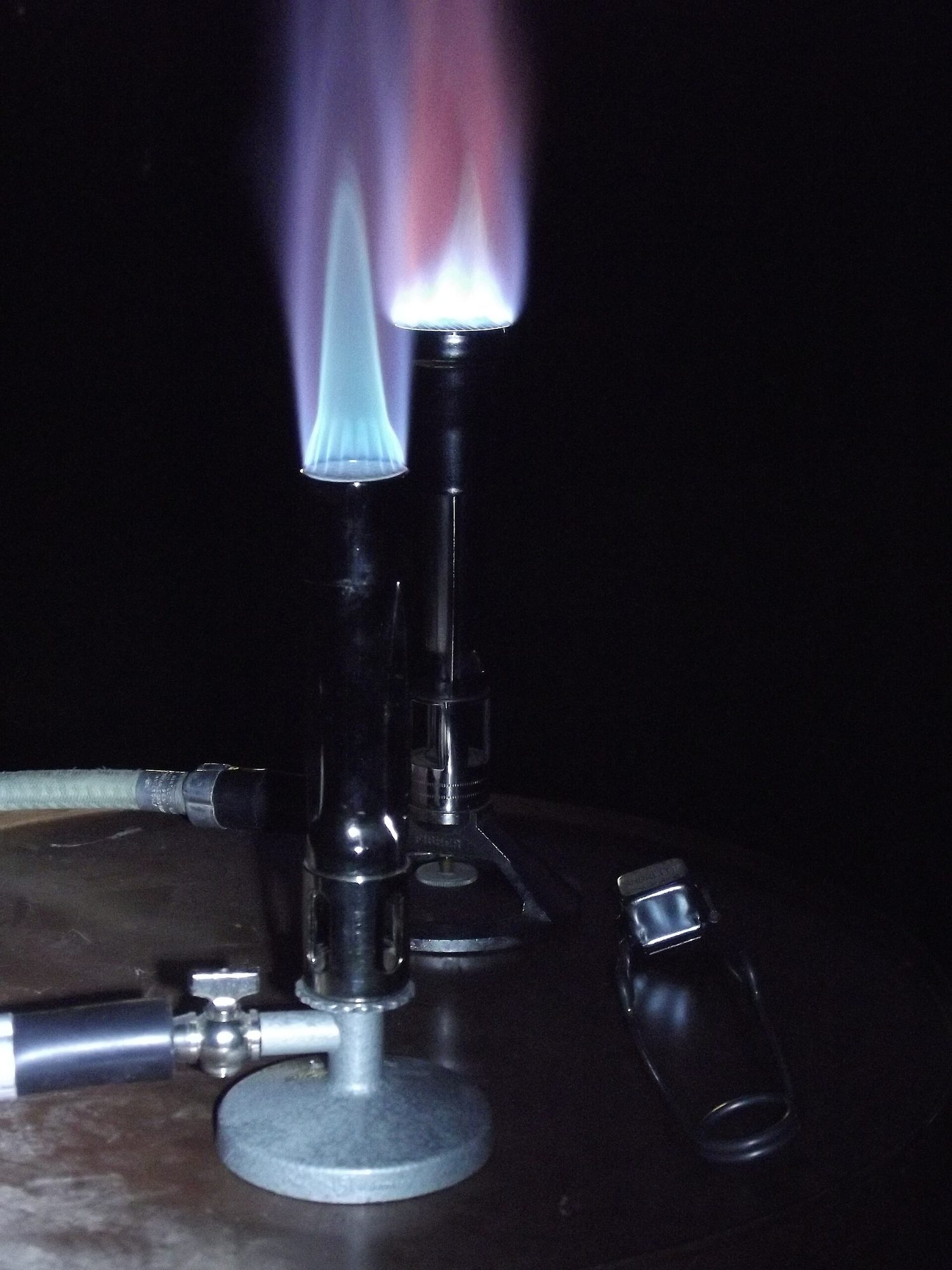
เปลวไฟเบรนเนอร์สีฟ้า
การเผาไหม้เชื้อเพลิงเป็นปฏิกิริยาคายความร้อน ปล่อยพลังงานสู่สิ่งแวดล้อม.
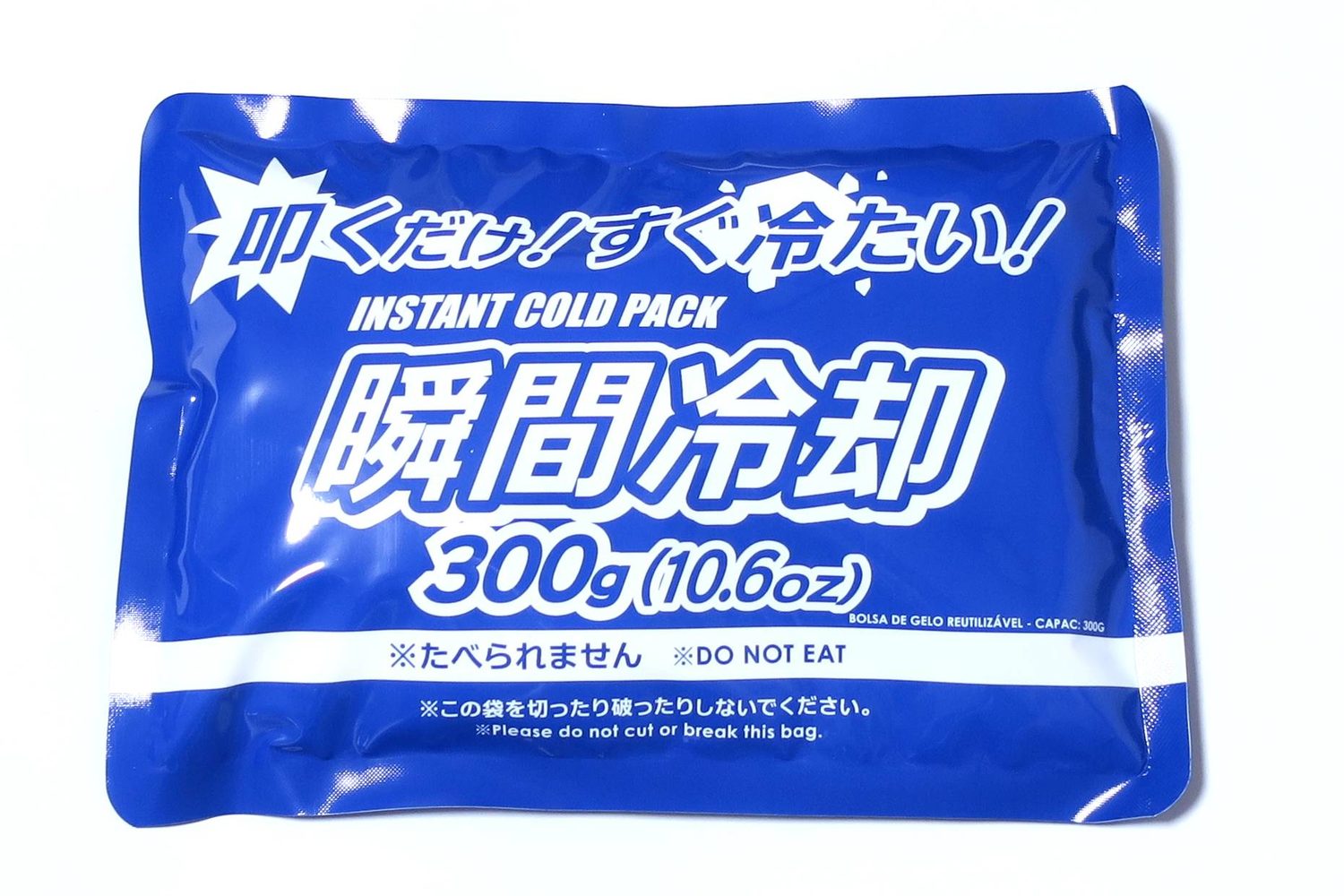
แพ็คเย็นทันที
แพ็คเย็นทันทีใช้ปฏิกิริยาดูดความร้อน yang takes in heat.

ปฏิกิริยาเคมีทุกชนิด吸收了หรือ放出พลังงาน การเปลี่ยนแปลงพลังงานนี้ ซึ่งวัดได้ที่ความดันคงที่ คือ การเปลี่ยนแปลงเอนثالปี โดยมีสัญลักษณ์ $\Delta H$.

  • ใน ปฏิกิริยาคายความร้อน ระบบจะคายความร้อน ดังนั้นผลิตภัณฑ์จะมีพลังงานน้อยกว่าสารตั้งต้น และ $\Delta H$ เป็น ลบ .
  • ใน ปฏิกิริยา吸热 ระบบจะดูดความร้อน ดังนั้นผลิตภัณฑ์จะมีพลังงานมากกว่าสารตั้งต้น และ $\Delta H$ เป็น บวก .

แผนภูมิเส้นทางปฏิกิริยา

แผนภาพเส้นทางการเกิดปฏิกิริยาแสดงพลังงานของสารตั้งต้นและผลิตภัณฑ์ รวมถึง "เนิน" พลังงานระหว่างทั้งสอง ความสูงของเนินนี้คือ พลังงานก่อกวน — ซึ่งเป็นพลังงานขั้นต่ำที่อนุภาคต้องการก่อนจะเกิดปฏิกิริยาได้

  • ปฏิกิริยาคายความร้อน: ผลิตภัณฑ์อยู่ที่ระดับ ต่ำกว่า สารตั้งต้น ($\Delta H < 0$)
  • ปฏิกิริยาดูดความร้อน: ผลิตภัณฑ์อยู่ที่ระดับ สูงกว่า สารตั้งต้น ($\Delta H > 0$)
แผนภาพเส้นทางการเกิดปฏิกิริยาสองแบบวางคู่กัน: แบบคายความร้อนที่มีผลิตภัณฑ์อยู่ด้านล่างของสารตั้งต้น และแบบดูดความร้อนที่มีผลิตภัณฑ์อยู่ด้านบน
ปฏิกิริยาคายความร้อนจบลงที่จุดต่ำกว่าจุดเริ่มต้น ($\Delta H<0$); ปฏิกิริยาดูดความร้อนจบลงที่จุดสูงกว่า ($\Delta H>0$)

สภาวะมาตรฐานและประเภทของการเปลี่ยนแปลงเอนทาลปี

ค่าพลังงานถูกเปรียบเทียบภายใต้ สภาวะมาตรฐาน: $298\ \text{K}$ และ $101\ \text{kPa}$ ซึ่งแสดงด้วยสัญลักษณ์ $^{\ominus}$. แต่ละสารอยู่ในสถานะทางกายภาพปกติภายใต้สภาวะเหล่านั้น

สัญลักษณ์ ชื่อ นิยาม (ต่อโมล, ภายใต้สภาวะมาตรฐาน)
$\Delta H_r^{\ominus}$ การเปลี่ยนแปลงเอนทาลปีของปฏิกิริยา สำหรับปริมาณตามที่ระบุในสมการ
$\Delta H_f^{\ominus}$ การเปลี่ยนแปลงเอนทาลปีของการเกิด การเกิดสารประกอบหนึ่งโมลจากธาตุองค์ประกอบ
$\Delta H_c^{\ominus}$ การเปลี่ยนแปลงเอนทาลปีของการเผาไหม้ การเผาไหม้สารประกอบหนึ่งโมลอย่างสมบูรณ์ในออกซิเจน
$\Delta H_{\text{neut}}^{\ominus}$ การเปลี่ยนแปลงเอนทาลปีของการเป็นกลาง การเกิดน้ำหนึ่งโมลจากกรดและเบส
กระบวนการสองอย่าง: การเกิดเริ่มจากธาตุไปเป็นสารประกอบหนึ่งโมล; การเผาไหม้เริ่มจากสารประกอบหนึ่งโมลบวกออกซิเจนเป็นคาร์บอนไดออกไซด์และน้ำ
อย่าสับสน: การสร้างสารประกอบ 1 โมลจากธาตุองค์ประกอบคือการเกิด; การเผาไหม้สารประกอบ 1 โมลในออกซิเจนคือการเผาไหม้

พลังงานจากการตัดและสร้างพันธะ

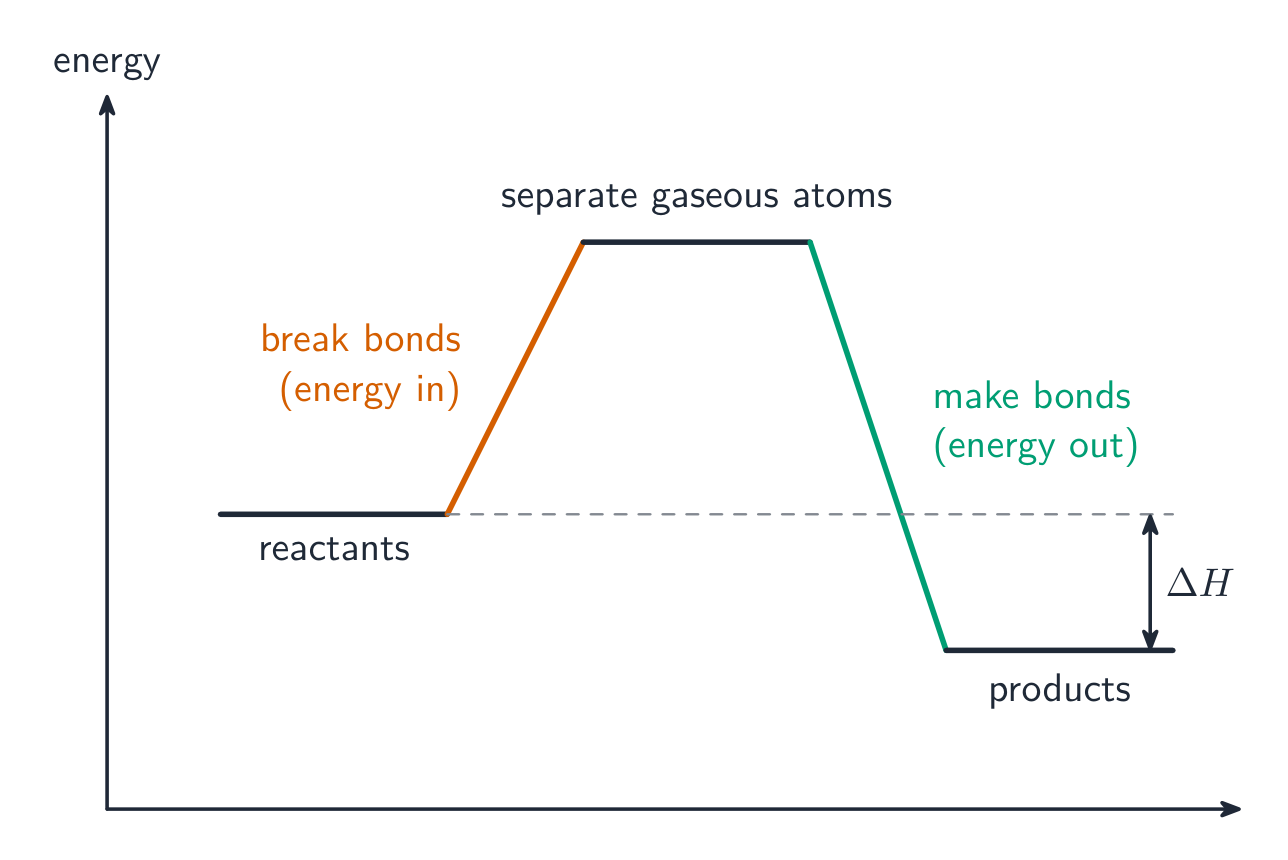
ระหว่างปฏิกิริยา พันธะเก่าจะแตกและพันธะใหม่จะเกิดขึ้น การตัด พันธะต้องใช้พลังงาน (ดูดความร้อน); การสร้าง พันธะจะปล่อยพลังงาน (คายความร้อน) การเปลี่ยนแปลงเอนทาลปีของปฏิกิริยาคือผลต่างระหว่างสองสิ่งนี้:

$$\Delta H_r = \sum (\text{bond energies broken}) - \sum (\text{bond energies made})$$

พลังงานพันธะ คือพลังงานที่ใช้ในการตัดพันธะเฉพาะชนิดหนึ่งโมลในสถานะก๊าซ ดังนั้นจึงมีค่าเป็นบวกเสมอ บางพลังงานพันธะมีค่าแน่นอน (สำหรับโมเลกุลเฉพาะชนิด); บางส่วนเป็นค่าเฉลี่ยที่คำนวณจากหลายโมเลกุลที่แตกต่างกัน ทำให้การคำนวณโดยใช้ค่าเหล่านี้เป็นเพียงค่าประมาณเท่านั้น

ตัวอย่างวิธีทำ. ใช้พลังงานพันธะเพื่อหาค่า $\Delta H$ สำหรับ $\text{H}_2 + \text{Cl}_2 \rightarrow 2\text{HCl}$. พลังงานพันธะ (kJ mol⁻¹): H–H $= 436$, Cl–Cl $= 242$, H–Cl $= 431$.

$$\Delta H = \sum(\text{broken}) - \sum(\text{made}) = (436 + 242) - (2 \times 431) = 678 - 862 = -184\ \text{kJ mol}^{-1}.$$
แผนภาพขั้นบันไดแสดงพลังงาน: สารตั้งต้นเพิ่มขึ้นสู่อะตอมก๊าซแยกตัวเมื่อพันธะแตก แล้วลดลงสู่ผลิตภัณฑ์เมื่อพันธะเกิดขึ้น
การตัดพันธะต้องรับพลังงานเข้า; การสร้างพันธะปล่อยพลังงานออก. $\Delta H$ คือผลต่างระหว่างสองสิ่งนี้

การวัดการเปลี่ยนแปลงเอนทาลปีในห้องปฏิบัติการ

เมื่อปฏิกิริยาทำให้มวลน้ำหรือสารละลายที่กำหนดทราบหนึ่งขึ้น (หรือลดลง) ปริมาณความร้อนที่ถ่ายโอนคือ:

$$q = mc\Delta T$$

โดยที่ $m$ คือมวล, $c$ คือ ความจุความร้อนจำเพาะ (ปริมาณพลังงานที่จำเป็นในการ升高อุณหภูมิ 1 g ขึ้น 1 K), และ $\Delta T$ คือการเปลี่ยนแปลงอุณหภูมิ จากนั้นการเปลี่ยนแปลงเอนทาลปีต่อโมลจะเป็น:

$$\Delta H = -\frac{mc\Delta T}{n}$$

เครื่องหมายลบทำให้ $\Delta H$ มีค่าน้อยกว่าศูนย์เมื่ออุณหภูมิสูงขึ้น (ปฏิกิริยาคายความร้อน)

ตัวอย่างวิธีทำ. การเผาไหม้ $0.50\ \text{g}$ ของเมทานอล ($M_r = 32$) ทำให้อุณหภูมิของ $100\ \text{g}$ ของน้ำเพิ่มขึ้น $18\ ^{\circ}\text{C}$. จงหาการเปลี่ยนแปลงเอนทาลปีของการเผาไหม้ต่อโมล. ($c = 4.18\ \text{J g}^{-1}\,\text{K}^{-1}$.)

ความร้อนที่ปล่อยออกมาคือ $q = mc\Delta T = 100 \times 4.18 \times 18 = 7520\ \text{J}$. ปริมาณที่เผาไหม้คือ $n = 0.50/32 = 0.0156\ \text{mol}$, ดังนั้น

$$\Delta H_c = -\frac{q}{n} = -\frac{7520}{0.0156} \approx -480\ \text{kJ mol}^{-1}.$$
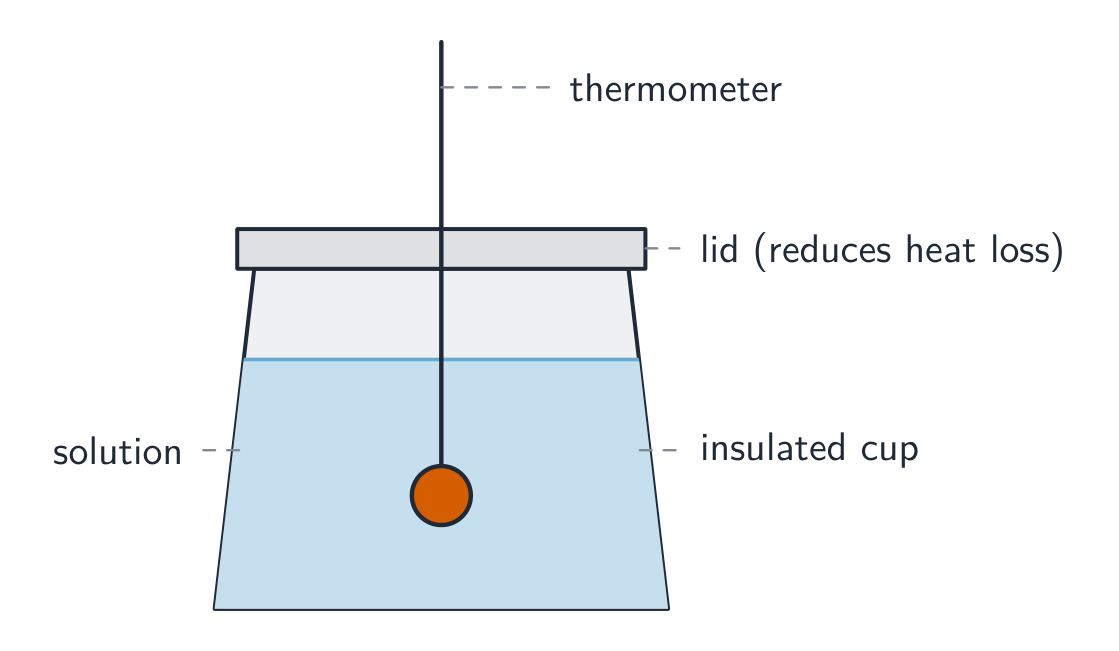
ถ้วยฉนวนที่มีฝาปิดและเทอร์โมมิเตอร์จุ่มอยู่ภายใน ใช้เพื่อวัดการเปลี่ยนแปลงอุณหภูมิ
ถ้วยฉนวนและเทอร์โมมิเตอร์ใช้วัดการเปลี่ยนแปลงอุณหภูมิของสารละลายที่มีมวลกำหนด Known
Explore · ⁨สำรวจ⁩

Exothermic and endothermic reactions · ⁨ปฏิกิริยาคายความร้อนและดูดความร้อน⁩

Drag ΔH. An exothermic reaction releases energy (products lower); an endothermic one takes it in (products higher). · ⁨ลาก ΔH. ปฏิกิริยา คายความร้อน ปล่อยพลังงาน (ผลิตภัณฑ์ต่ำกว่า); ดูดความร้อน ดูดเข้าไป (ผลิตภัณฑ์สูงกว่า)⁩

Vocabulary · ⁨คำศัพท์⁩ Train · ⁨ฝึกฝน⁩
English ไทย
enthalpy change/enˈθælpi tʃeɪndʒ/ การเปลี่ยนแปลงเอนثالปี
exothermic/eɡzəˈðɜːmɪk/ คายความร้อน
endothermic/ˌendəʊˈθɜːmɪk/ ดูดความร้อน
reaction pathway diagram/rɪˈækʃn ˈpæθweɪ ˈdaɪəɡræm/ แผนภาพเส้นทางปฏิกิริยาเคมี
activation energy/ˌæktɪˈveɪʃn ˈenədʒi/ พลังงานก่อกวน (activation energy)
standard conditions/ˈstændəd kənˈdɪʃnz/ สภาวะมาตรฐาน
enthalpy change of reaction/enˈθælpi tʃeɪndʒ ɒv rɪˈækʃn/ การเปลี่ยนแปลงเอนثالปีของปฏิกิริยา
enthalpy change of formation/enˈθælpi tʃeɪndʒ ɒv fɔːˈmeɪʃn/ การเปลี่ยนแปลงเอนثالปีของการเกิด
enthalpy change of combustion/enˈθælpi tʃeɪndʒ ɒv kəmˈbʌstʃn/ การเปลี่ยนแปลงเอนثالปีของการเผาไหม้
enthalpy change of neutralisation/enˈθælpi tʃeɪndʒ ɒv ˌnjuːtrəlaɪˈzeɪʃn/ การเปลี่ยนแปลงเอนثالปีของการ中和
bond energy/bɒnd ˈenədʒi/ พลังงานพันธะ
specific heat capacity/spəˈsɪfɪk hiːt kəˈpæsɪti/ ความจุความร้อนจำเพาะ
Hess's law/ˈhesɪz lɔː/ กฎของเฮส (Hess's law)
energy cycle/ˈenədʒi ˈsaɪkl/ วงจรพลังงาน
5.2

Hess's law · ⁨กฎเฮสส์⁩

Syllabus · ⁨หลักสูตร⁩
English
  1. apply Hess’s law to construct simple energy cycles
  2. carry out calculations using cycles and relevant energy terms, including: (a) determining enthalpy changes that cannot be found by direct experiment (b) use of bond energy data
ไทย
  1. ใช้ กฎเฮสส์ เพื่อสร้างวงจรราคาพลังงานอย่างง่าย
  2. ทำการคำนวณโดยใช้วงจรและพจน์พลังงานที่เกี่ยวข้อง بما其中包括: (a) การหาการเปลี่ยนแปลงเอนทาลปีที่ไม่สามารถหาได้จากการทดลองโดยตรง (b) การใช้ข้อมูลพลังงานพันธะ

Source: Cambridge International syllabus · ⁨แหล่งที่มา: หลักสูตร Cambridge International⁩

English

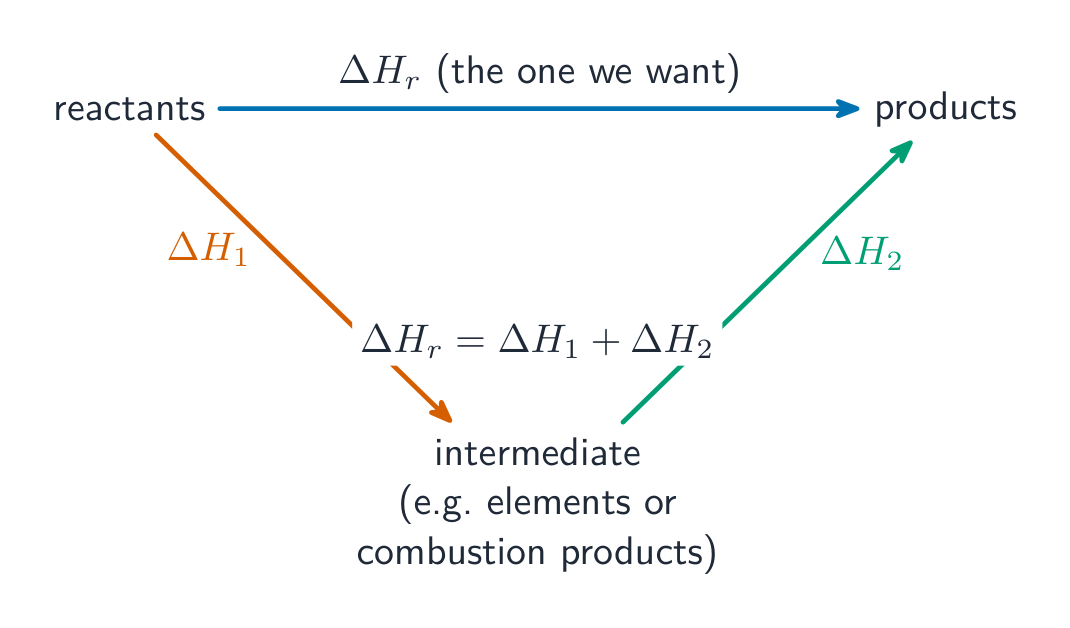
Hess's law 盖斯定律 says that the total enthalpy change for a reaction is the same, no matter which route you take from reactants to products. This is because energy is conserved.

This lets you draw an energy cycle 能量循环: link the reactants and products by a direct step and by an indirect route, then add the steps so that both routes give the same total.

Hess's law is useful in two ways:

  • it lets you find an enthalpy change that you cannot measure directly (for example, the formation of a compound that forms slowly or with side reactions).
  • it lets you calculate $\Delta H_r$ from bond energy data, or from formation or combustion data given in the question.
ไทย

กฎเฮสส์ ระบุว่า مجموعการเปลี่ยนแปลงเอนทาลปีของปฏิกิริยานั้นเท่าเดิม ไม่ว่าคุณจะเลือกเส้นทางใดในการเปลี่ยนสารตั้งต้นให้เป็นผลิตภัณฑ์ สิ่งนี้เป็นเพราะพลังงานถูกอนุรักษ์ไว้

สิ่งนี้ช่วยให้คุณสามารถวาด วงจรรายละเอียดพลังงาน: เชื่อมสารตั้งต้นและผลิตภัณฑ์ด้วยขั้นตอนโดยตรงและเส้นทางอ้อม แล้วรวมขั้นตอนเพื่อให้ทั้งสองเส้นทางให้ผลลัพธ์รวมเท่ากัน

วงจรถล่มเฮสส์สามเหลี่ยมเชื่อมสารตั้งต้นและผลิตภัณฑ์ทั้งโดยตรงและผ่านสารกลาง พร้อมติดป้ายชื่อการเปลี่ยนแปลงเอนทาลปีทั้งสาม
เส้นทางตรงเท่ากับเส้นทางอ้อม ดังนั้น $\Delta H_r = \Delta H_1 + \Delta H_2$

กฎเฮสส์มีประโยชน์ในสองด้าน:

  • ช่วยให้หาค่าการเปลี่ยนแปลงเอนทาลปีที่คุณ ไม่สามารถ วัดโดยตรงได้ (เช่น การเกิดสารประกอบที่เกิดช้าหรือมีปฏิกิริยาร่วมข้างเคียง).
  • ช่วยให้คุณคำนวณ $\Delta H_r$ จากข้อมูลพลังงานพันธะ หรือจากข้อมูลการเกิดหรือการเผาไหม้ที่โจทย์กำหนดให้
Explore · ⁨สำรวจ⁩

Hess's law cycle · ⁨วงจรรูปแบบเฮส (Hess's law cycle)⁩

Enthalpy change is the same whichever route you take — so an unknown ΔH can be found by an alternative path. · ⁨การเปลี่ยนแปลงเอนทาลปีเท่ากันไม่ว่าคุณจะเลือกเส้นทางไหน — ดังนั้นค่า ΔH ที่ไม่รู้สามารถหาได้จากเส้นทางอื่น⁩

5.2

Exam tips · ⁨ข้อแนะนำสำหรับการสอบ⁩

English
  • Define each enthalpy change with its exact standard conditions (e.g. combustion = one mole burned completely in excess oxygen).
  • Use $\Delta H = \sum(\text{bonds broken}) - \sum(\text{bonds made})$; breaking is endothermic ($+$), making is exothermic ($-$) — getting the sign the wrong way round is the classic error.
  • In $q = mc\Delta T$ use the mass of the water/solution, then divide by moles and add the minus sign for an exothermic reaction.
  • Draw Hess cycles with arrows the same way round, follow the alternative route, and always give $\Delta H$ a sign and units ($\text{kJ mol}^{-1}$).
ไทย
  • นิยามการเปลี่ยนแปลงเอนทาลปีแต่ละชนิดพร้อม สภาวะมาตรฐานที่ชัดเจน (เช่น การเผาไหม้ = การเผาไหม้สารประกอบหนึ่งโมลอย่างสมบูรณ์ในออกซิเจนส่วนเกิน).
  • ใช้ $\Delta H = \sum(\text{bonds broken}) - \sum(\text{bonds made})$; การตัดเป็นกระบวนการดูดความร้อน ($+$), การสร้างเป็นกระบวนการคายความร้อน ($-$) — การสลับเครื่องหมายผิดเป็นข้อผิดพลาดคลาสสิก
  • ใน $q = mc\Delta T$ ให้ใช้มวลของ น้ำ/สารละลาย, แล้วหารด้วยจำนวนโมลและเพิ่มเครื่องหมายลบสำหรับปฏิกิริยาคายความร้อน
  • วาด วงจรถล่มเฮสส์ โดยมีลูกศรชี้ทิศทางเดียวกัน ติดตามเส้นทางทางเลือก และให้ค่า $\Delta H$ ทั้งเครื่องหมายและหน่วยเสมอ ($\text{kJ mol}^{-1}$).

Interactive lessons on this topic · ⁨บทเรียนเชิงโต้ตอบสำหรับหัวข้อนี้⁩

Work through it step by step, with instant-check exercises. · ⁨ทำทีละขั้นตอน พร้อมแบบฝึกหัดตรวจสอบผลทันที⁩

Past Papers · ⁨ข้อสอบย้อนหลัง⁩

More topics in A-Level Chemistry · ⁨Chemistry A-Level⁩ · ⁨หัวข้อเพิ่มเติมใน A-Level Chemistry · ⁨Chemistry A-Level⁩⁩

Log in or create account · ⁨เข้าสู่ระบบหรือสร้างบัญชี⁩

IGCSE, A-Level & AP