The diffraction grating
| English | Chinese | Pinyin |
|---|---|---|
| diffraction grating | 衍射光栅 | yǎn shè guāng shān |
| slits | 狭缝 | xiá fèng |
| coherent | 相干 | xiāng gān |
| monochromatic | 单色 | dān sè |
| maxima | 极大 | jí dà |
| order | 级次 | jí cì |
| normal | 法线 | fǎ xiàn |
| spectrum | 光谱 | guāng pǔ |
The rainbow on a CD
- Tilt a CD in the light and you see bright rainbow colours.
- The disc's fine tracks act as a diffraction grating 衍射光栅, splitting the light by wavelength.
- Gratings are how we measure wavelengths precisely.
What a grating is
- A grating has many equally spaced slits 狭缝 — often hundreds per millimetre.
- Each slit is a coherent 相干 source, and they all interfere together.

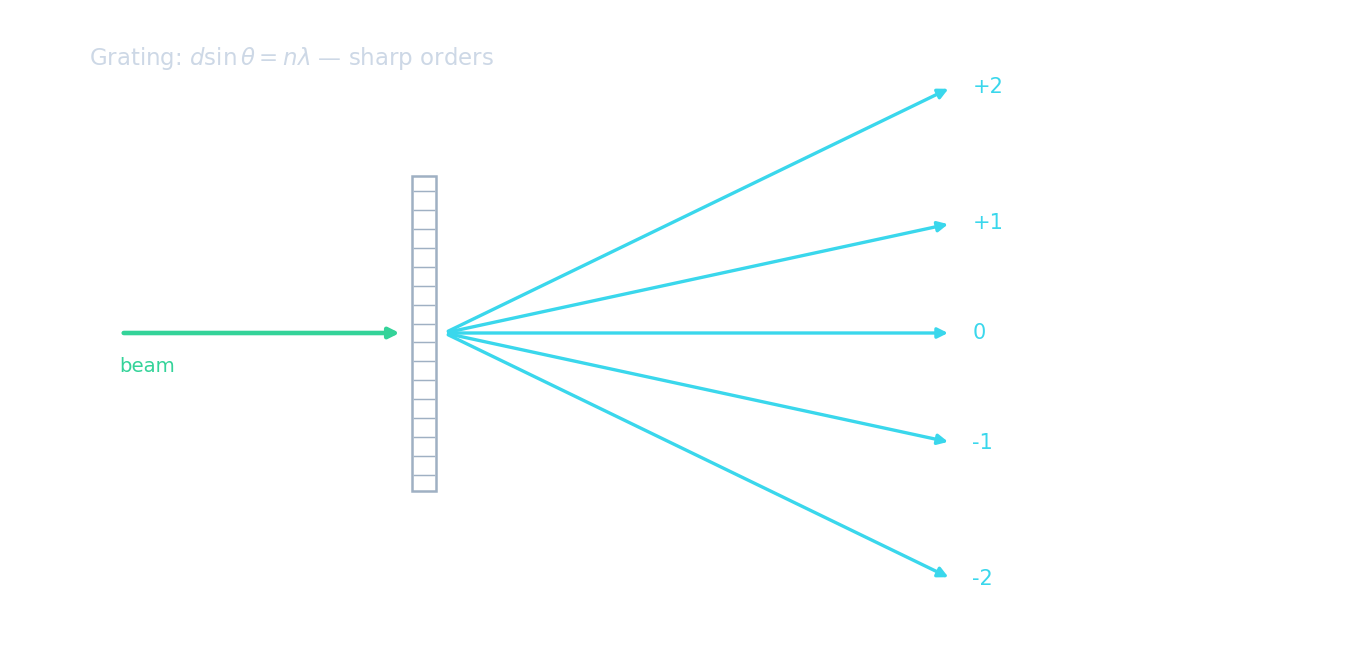
A diffraction grating splits monochromatic 单色 light into sharp maxima on a screen
Why the grating gives sharp maxima
Two waves add when in phase and cancel when out of phase — change the phase and watch the resultant. A grating's many slits make the bright fringes razor-sharp.
A diffraction grating is made of:
Hundreds or thousands of equally spaced slits, each acting as a coherent source.
The grating equation
- Bright maxima 极大 appear at angles given by $d\sin\theta = n\lambda$.
- $d$ = slit spacing, $n = 0, 1, 2, \ldots$ is the order 级次, $\theta$ measured from the normal 法线 (the straight-through direction).
Light hits a grating of slit spacing $2.0\ \mu\text{m}$. The first-order ($n=1$) maximum is where $\sin\theta = 0.30$. Find the wavelength, in nm.
$\lambda = \dfrac{d\sin\theta}{n} = \dfrac{2.0 \times 10^{-6} \times 0.30}{1} = 6.0 \times 10^{-7}\ \text{m} = 600\ \text{nm}$.
Sharper than two slits
- With many slits, every "wrong" direction is cancelled by lots of slits.
- So a grating gives much sharper maxima than a double slit.

Young's double-slit experiment — the single slit makes the two slits coherent sources
A diffraction grating gives sharper maxima than a double slit.
Yes — many slits cancel every "wrong" direction, leaving narrow, bright maxima.
Slit spacing and highest order
- $N$ lines per mm → $d = \dfrac{1}{N}\ \text{mm}$.
- Since $\sin\theta \le 1$, the highest order is $n_{\text{max}} = \left\lfloor \dfrac{d}{\lambda} \right\rfloor$.
A grating has $500$ lines per mm. What is the slit spacing $d$, in µm?
$d = \dfrac{1}{500}\ \text{mm} = 0.002\ \text{mm} = 2.0\ \mu\text{m}$.
For a grating and wavelength with $\dfrac{d}{\lambda} = 3.27$, the highest order seen is:
$n_{\text{max}} = \left\lfloor \dfrac{d}{\lambda} \right\rfloor = \lfloor 3.27 \rfloor = 3$. Order 4 would need $\sin\theta > 1$.
Finding a wavelength
- Shine the light straight at the grating and measure the angle of a maximum.
- Then $\lambda = d\sin\theta$ (use $n = 1$ for the first order); average over orders to reduce error.
To find a wavelength with a grating, you measure the ____ of a maximum.
Measure $\theta$ for a known order, then $\lambda = \dfrac{d\sin\theta}{n}$.
Worked example: a grating with 500 lines per mm
Light of wavelength $720\ \text{nm}$ falls normally on a grating with $500$ lines per mm. Find the angle between the two second-order maxima, the highest order visible, and the wavelength that would put its third-order maxima at the same angle.
- Spacing: $d = \dfrac{1}{500}\ \text{mm} = 2.0 \times 10^{-6}\ \text{m}$.
- Second order: $\sin\theta = \dfrac{2 \times 720 \times 10^{-9}}{2.0 \times 10^{-6}} = 0.72$, so $\theta = 46^\circ$. The two second-order maxima sit either side of the centre, so the angle between them is $2 \times 46^\circ = 92^\circ$.
- Highest order: $\dfrac{d}{\lambda} = \dfrac{2.0 \times 10^{-6}}{720 \times 10^{-9}} = 2.8$, so $n_{\text{max}} = 2$ — the third order would need $\sin\theta > 1$.
- Same angle, third order: $3\lambda = 2 \times 720\ \text{nm}$, so $\lambda = 480\ \text{nm}$ (blue).
- Check: at the same angle $d\sin\theta$ is fixed, so $n\lambda$ is fixed: a higher order needs a proportionally shorter wavelength.
Light of wavelength $600\ \text{nm}$ falls normally on a grating with $400$ lines per mm. What is the angle, in degrees, between the two first-order maxima?
$d = \dfrac{1}{400}\ \text{mm} = 2.5 \times 10^{-6}\ \text{m}$; $\sin\theta = \dfrac{600 \times 10^{-9}}{2.5 \times 10^{-6}} = 0.24$, so $\theta = 13.9^\circ$ and the angle between the two maxima is $2\theta = 27.8^\circ$.
$\theta$ is measured from the normal, not from the surface of the grating, and "the angle between the two first-order maxima" means $2\theta$. Round $\dfrac{d}{\lambda}$ down for the highest order — a $\sin\theta$ above $1$ has no angle, so that order simply does not exist. And convert "lines per mm" to a spacing in metres before you start.
In the grating equation $d\sin\theta = n\lambda$, the angle $\theta$ is measured from the surface of the grating.
$\theta$ is measured from the normal — the straight-through direction of the zero order. Measuring from the surface swaps sine for cosine and gives the wrong wavelength.
White light through a grating
- The zero order is white: every wavelength has $\theta = 0$ there.
- Every other order is a spectrum 光谱, with violet nearest the centre (shortest $\lambda$, smallest $\theta$) and red furthest out.
- Higher orders are wider, and from the second order onwards they can overlap — red of order 2 can land on violet of order 3.
White light passes through a grating. Put these colours of the first-order spectrum in order, starting nearest the central maximum.
From $d\sin\theta = n\lambda$, a shorter wavelength gives a smaller angle, so violet is nearest the centre and red furthest out.
You've got it
- a grating is many equally spaced slits → sharp maxima
- grating equation $d\sin\theta = n\lambda$, with $\theta$ from the normal; $d = \dfrac{1}{N}$ from "$N$ lines per mm"
- highest order $n_{\text{max}} = \left\lfloor \dfrac{d}{\lambda} \right\rfloor$; white light gives a spectrum in each order with violet nearest the centre