Kinetic and potential energy
| English | Chinese | Pinyin |
|---|---|---|
| kinetic energy | 动能 | dòng néng |
| gravitational potential energy | 重力势能 | zhòng lì shì néng |
| thermal energy | 热能 | rè néng |
| momentum | 动量 | dòngliàng |
| elastic potential energy | 弹性势能 | tán xìng shì néng |
| compression | 压缩 | yā suō |
The roller-coaster swap
- At the top of a drop a coaster crawls; at the bottom it races.
- Height has turned into speed — potential energy into kinetic energy 动能.
- Energy is just moving between two stores.
Gravitational potential energy 重力势能
- Lifting a mass $m$ through a height $\Delta h$ stores $\Delta E_{\text{P}} = mg\Delta h$.
- It comes from the work done against gravity: $W = mg \times \Delta h$.

Gravitational PE depends only on the change in height Δh, not on the path taken

Wind turbines transfer the kinetic energy of the wind into electrical energy
Kinetic & potential energy
PE + KE = constant
Potential energy turns into kinetic energy — the total never changes.
A $2.0\ \text{kg}$ book is lifted $5.0\ \text{m}$. How much gravitational PE does it gain? (Use $g = 9.81\ \dfrac{\text{m}}{\text{s}^2}$.)
$\Delta E_{\text{P}} = mg\Delta h = 2.0 \times 9.81 \times 5.0 \approx 98\ \text{J}$.
Kinetic energy
- A mass $m$ moving at speed $v$ has $E_{\text{K}} = \tfrac{1}{2}mv^{2}$.
- It comes from the work done to speed it up: $W = Fs = \tfrac{1}{2}mv^{2}$.
A $4.0\ \text{kg}$ trolley moves at $3.0\ \dfrac{\text{m}}{\text{s}}$. What is its kinetic energy?
$E_{\text{K}} = \tfrac{1}{2}mv^{2} = \tfrac{1}{2} \times 4.0 \times 3.0^{2} = 18\ \text{J}$.
Two traps. Squaring: doubling the speed gives four times the kinetic energy, not two. Height: $\Delta h$ is the vertical change in height, never the distance along a slope — a ramp of length $3\ \text{m}$ that drops $1.5\ \text{m}$ uses $1.5\ \text{m}$.
The energy swap
- On a frictionless ramp, GPE becomes KE: $mgh = \tfrac{1}{2}mv^{2}$, so $v = \sqrt{2gh}$.
- The mass cancels — every object reaches the same speed from the same height.
- With friction, some of it becomes thermal energy 热能 instead.
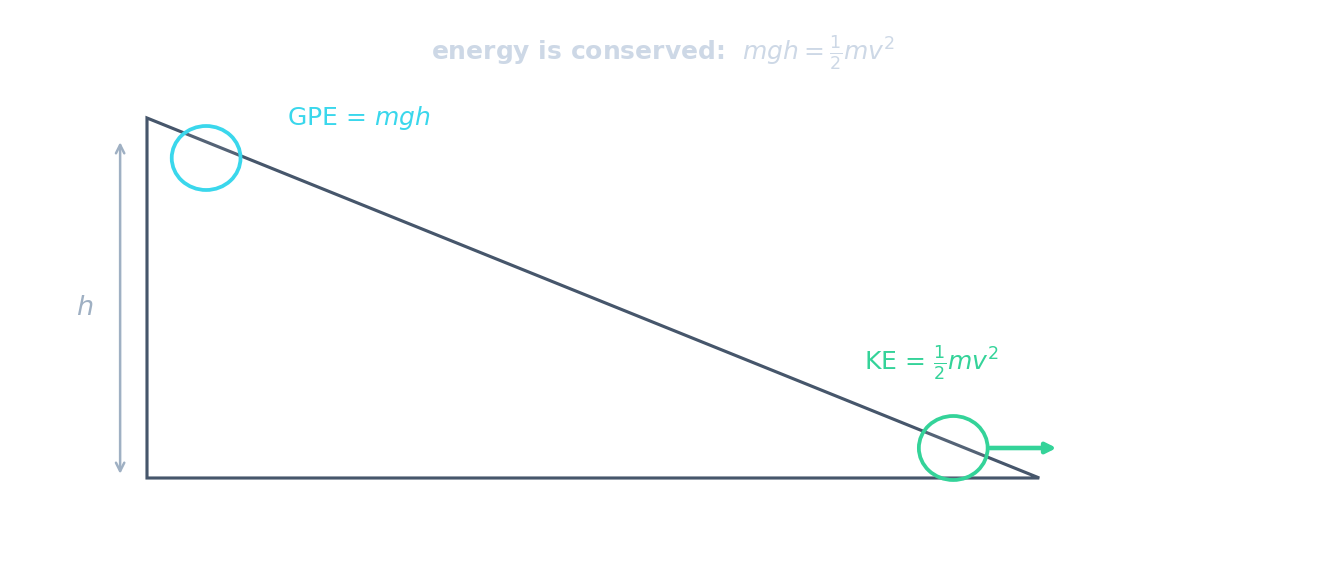
As a ball rolls down a frictionless ramp, its gravitational PE turns mainly into:
With no friction, all the lost GPE becomes kinetic energy: $mgh = \tfrac{1}{2}mv^{2}$.
Worked example: a ramp with friction
A $2.0\ \text{kg}$ trolley is released from rest at the top of a ramp $3.0\ \text{m}$ long that drops $1.5\ \text{m}$. It reaches the bottom at $4.0\ \dfrac{\text{m}}{\text{s}}$. Find the work done against friction and the average friction force.
- GPE lost: $mg\Delta h = 2.0 \times 9.81 \times 1.5 = 29\ \text{J}$.
- KE gained: $\tfrac{1}{2}mv^{2} = \tfrac{1}{2} \times 2.0 \times 4.0^{2} = 16\ \text{J}$.
- The difference is the work done against friction: $29 - 16 = 13\ \text{J}$.
- Friction force: work = force × distance along the ramp, so $F = \dfrac{13}{3.0} = 4.5\ \text{N}$.
- Check: without friction the speed would have been $\sqrt{2 \times 9.81 \times 1.5} = 5.4\ \dfrac{\text{m}}{\text{s}}$ — larger than $4.0$, as it must be.
A trolley rolls down a rough ramp. Compared with a frictionless ramp, which statements are true? Select all that apply.
The GPE lost is fixed by the height drop and is the same on both ramps. Friction takes some of it as thermal energy, so the KE at the bottom is smaller by exactly the work done against friction.
Energy and momentum 动量
- Combining $p = mv$ with $E_{\text{K}} = \tfrac{1}{2}mv^{2}$ gives $E_{\text{K}} = \dfrac{p^{2}}{2m}$.
- Handy when you know the momentum but not the speed.
Kinetic energy written in terms of momentum $p$ is:
From $p = mv$ and $E_{\text{K}} = \tfrac{1}{2}mv^{2}$, substituting $v = p/m$ gives $E_{\text{K}} = \dfrac{p^{2}}{2m}$.
Energy methods
- Write the energy at the start and end, then balance the books.
- Spring: a block's KE becomes elastic potential energy 弹性势能 $\tfrac{1}{2}kx^{2}$ at greatest compression 压缩.
- Bounce: the height ratio $\dfrac{h_2}{h_1}$ is the fraction of energy kept.

A stretched or compressed spring stores elastic PE ½kx², ready to become kinetic energy
A block slides into a spring on a frictionless surface. At greatest compression its kinetic energy has all become ____ potential energy.
KE → elastic PE $= \tfrac{1}{2}kx^{2}$ at the point of greatest compression, then back to KE as the spring pushes it off.
When friction acts, some mechanical energy becomes thermal energy.
Yes — that "lost" energy is not destroyed; it heats the surfaces and surroundings.
Worked example: a block meets a spring
A block slides down a slope and hits a spring with $60\ \text{J}$ of kinetic energy. While the spring compresses to its maximum, the block's gravitational PE falls by a further $10\ \text{J}$. All the energy the block loses becomes elastic PE in the spring, whose constant is $k = 3500\ \dfrac{\text{N}}{\text{m}}$. Find the maximum compression and the force on the block there.
- Energy into the spring: $60 + 10 = 70\ \text{J}$ (the block loses both its KE and some GPE).
- Compression: $\tfrac{1}{2}kx^{2} = 70$, so $x^{2} = \dfrac{140}{3500} = 0.040$ and $x = 0.20\ \text{m}$.
- Force at maximum compression: $F = kx = 3500 \times 0.20 = 700\ \text{N}$.
- Check: on a force–compression graph the area under the line to $x = 0.20\ \text{m}$ is $\tfrac{1}{2} \times 700 \times 0.20 = 70\ \text{J}$ — the same energy, found the other way.
A block with $40\ \text{J}$ of kinetic energy hits a spring of constant $k = 2000\ \dfrac{\text{N}}{\text{m}}$ on a level surface. All its KE becomes elastic PE. What is the maximum compression, in m?
$\tfrac{1}{2}kx^{2} = 40$, so $x^{2} = \dfrac{80}{2000} = 0.040$ and $x = 0.20\ \text{m}$.
You've got it
- gravitational PE $\Delta E_{\text{P}} = mg\Delta h$ (vertical height!); kinetic energy $E_{\text{K}} = \tfrac{1}{2}mv^{2}$
- on a frictionless ramp $mgh = \tfrac{1}{2}mv^{2}$, so $v = \sqrt{2gh}$; with friction the missing energy is the work done against it
- in momentum terms, $E_{\text{K}} = \dfrac{p^{2}}{2m}$; a spring stores $\tfrac{1}{2}kx^{2}$