Copyright and software licences
| English | Chinese | Pinyin |
|---|---|---|
| copyright | 版权 | bǎn quán |
| patent | 专利 | zhuān lì |
| software licence | 软件许可证 | ruǎn jiàn xǔ kě zhèng |
| commercial software | 商业软件 | shāng yè ruǎn jiàn |
| proprietary | 专有 | zhuān yǒu |
| open-source | 开源 | kāi yuán |
| freeware | 免费软件 | miǎn fèi ruǎn jiàn |
| shareware | 共享软件 | gòng xiǎng ruǎn jiàn |
| permissive | 宽松许可 | kuān sōng xǔ kě |
| copyleft | 著佐权 | zhù zuǒ quán |
An open letter to the people who did not pay
- In February 1976 a 20-year-old Bill Gates wrote an open letter to computer hobbyists. His company's BASIC interpreter was running on thousands of machines, and fewer than one owner in ten had paid for it.
- "Who can afford to do professional work for nothing?" he asked. Within a few years, the law made clear that software was a creative work like a book, and copying it without permission was illegal.
- The argument has never gone away: pay per copy, or give the code away and let anyone improve it? Both answers are on the syllabus, and both are right in the right situation.
- This lesson is copyright 版权, the licences built on it, and how to justify one for a given case.
Copyright
- Copyright is the legal right of the creator of an original work to control how it is copied, distributed, modified and performed.
- It applies automatically, with no registration, to source code, software, documents, images, audio and video, and it lasts a long time, often 70 years after the creator's death.
- Why a programmer relies on it, in the scheme's words: to be identified as the owner and author; so that there are legal consequences if anyone copies or steals the program; to stop competitors selling the same work; and to earn money by licensing it.
Copyright applies automatically to an original work (including code) and controls how it is copied and modified — but a general idea or algorithm needs a patent instead.
Copyright protects the specific expression; ideas/inventions are protected (if at all) by patents.
Why should a programmer rely on copyright for a program? Select all that apply.
Ownership, legal protection, market protection and income are the four reasons the scheme lists. Copyright has nothing to do with performance.
Copyright is not a patent
- Copyright protects the expression: the program as written. A different program that does the same job does not infringe it.
- A patent 专利 protects a novel idea or invention. It must be applied for, examined and granted, and it lasts about 20 years.
- General ideas and algorithms are not covered by copyright; in some countries an inventive one can be patented.

Copyright is automatic and long; a patent is filed and shorter
A general idea or algorithm is NOT covered by copyright, but may be protected by a:
Copyright protects the specific expression (the code/text); ideas and inventions may be protected by a patent.
Software licences
- A software licence 软件许可证 is the legal agreement that states how a piece of software may be used, copied and distributed. Choosing and applying one is software licencing.
- Commercial software 商业软件 is sold: the buyer pays for a licence, receives no source code, and may not modify or redistribute it. The product is proprietary 专有.
- Open-source 开源 software publishes its source code; users may read, modify and redistribute it under the licence's conditions.
- Freeware 免费软件 costs nothing and may be passed on, but no source code is released and it may not be modified. Shareware 共享软件 is free for a trial period or with limited features; the user then pays to keep using the full version.
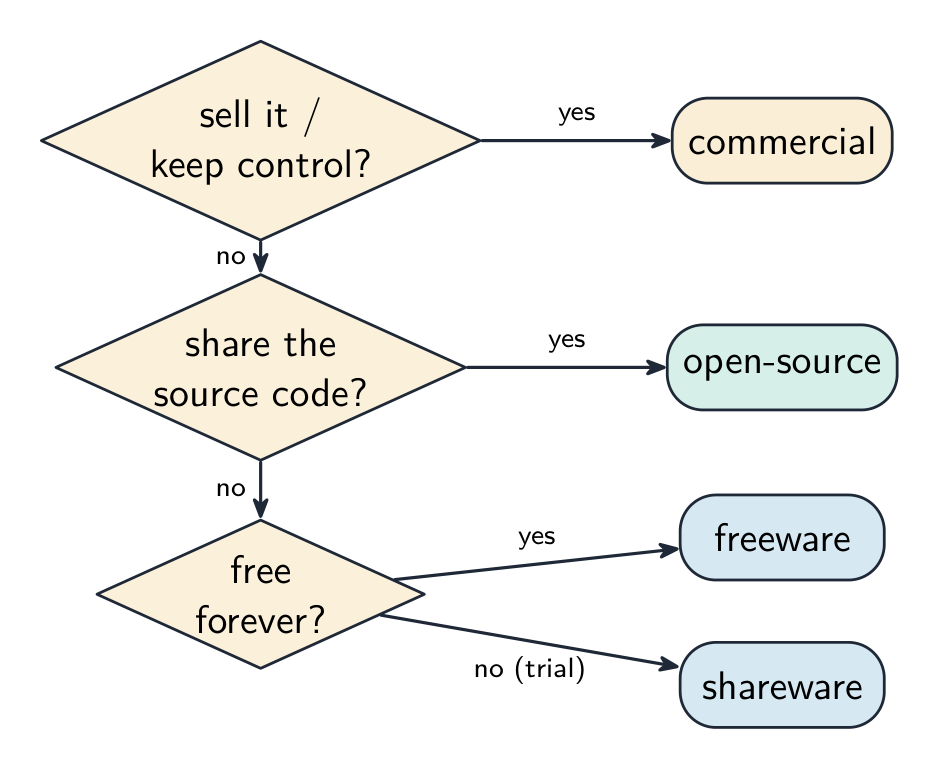
Four kinds of licence, and open source splits again
Risk and responsibility lab
Sort examples by the rule, risk or protection involved.
Match each licence type to its key feature.
Commercial = paid/closed; open-source = source available and modifiable; freeware = free but closed.
Free software, open source, permissive, copyleft
- The Free Software Foundation (FSF) defines free software as free as in freedom, not price: the user may run the program for any purpose, study and change it, redistribute copies and distribute modified versions. So the source code must be available, and a fee may still be charged for a copy.
- The Open Source Initiative (OSI) defines open source by its licence: the source code is available and may be modified and redistributed. The exam marks FSF and OSI as distinct answers.
- Permissive 宽松许可 licences such as MIT and BSD allow almost any use. Copyleft 著佐权 licences such as the GPL require modified versions to be released under the same licence: share-alike.
Open-source software means:
Open-source publishes the source so the community can read, modify and redistribute it (under the licence terms).
A copyleft licence such as the GPL requires that:
Copyleft ("share-alike") forces derivative works to keep the same open licence; permissive licences (MIT/BSD) do not.
The Free Software Foundation's "free" means free as in ____, not free of charge.
Users may run, study, change and redistribute the program; a copy may still be sold. The OSI's open source definition is about the licence terms instead.
Worked example: describe shareware and commercial software
- Shareware is distributed free for a trial, a limited time or limited features, and the user pays to continue using the full version. The programmer reaches many users cheaply and converts some to paying customers.
- Commercial software is sold for a fee; the source code is not supplied; the licence protects the developer's intellectual property; and the fee usually buys support and updates.
- Each description is two or three separate facts. "You pay for it" alone is one mark at most.
How does shareware differ from freeware?
Freeware is free with no source; shareware is free only for a trial, then requires payment.
Worked example: a game to sell to the public
- A programmer has written a game to sell. Identify the most appropriate licence and justify it.
- A commercial licence. The game is sold for a fee, so the programmer earns from every copy; the source code is not released, so nobody can copy the game or change it and sell it as their own.
- The licence protects the intellectual property, and buyers receive updates and support.
- Open source would not fit: the source would be available, so the game could be copied and redistributed free, and the programmer would earn nothing.
Worked example: why open source might not suit this program
- A program reads product labels aloud for shoppers. Explain why an open source licence might not be appropriate.
- The source code would be accessible, so anyone could change it. A changed version might output the wrong product information, so shoppers could buy the wrong item or one they are allergic to.
- The programmer would lose control over the quality and safety of what is distributed under the program's name.
- The other direction is also examined: programs are released as open source so that other developers can improve and extend them and the software spreads quickly at no cost.
Releasing the label-reading program as open source guarantees that every version shoppers use gives correct information.
The opposite: anyone could change the code and distribute a version that reads labels wrongly, and the programmer would have no control over it.
Choosing from the developer's goal
- Revenue per user and control of the code: commercial.
- The widest reach and improvement by a community: open source.
- Free distribution to build an audience, then a paid full version: shareware. Free to use but the code kept private: freeware.
- Justify by linking the licence's features to the developer's goal, the user's needs and the use case.
Match each developer's goal to the licence that serves it.
The licence follows the goal: revenue, reach, conversion, or free distribution without giving up the code.
Marks that slip away
- Copyright is automatic. "Register it for copyright" is wrong; registration belongs to patents.
- Freeware is not open source. Free of charge, yes; source code, no.
- Shareware is not "free software". It is a trial that ends in a payment.
- FSF and OSI are two different bodies with two different definitions. Name the one the question asks for.
You've got it
- copyright is the automatic, long-lasting right to control copying, distribution and modification of the program as written; a patent protects an idea and must be granted
- commercial: paid, no source, no changes · open source: source published, modify and share · freeware: free, no source · shareware: trial, then pay
- FSF free software = the four freedoms; OSI open source = the licence; permissive allows anything, copyleft keeps derivatives under the same licence
- justify a licence from the developer's goal: revenue and control, reach and community, or a free trial that converts