| Candidates should be able to: | Notes and guidance |
|---|---|
| Show an understanding of abstraction | Need for and benefits of using abstraction Describe the purpose of abstraction Produce an abstract model of a system by only including essential details |
| Describe and use decomposition | Break down problems into sub-problems leading to the concept of a program module (procedure / function) |
Algorithm Design and Problem-solving
A-Level Computer Science · Topic 9
9.1
Computational thinking

Syllabus
Source: Cambridge International syllabus
Computational thinking 计算思维 is the set of mental tools for analysing a problem and designing a solution a computer can run. Two key ones are abstraction and decomposition.
Abstraction
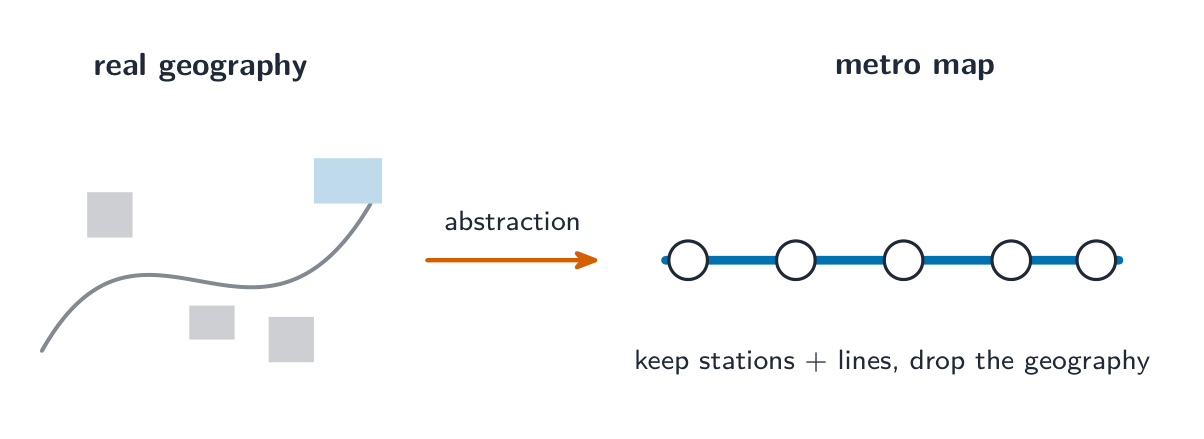
Abstraction 抽象 means keeping the essential features of a problem and ignoring the irrelevant detail, giving a simpler model.
Examples:
- a train-network map keeps the stations and lines but drops the geography.
- a class in object-oriented programming keeps only the attributes and methods the system needs.
- a function hides a piece of work behind a name.
A full model of any real problem would be too big to reason about, so abstraction is essential.
The examiner asks for the purpose of abstraction and for its benefits. Purpose: to produce a simpler model of a problem that contains only the details needed to solve it. Benefits: the problem is easier to understand and to program; the program is smaller and faster to write and test; the same model can be reused for similar problems. When you are asked to produce an abstract model of a system, list only the data and actions the task needs. For a school timetable that means the classes, rooms, teachers and periods; it does not mean the colour of the rooms or the age of the teachers.
Decomposition
Decomposition 分解 means breaking a large problem into smaller sub-problems, each easier to solve and tackled one at a time.
- find the main parts of the task.
- break each into smaller sub-tasks.
- continue until each is small enough to design directly.
- solve the small tasks and combine them.
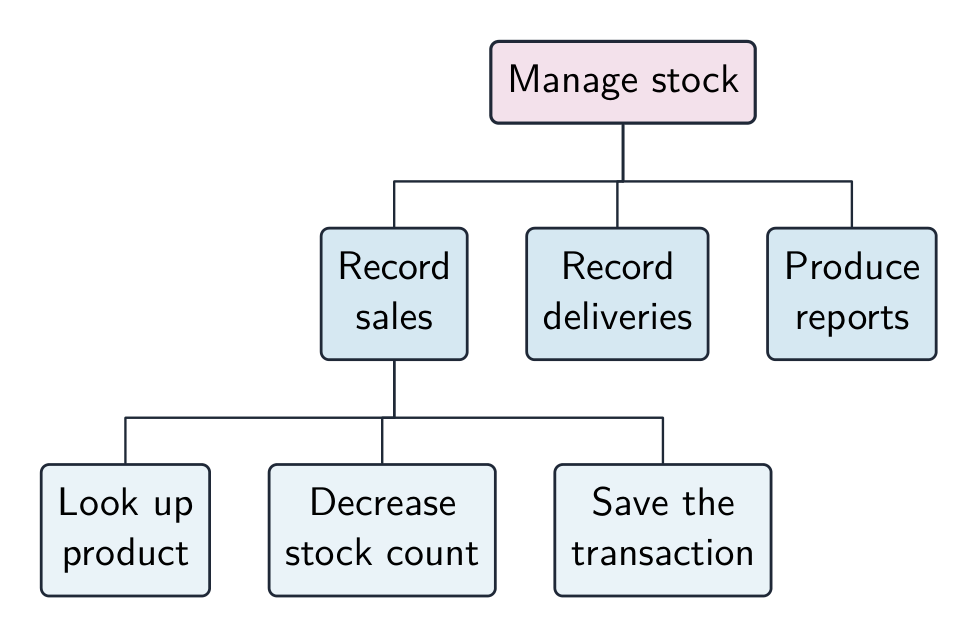
For stock control: "manage stock" → "record sales", "record deliveries", "produce reports" → ("record sales") "look up product", "decrease stock count", "save the transaction". Decomposition makes big problems manageable, lets a team divide the work, and gives modular code — each module becomes a procedure 过程 or function.
"Explain why decomposition is used" is a three-mark question with a fixed shape. Give three separate benefits: each sub-problem 子问题 is small enough to design, code and test on its own; different programmers can work on different modules 模块 at the same time; a module that already exists (or a library routine) can be reused, and a fault is easier to find because it lies inside one module. A structure chart (topic 12) is the diagram of a decomposition: the program at the top, its modules beneath, and the data passed between them.
Explore
Solving a problem the computational way
Step through the four cornerstones in the order you'd use them — break the problem down, spot what repeats, strip it to essentials, then write the steps.
Vocabulary
Train
| English | Chinese | Pinyin |
|---|---|---|
| Computational thinking | 计算思维 | jì suàn sī wéi |
| Abstraction | 抽象 | chōu xiàng |
| Decomposition | 分解 | fēn jiě |
| procedure | 过程 | guò chéng |
| sub-problem | 子问题 | zi wèn tí |
| modules | 模块 | mó kuài |
9.2
Algorithms
Syllabus
| Candidates should be able to: | Notes and guidance |
|---|---|
| Show understanding that an algorithm is a solution to a problem expressed as a sequence of defined steps | |
| Use suitable identifier names for the representation of data used by a problem and represent these using an identifier table | |
| Write pseudocode that contains input, process and output | |
| Write pseudocode using the three basic constructs of sequence, selection and iteration (repetition) | |
| Document a simple algorithm using a structured English description, a flowchart or pseudocode | |
| Write pseudocode from: • a structured English description • a flowchart | |
| Draw a flowchart from: • a structured English description • pseudocode | |
| Describe and use the process of stepwise refinement to express an algorithm to a level of detail from which the task may be programmed | |
| Use logic statements to define parts of an algorithm solution |
Source: Cambridge International syllabus
An algorithm 算法 is a solution expressed as a sequence of defined steps. Each step is unambiguous 无歧义 (one meaning), deterministic 确定性 (same input → same output), finite (the steps end), and effective (each can be done). An algorithm says what to do, independent of the programming language used to implement it.
Explore
Selection: follow the IF / ELSE branches
Drag the score and watch which branch runs. Selection tests each condition in turn and takes the FIRST one that is true — that is how IF … ELSE IF … ELSE works.
Vocabulary
Train
| English | Chinese | Pinyin |
|---|---|---|
| algorithm | 算法 | suàn fǎ |
| unambiguous | 无歧义 | wú qí yì |
| deterministic | 确定性 | què dìng xìng |
9.2
Identifier table

When you start an algorithm, list every piece of data in an identifier table 标识符表 — its identifier 标识符 (the variable 变量 name), data type 数据类型, and description. The exam's table has exactly these three columns:
| Identifier | Data type | Description |
|---|---|---|
Category |
STRING |
the product category |
SaleDate |
DATE |
when the item was sold |
ItemCost |
REAL |
cost of the item |
InStock |
BOOLEAN |
TRUE if in stock |
Sales |
ARRAY[1:30] OF REAL |
the last 30 daily sales totals |
Use descriptive names (ItemCost, not x): an identifier starts with a letter, contains no spaces, and is written the same way every time it appears. Common types are INTEGER, REAL, STRING, CHAR, BOOLEAN, DATE, plus arrays. The table forces you to name every piece of data before writing code, and a "complete the identifier table" question gives one mark for each correct data type or description, so write the type exactly as the pseudocode guide does.
Vocabulary
Train
| English | Chinese | Pinyin |
|---|---|---|
| identifier table | 标识符表 | biāo shí fú biǎo |
| identifier | 标识符 | biāo shí fú |
| variable | 变量 | biàn liàng |
| data type | 数据类型 | shù jù lèi xíng |
9.2
Pseudocode — the three basic constructs

Pseudocode 伪代码 is a structured, language-neutral way to describe algorithms.
1. Sequence
Steps run one after another (sequence 顺序):
INPUT Name
INPUT Age
OUTPUT "Hello", Name
2. Selection
A choice of which steps run, based on a condition (selection 选择):
IF Age >= 18 THEN
    OUTPUT "Adult"
ELSE
    OUTPUT "Minor"
ENDIF
For more options, use CASE OF ... ENDCASE.
3. Iteration
Repeating a block (iteration 迭代, a loop 循环):
FOR i ← 1 TO 10
    OUTPUT i
NEXT i
A WHILE loop tests the condition before each pass (may run zero times); a REPEAT...UNTIL loop tests after each pass (always runs at least once).
WHILE Total < 100 DO
    INPUT Value
    Total ← Total + Value
ENDWHILE

REPEAT
    INPUT Mark
UNTIL Mark >= 0 AND Mark <= 100

Choosing the loop is itself a mark: FOR when you know how many times (a count-controlled loop 计数循环); WHILE when the loop might not run at all (a pre-condition loop 前测循环); REPEAT ... UNTIL when it must run at least once, as in validating an input (a post-condition loop 后测循环). A "describe the iteration construct" answer names the construct, says where the condition is tested, and gives the consequence (zero times or at least once).
Common operations
- assignment 赋值:
x ← 5(an arrow;=is for comparison). - input/output:
INPUT variable,OUTPUT expression. - comparisons
=,<>,<,>,<=,>=; logicAND,OR,NOT. - arithmetic
+ - * /, plusDIV(integer division) andMOD(remainder). - strings:
LENGTH,LEFT,RIGHT,MID, and&for concatenation 拼接 (joining).
The pseudocode the exam expects
Every pseudocode answer is marked against Cambridge's published pseudocode guide. Write these forms exactly:
| Construct | Pseudocode |
|---|---|
| declare a variable | DECLARE Total : INTEGER |
| declare an array | DECLARE Marks : ARRAY[1:30] OF REAL |
| a constant | CONSTANT MaxTries = 3 |
| assignment | Total ← Total + Value |
| input and output | INPUT Name and OUTPUT "Hello ", Name |
| several options | CASE OF Choice ... 1 : OUTPUT "Add" ... OTHERWISE OUTPUT "Error" ... ENDCASE |
| count-controlled loop | FOR i ← 1 TO 10 STEP 2 ... NEXT i |
| pre-condition loop | WHILE Total < 100 DO ... ENDWHILE |
| post-condition loop | REPEAT ... UNTIL Mark >= 0 |
| integer division and remainder | DIV and MOD: 17 DIV 5 = 3, 17 MOD 5 = 2 |
| string functions | LENGTH(S), LEFT(S, 3), RIGHT(S, 2), MID(S, 2, 4), UCASE(S), LCASE(S) |
| conversions | INT(3.7) = 3, NUM_TO_STR(12), STR_TO_NUM("4.5"), ASC('A') = 65, CHR(66) = 'B' |
| a random number | RAND(100) gives a real number from 0 up to (but not including) 100; INT(RAND(100)) + 1 gives an integer from 1 to 100 |
Two habits earn marks on every question: declare every variable you use, with the type from your identifier table, and initialise 初始化 every counter 计数器 and total (Count ← 0, Total ← 0) before the loop that changes it.
Input → Process → Output
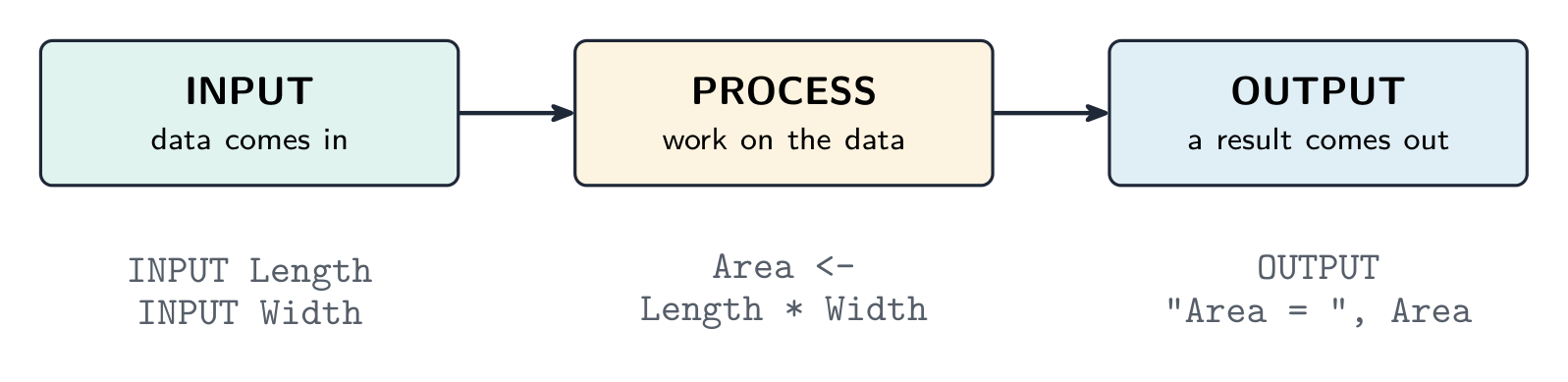
Every program follows this shape:
INPUT Length
INPUT Width
Area ← Length * Width
OUTPUT "Area = ", Area
Listing the inputs and outputs first makes the algorithm cleaner.
Worked example. Write pseudocode that inputs 100 integers and outputs how many of them, and the total of those, that lie between 10 and 20 inclusive.
Identifier table: Count : INTEGER (loop counter), Value : INTEGER (the integer just input), InRange : INTEGER (how many were in range), Total : INTEGER (their sum).
DECLARE Count, Value, InRange, Total : INTEGER
InRange ← 0
Total ← 0
FOR Count ← 1 TO 100
    INPUT Value
    IF Value >= 10 AND Value <= 20 THEN
        InRange ← InRange + 1
        Total ← Total + Value
    ENDIF
NEXT Count
OUTPUT InRange, Total
If the question then asks you to "identify two constructs and state how each is used", answer in the same shape: iteration, the FOR loop, repeats the input 100 times; selection, the IF statement, adds a value only when it is in range.
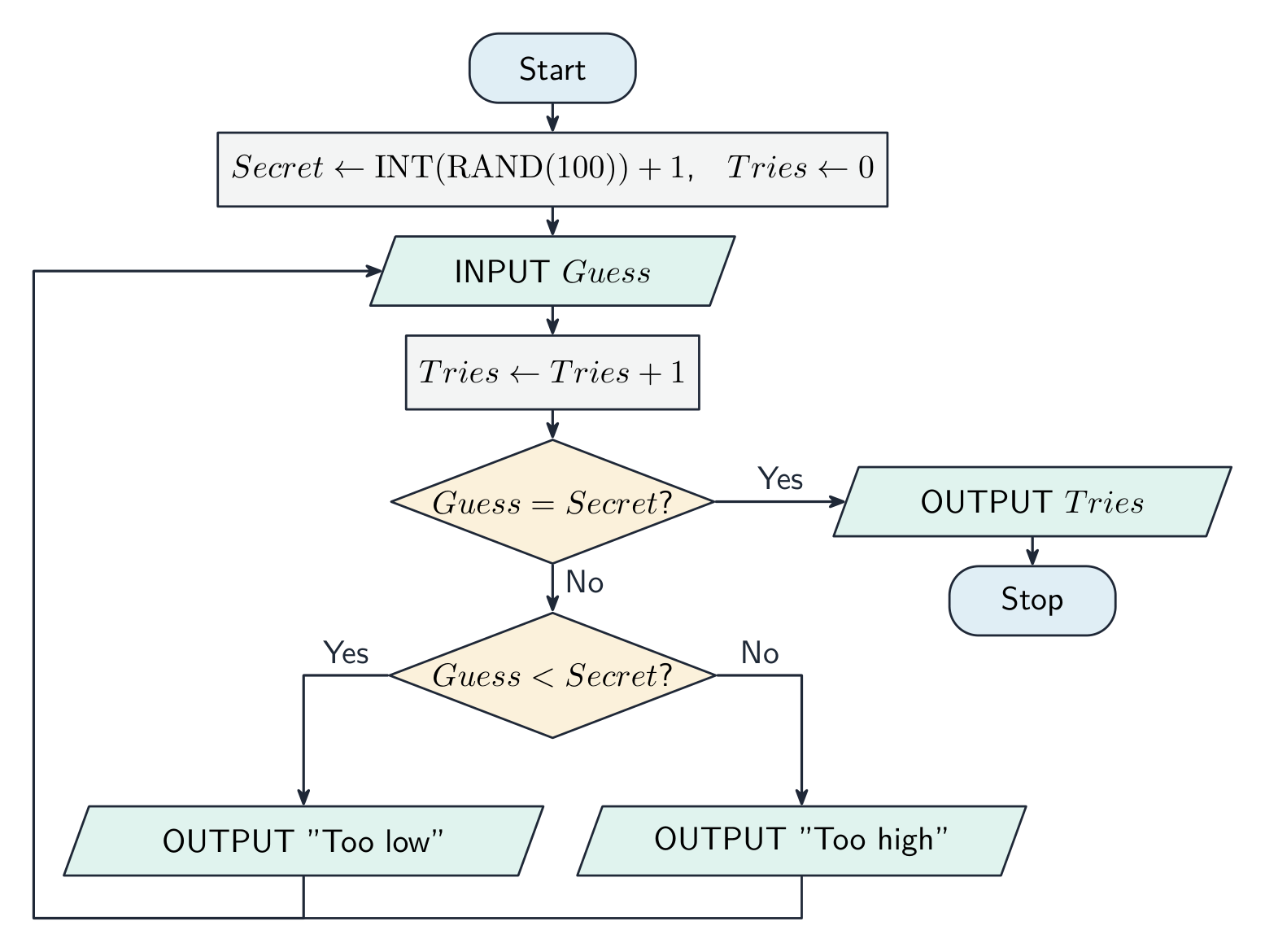
Worked example. A program picks a secret integer from 1 to 100. The user guesses until they are right; after each wrong guess the program says "Too low" or "Too high", and at the end it outputs how many guesses were made.
Identifier table: Secret : INTEGER (the number to guess), Guess : INTEGER (the user's input), Tries : INTEGER (how many guesses so far).
DECLARE Secret, Guess, Tries : INTEGER
Secret ← INT(RAND(100)) + 1
Tries ← 0
REPEAT
    INPUT Guess
    Tries ← Tries + 1
    IF Guess < Secret THEN
        OUTPUT "Too low"
    ELSE
        IF Guess > Secret THEN
            OUTPUT "Too high"
        ENDIF
    ENDIF
UNTIL Guess = Secret
OUTPUT "You took ", Tries, " guesses"
A REPEAT ... UNTIL loop is the right choice because the user must guess at least once. The marks are for: the random number in the right range, a loop that ends on a correct guess, the counter that starts at zero and increases inside the loop, the two messages under the right conditions, and the final output.
Worked example. Output two different random integers, each between $-10$ and $10$ inclusive.
There are 21 possible values, so INT(RAND(21)) gives 0 to 20 and subtracting 10 shifts it to the range $-10$ to $10$. The second number must be generated again until it differs from the first:
DECLARE First, Second : INTEGER
First ← INT(RAND(21)) - 10
REPEAT
    Second ← INT(RAND(21)) - 10
UNTIL Second <> First
OUTPUT First, Second
Explore
IF … ELSE selection
Change the value and watch which branch runs — how a program makes a decision.
Vocabulary
Train
| English | Chinese | Pinyin |
|---|---|---|
| Pseudocode | 伪代码 | wěi dài mǎ |
| sequence | 顺序 | shùn xù |
| selection | 选择 | xuǎn zé |
| iteration | 迭代 | dié dài |
| loop | 循环 | xún huán |
| count-controlled loop | 计数循环 | jì shù xún huán |
| pre-condition loop | 前测循环 | qián cè xún huán |
| post-condition loop | 后测循环 | hòu cè xún huán |
| assignment | 赋值 | fù zhí |
| concatenation | 拼接 | pīn jiē |
| initialise | 初始化 | chū shǐ huà |
| counter | 计数器 | jì shù qì |
9.2
Three notations

The same algorithm can be written three ways.
- structured English 结构化英语 — natural language with indentation and fixed keywords; good for a high-level description.
- flowchart 流程图 — a diagram with standard shapes:
| Shape | Meaning |
|---|---|
| Rounded rectangle | Start / Stop |
| Parallelogram | Input / Output |
| Rectangle | Process |
| Diamond | Decision |
| Arrow | Flow of control |
- pseudocode — the keyword notation above; closest to code.
You should be able to convert between any pair: each IF is a decision diamond, each loop is a back-arrow, and a sequence is stacked rectangles.
Converting a flowchart into pseudocode: start at the terminator and follow the arrows in order; a parallelogram becomes INPUT or OUTPUT; a rectangle becomes an assignment; a diamond with two exits that rejoin further down becomes IF ... THEN ... ELSE ... ENDIF; a diamond whose one exit arrows back upwards is a loop, and it is a WHILE loop if the diamond comes before the repeated boxes and a REPEAT ... UNTIL loop if it comes after them. Converting the other way, draw exactly one box per statement and one diamond per condition, and label every exit of a diamond Yes or No.
Vocabulary
Train
| English | Chinese | Pinyin |
|---|---|---|
| structured English | 结构化英语 | jié gòu huà yīng yǔ |
| flowchart | 流程图 | liú chéng tú |
9.2
Stepwise refinement

Stepwise refinement 逐步求精 starts with a high-level outline and expands each step until it is small enough to code. For an average of $n$ numbers:
Level 1:
Read in the numbers
Compute the average
Output the average
Level 2:
INPUT n
total ← 0
FOR i ← 1 TO n
    INPUT value
    total ← total + value
NEXT i
average ← total / n
OUTPUT average
Each refinement keeps the previous structure and adds detail.
A six-mark "apply stepwise refinement" question gives you a high-level outline and wants each step expanded into the concrete statements a programmer could code. Keep the steps in the same order, name the data each step reads or produces, and stop when every line is a single input, assignment, output, loop or condition. For example, "validate the password" becomes: input the password; check its length is at least 8; check it contains at least one digit; output "accepted" if both checks pass, otherwise output "rejected".
Explore
Stepwise refinement: outline to code
Step down the levels. You start with the whole task in one line and keep expanding each step into smaller ones — until every step is simple enough to code directly.
Vocabulary
Train
| English | Chinese | Pinyin |
|---|---|---|
| Stepwise refinement | 逐步求精 | zhú bù qiú jīng |
9.2
Logic statements
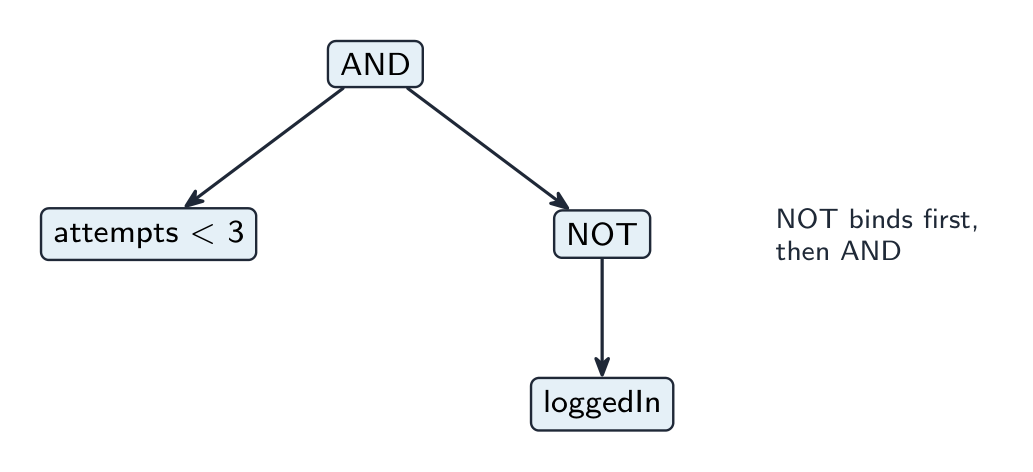
A logic statement 逻辑语句 is a Boolean 布尔 condition that controls branching, built from comparisons (x > 10), connectives (AND, OR, NOT) and brackets. Use it as the condition of IF, WHILE or REPEAT...UNTIL:
WHILE attempts < 3 AND NOT loggedIn DO
    INPUT password
    IF password = correctPassword THEN
        loggedIn ← TRUE
    ELSE
        attempts ← attempts + 1
    ENDIF
ENDWHILE
Precedence 优先级 (highest to lowest): NOT, then AND, then OR. Use brackets when unsure. Common mistakes:
a = 1 OR 2is wrong — writea = 1 OR a = 2.NOT a > 5meansNOT (a > 5), i.e.a <= 5.NOT (A AND B)is the same as(NOT A) OR (NOT B)(De Morgan's law 德摩根定律) — handy for simplifying conditions.
Turning a sentence into a logic statement is a skill the papers test directly. "A ticket is free for anyone under 5 or over 65" becomes Age < 5 OR Age > 65. "A mark is valid if it is a whole number from 0 to 100" becomes Mark >= 0 AND Mark <= 100. "The loop stops when the file is finished or ten records have been read" becomes UNTIL EOF(File) OR Count = 10. Write each comparison in full: Age > 65 and Age < 5, never Age > 65 OR < 5.
Worked example. Write an identifier table and pseudocode to read 10 numbers and output the largest. The identifier table names each variable with its data type and purpose: Count : INTEGER (loop counter), Num : REAL (the number just read), Max : REAL (largest so far).
Max ← -999999
FOR Count ← 1 TO 10
    INPUT Num
    IF Num > Max THEN
        Max ← Num
    ENDIF
NEXT Count
OUTPUT Max
The design decision carrying the marks is initialising Max: it must start lower than any possible input - or, safer still, be set to the first number read. Initialise it to 0 and the algorithm wrongly returns 0 for a list of negative numbers, a bug your trace only exposes if the test data include a negative.
Vocabulary
Train
| English | Chinese | Pinyin |
|---|---|---|
| logic statement | 逻辑语句 | luó jí yǔ jù |
| Boolean | 布尔 | bù ěr |
| Precedence | 优先级 | yōu xiān jí |
| De Morgan's law | 德摩根定律 | dé mó gēn dìng lǜ |
9.2
Definitions the examiner accepts
A definition question is marked against fixed wording. Learn these exactly, and give one answer only.
| Term | Definition |
|---|---|
| abstraction | keeping the essential details of a problem and leaving out the details that are not needed |
| decomposition | breaking a problem down into smaller sub-problems, each of which can be solved separately |
| algorithm | a solution to a problem expressed as a sequence of defined steps |
| identifier table | a table listing each identifier used in an algorithm with its data type and a description of its purpose |
| pseudocode | a structured, language-independent way of writing the steps of an algorithm |
| flowchart | a diagram that shows the steps and decisions of an algorithm using standard symbols joined by arrows |
| sequence | statements executed one after another in the order written |
| selection | choosing which statements to execute according to a condition |
| iteration | repeating a group of statements while, or until, a condition holds |
| stepwise refinement | breaking each step of an outline into smaller steps, repeatedly, until each step can be coded directly |
| logic statement | a condition built from comparisons and the operators AND, OR and NOT that evaluates to TRUE or FALSE |
9.2
Exam tips
- Define an algorithm as an unambiguous, finite, deterministic sequence of steps, independent of language.
- Use the three constructs correctly — sequence, selection, iteration — and keep an identifier table with data types.
- Break a problem down by decomposition and abstraction, then stepwise refinement.
- Write pseudocode that would actually run: declare variables and follow the exam's pseudocode style.
Common mistakes
- Using
=to assign a value. Assignment is←;=is a comparison. - Forgetting
ENDIF,ENDWHILE,ENDCASEorNEXT. Every construct closes, and the closing word is where the mark for the construct is checked. - Not initialising a total or counter before the loop, so the algorithm adds to a value that never existed.
- Using a
FORloop when the number of repetitions is unknown. Reading until a sentinel value or a correct guess needsWHILEorREPEAT ... UNTIL. - Writing
Age > 65 OR < 5. Each side ofORandANDmust be a complete comparison. - Answering "explain why decomposition is used" with one benefit written three ways. Three marks need three different benefits.
Interactive lessons on this topic
Work through it step by step, with instant-check exercises.
A-Level Computer Science Past Papers