Magnetic circuits and transformers
Introduced| English | Meaning |
|---|---|
| transformer/trænsˈfɔːmə/ | A device that changes alternating potential difference using electromagnetic induction between coils. |
| flux/flʌks/ | The total magnetic field passing through an area, measured in webers. |
| magnetomotive force | The driving force for magnetic flux in a magnetic circuit, equal to the number of coil turns times the current. |
| reluctance | The opposition of a magnetic circuit to magnetic flux, like resistance in an electric circuit. |
| air gap | A nonmagnetic gap in a magnetic circuit, often contributing much of its reluctance. |
| copper loss | Resistive power loss in windings, calculated as current squared times resistance for the stated current convention. |
| core loss | The power lost as heat in the iron core of a machine or transformer, from hysteresis and eddy currents. |
| eddy currents/ˈedi ˈkʌrənts/ | eddy currents |
| open-circuit test | A transformer test with an open secondary, commonly used at rated voltage to estimate excitation and core-loss behaviour. |
| short-circuit test | A reduced-voltage transformer test with a shorted winding, commonly used at rated current to estimate series impedance and winding loss. |
A transformer smaller than a coin
- A phone charger contains a transformer smaller than a coin. A grid substation contains one bigger than a house.
- Both work because magnetic flux flows in loops through iron, much as current flows round a circuit. This lesson builds that picture.
The magnetic circuit
- A coil of $N$ turns carrying current $I$ makes a magnetomotive force 磁动势 $F = NI$ (ampere-turns). It drives flux 磁通 $\Phi$ round the iron.
- The iron opposes it with reluctance 磁阻 $R_{m} = \dfrac{l}{\mu A}$, so $\Phi = \dfrac{F}{R_{m}}$: Ohm's law for magnetism.
A coil gives 150 At of magnetomotive force round a core of reluctance 75 000 At/Wb. What is the flux, in mWb?
Difficulty 2/5 · 140 coins + a small bonus on first completion today
$\Phi = F/R_{m} = 150/75\,000 = 0.002$ Wb = 2 mWb.
Flux density and the air gap
- The flux density $B = \Phi/A$ (tesla) is what the iron feels. Power-frequency cores work between about 1.0 and 1.5 T.
- Air has $\mu_{r} = 1$, thousands of times lower than iron. A thin air gap 气隙 can carry most of the loop's reluctance.
Match each magnetic quantity to its electric twin.
Difficulty 2/5 · 140 coins + a small bonus on first completion today
The magnetic circuit is Ohm's law with new names, so series reluctances add like series resistors.
Worked example: a core, then a gap
- Core: $l = 0.5$ m, $A = 10^{-3}$ m², $\mu_{r} = 4000$, 200 turns at 0.5 A. $F = 100$ At and $R_{m} = 99\,472$ At/Wb, so $\Phi = 1.005$ mWb and $B = 1.005$ T.
- Cut a 0.5 mm gap: it adds 397 887 At/Wb, four times the core. The flux falls to 0.201 mWb, one fifth.
How can a tiny air gap dominate a whole iron core?
$\Phi=NI/(R_{iron}+R_{gap}),\quad R_{gap}/R_{iron}=\mu_r g/l$
Start with the worked 200-turn coil at 0.5 A on a 0.5 m iron path. Compare no gap with a 0.5 mm gap. Gap reluctance is four times iron reluctance, 80% of NI falls across the air, and flux falls to one fifth. Change the cross-section to separate flux from flux density.
The 0.5 mm gap adds four times the core's reluctance. What happens to the flux for the same coil current?
Difficulty 1/5 · 100 coins + a small bonus on first completion today
The total reluctance becomes 1 + 4 = 5 times the core alone, so the flux is one fifth: 1.005 mWb becomes 0.201 mWb.
The transformer
- A transformer 变压器 links two windings through one flux. Ideally $\dfrac{V_{1}}{V_{2}} = \dfrac{N_{1}}{N_{2}}$ and $\dfrac{I_{1}}{I_{2}} = \dfrac{N_{2}}{N_{1}}$: volts trade against amps, and power stays the same.
- A real one loses copper loss 铜损 $I^{2}R$ in the windings and core loss 铁损 in the iron, from hysteresis and eddy currents 涡流.
A 2000 V / 400 V transformer carries 5 A on its HV side. What current flows on the LV side, in A (ideal transformer)?
Difficulty 2/5 · 140 coins + a small bonus on first completion today
The current ratio is the inverse of the voltage ratio: 5 × 2000/400 = 25 A. Both sides carry 10 kVA.
Two tests, two branches
- The open-circuit test 空载试验 at rated voltage measures core loss: 400 V, 0.7 A, 240 W gives $R_{c} = 667\ \Omega$ and $X_{m} = 1108\ \Omega$.
- The short-circuit test 短路试验 at rated current measures copper loss: 80 V, 5 A, 300 W gives $R_{eq} = 12\ \Omega$ and $X_{eq} = 10.6\ \Omega$.
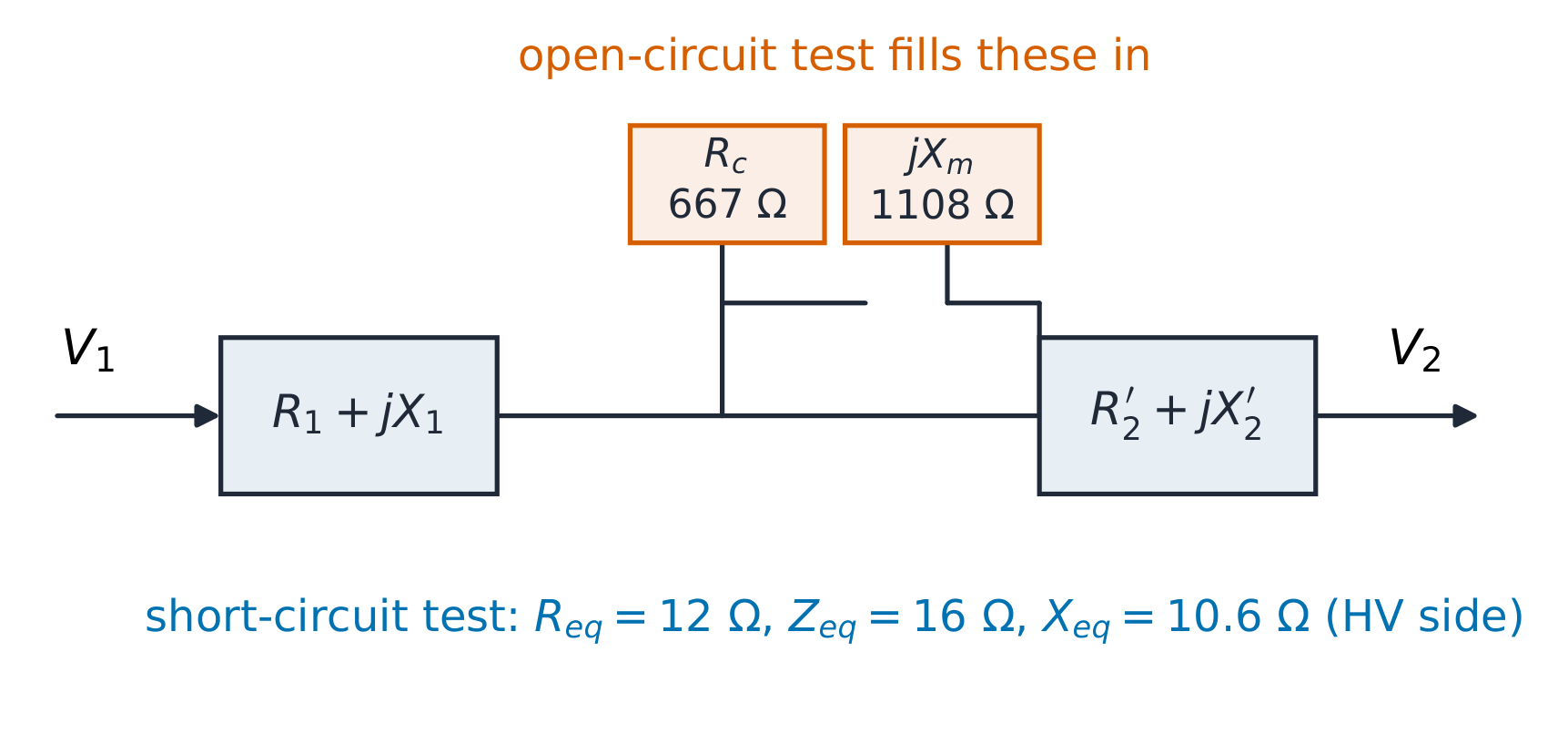
The power drawn in the open-circuit test is almost all core loss.
Difficulty 1/5 · 100 coins + a small bonus on first completion today
With no load, only the small magnetising current flows, so the copper loss is negligible and the 240 W is core loss. The short-circuit test is the opposite.
Worked example: efficiency
- At full load and unity power factor, 10 kVA gives $\eta = \dfrac{10\,000}{10\,000 + 240 + 300} = 94.9\%$. At power factor 0.8 the output is 8000 W and $\eta = 93.7\%$.
- Efficiency peaks where copper loss equals core loss: at $\sqrt{240/300} = 0.894$ of full load.
The same 10 kVA transformer (core loss 240 W, full-load copper loss 300 W) runs at half load, unity power factor. What is its efficiency, in %? Give 1 decimal place.
Difficulty 2/5 · 140 coins + a small bonus on first completion today
Copper loss scales with current squared: 300 × 0.25 = 75 W. $\eta = 5000/(5000 + 240 + 75) = 94.1\%$.
Three common slips
- Forgetting $\mu_{0}$. $\mu = \mu_{0}\mu_{r}$; leaving out $\mu_{0}$ is an error of about a million.
- Mixing sides. Moving an impedance across a transformer multiplies it by the turns ratio squared.
- Ignoring the gap. A gap as thin as a hair can hold four fifths of the reluctance.
A transformer has 100 W core loss and 400 W copper loss at full load. At what fraction of full load is it most efficient?
Difficulty 2/5 · 140 coins + a small bonus on first completion today
Peak efficiency is where $x^{2} \times 400 = 100$, so $x = \sqrt{100/400} = 0.5$.
Recap
- $F = NI$, $\Phi = F/R_{m}$, $R_{m} = l/(\mu A)$; keep $B$ under about 1.5 T.
- Open circuit gives the core branch; short circuit gives the copper branch.
- Efficiency peaks where copper loss equals core loss.