ADC, DAC and sensors
Introduced| English | Meaning |
|---|---|
| resolution/ˌrezəˈluːʃn/ | The smallest distinguishable change; in an ADC this concerns quantisation steps, while in spectrum analysis it concerns separating frequency components. |
| LSB | Least significant bit: the rightmost bit, with the smallest place value. |
| ADC/ˌeɪ diː ˈsiː/ | Analogue-to-digital converter: a circuit that turns a voltage into a binary number. |
| DAC/ˌdiː eɪ ˈsiː/ | A digital-to-analogue converter producing an analogue electrical output from a digital code. |
Volts in, numbers out
- The world speaks in volts; the CPU speaks in numbers. The node's temperature reading is only as good as its converter and its wiring.
- Errors here are quiet: the code runs, the number looks fine, and it is wrong.
Resolution: one LSB
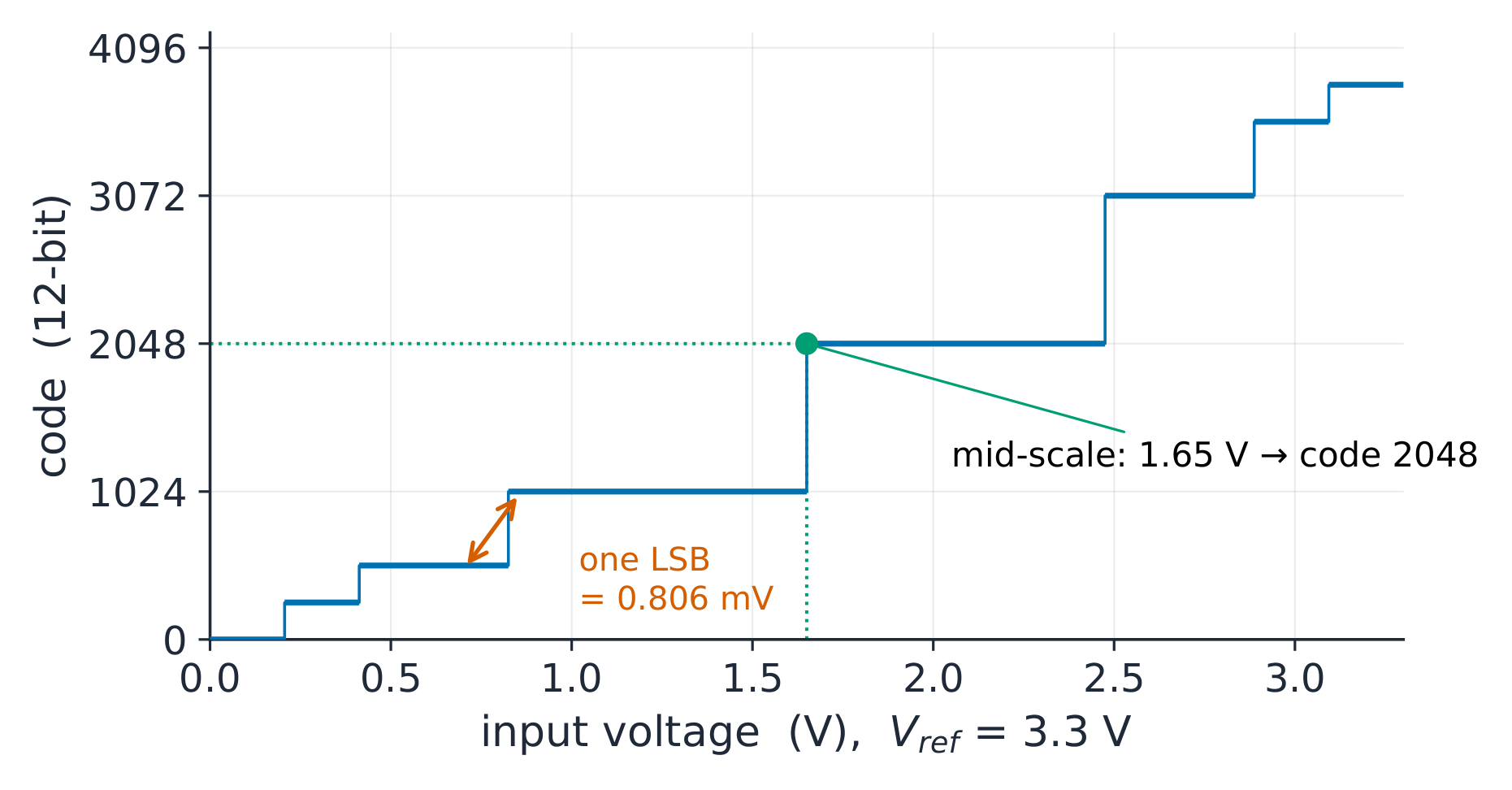
- An ADC 模数转换器 turns a voltage into a code. An N-bit converter on a reference $V_{\text{ref}}$ has a resolution 分辨率 of one LSB 最低有效位: $V_{\text{ref}}/2^{N}$.
- Each code owns a band one LSB wide. Reconstructing the input at the band midpoint gives at most half an LSB of ideal quantisation error within the input range. More bits means finer steps.
An 8-bit ADC uses a 3.3 V reference. What is one LSB, in mV? Give 1 decimal place.
Difficulty 2/5 · 140 coins + a small bonus on first completion today
$3.3/2^{8} = 3.3/256 = 12.9$ mV. Each extra bit halves the step.
From voltage to code
- The code is $\left\lfloor \dfrac{V_{\text{in}}}{V_{\text{ref}}} \times 2^{N} \right\rfloor$, so half of $V_{\text{ref}}$ reads $2^{N-1}$.
- A DAC 数模转换器 works in reverse: writing 2048 to a 12-bit DAC on 3.3 V gives 1.650 V.
A 12-bit ADC with a 3.3 V reference reads 0.5 V. What code does it give?
Difficulty 2/5 · 140 coins + a small bonus on first completion today
$0.5/3.3 \times 4096 = 620.6$, and the code is the whole number below: 620.
You write 1024 to a 12-bit DAC on a 3.3 V reference. What voltage comes out, in V? Give 3 decimal places.
Difficulty 2/5 · 140 coins + a small bonus on first completion today
$1024/4096 \times 3.3 = 0.825$ V, a quarter of the reference.
Worked example: the 12-bit sensor
- At $V_{\text{ref}} = 3.3$ V, one LSB is $3.3/4096 = 0.806$ mV, and 1.65 V reads 2048.
- To resolve 0.1 °C at 10 mV per °C the node needs 1 mV steps. 12 bits (0.806 mV) pass; 10 bits (3.22 mV) fail.
A sensor gives 10 mV per °C and must resolve 0.1 °C on a 3.3 V reference. What is the smallest ADC that works?
Difficulty 1/5 · 100 coins + a small bonus on first completion today
0.1 °C is 1 mV, so the step must be at most 1 mV. 11 bits gives 1.61 mV and fails; 12 bits is the first that passes.
The sampling capacitor
- Inside the ADC, a small capacitor (about 7 pF) charges through the source resistance before each conversion.
- Settling to half an LSB needs a sampling time of at least $R_{\text{source}}\,C \ln(2^{N+1})$.
Worked example: the source-impedance trap
- For a 50 kΩ source on 12 bits: $50\,000 \times 7\text{ pF} \times 9.01 \approx 3.2$ µs. This is a full-scale-step estimate for this simple RC model.
- With a 1 µs window, the same bound allows only 16 kΩ. Choose the longer window, or lower the divider resistors.
Fine ADC steps need time for the sample to settle
$V_{error}=\Delta V e^{-t_s/(RC)},\quad t_s\ge RC\max[0,\ln(2^{N+1}\Delta V/V_{ref})]$
Start with the worked 50 kΩ source and 7 pF sampling capacitor on a 12-bit ADC. A 3.2 µs acquisition window meets the half-LSB settling budget; a 1 µs window misses it. Lower the source resistance or lengthen acquisition, then compare 16 bits to see why finer voltage steps demand a smaller remaining error. Separate acquisition error from quantisation.
A 10 kΩ source drives a 12-bit ADC with a 7 pF sampling capacitor. What is the shortest sampling time, in µs? Use ln(2^13) = 9.01 and give 2 decimal places.
Difficulty 2/5 · 140 coins + a small bonus on first completion today
$10\,000 \times 7 \times 10^{-12} \times 9.01 = 0.63$ µs. A 50 kΩ source needs five times as long.
Three common slips
- Bits without the reference. 0.806 mV is true only at 3.3 V.
- ADC as a voltmeter. Its sampling current loads a high-impedance sensor, as the RC bound shows.
- Averaging to buy bits. 16 samples of random noise gain about 2 bits, but no average removes a fixed offset.
Averaging N samples of random noise gains half a bit for each doubling of N. How many bits do 64 samples gain?
Difficulty 2/5 · 140 coins + a small bonus on first completion today
64 is $2^{6}$, six doublings, so $6 \times 0.5 = 3$ bits. Averaging cannot remove a fixed offset.
A 12-bit ADC always measures to 0.806 mV, whatever its reference voltage.
Difficulty 1/5 · 100 coins + a small bonus on first completion today
One LSB is $V_{\text{ref}}/4096$. 0.806 mV is true only at 3.3 V; at 2.5 V the step is 0.61 mV.
Recap
- One LSB $= V_{\text{ref}}/2^{N}$; the requirement picks N.
- A code identifies a one-LSB input band; midpoint reconstruction has a half-LSB error bound.
- Sampling time $\ge R C \ln(2^{N+1})$ trades source resistance against speed.