Laplace transform and system functions
Introduced| English | Meaning |
|---|---|
| poles and zeros | Singularities and zeros of a reduced system function in its complex variable, such as s or z. |
| system function | A transform-domain input-output relation for a linear system, defined with zero initial conditions and the required convergence assumptions. |
| region of convergence | region of convergence |
| frequency response | How a system's gain and phase change with the frequency of a sinusoidal input. |
Read a circuit from a few dots
- A tone control's behaviour (how fast it settles, whether it rings, which frequencies it boosts) can be read from a handful of dots on a plane.
- Those dots are the poles and zeros of the system function. This lesson reads time and frequency behaviour from them.
The system function
- The system function 系统函数 is $H(s) = \dfrac{Y(s)}{X(s)}$, the Laplace transform of the impulse response $h(t)$.
- For circuits, $H(s)$ is a ratio of polynomials. Factor it into poles and zeros 零极点: values of $s$ where $H$ blows up or vanishes.
H(s) = (s + 3)/((s + 1)(s + 5)). Where are the poles and zero?
Difficulty 1/5 · 100 coins + a small bonus on first completion today
Poles make the denominator zero ($s = -1, -5$); the zero makes the numerator zero ($s = -3$).
Poles are the natural modes
- Each pole $p$ adds a term $e^{pt}$ to the response. A real negative pole decays; a complex pair rings; a pole in the right half-plane grows.
- A causal system is stable when every pole lies in the open left half-plane. The region of convergence 收敛域 (ROC) records which side of the poles the transform converges on, and so whether $h$ is causal.
Match each pole position to the mode it adds.
Difficulty 2/5 · 140 coins + a small bonus on first completion today
A pole $p$ contributes $e^{pt}$: the real part sets growth or decay, the imaginary part the ringing frequency.
H(s) = 1/(s − 2) with ROC Re(s) > 2 describes
Difficulty 1/5 · 100 coins + a small bonus on first completion today
An ROC to the right of the pole means $h(t) = e^{2t}u(t)$, causal but growing. A causal system with a right-half-plane pole is unstable.
Worked example: the step response
- $H(s) = \dfrac{1}{s + 1}$ driven by a step $\dfrac{1}{s}$: $Y(s) = \dfrac{1}{s(s + 1)} = \dfrac{1}{s} - \dfrac{1}{s + 1}$.
- So $y(t) = 1 - e^{-t}$: the same answer as the convolution, by three lines of partial fractions.
H(s) = 4/(s + 2) is driven by a unit step. What is the final value of y(t)?
Difficulty 2/5 · 140 coins + a small bonus on first completion today
$Y(s) = \dfrac{4}{s(s + 2)} = \dfrac{2}{s} - \dfrac{2}{s + 2}$, so $y(t) = 2 - 2e^{-2t} \to 2$: the DC gain $H(0) = 2$.
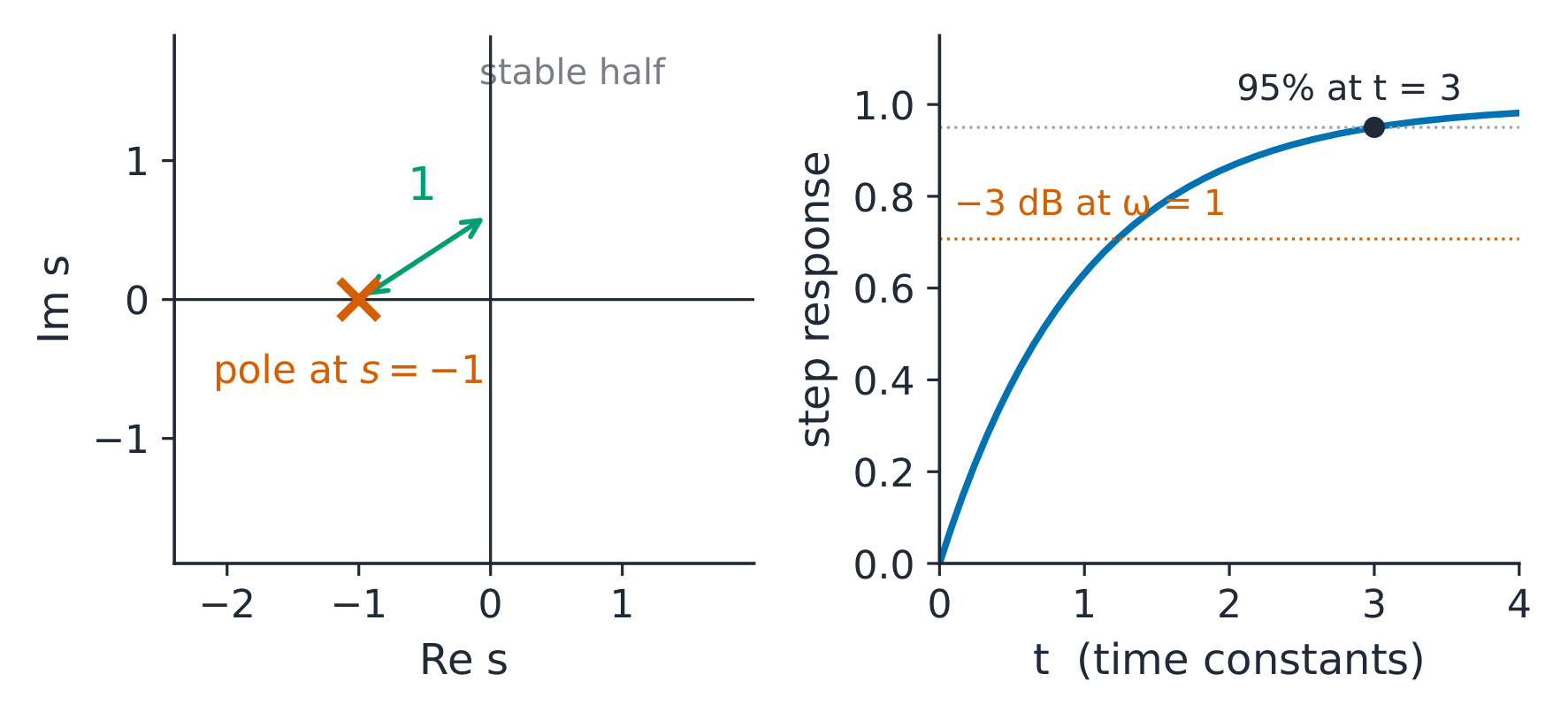
One pole, three readings
- The pole at $s = -1$ is the $e^{-t}$ decay, time constant 1 s; the step response reaches 95% at $t = 3$ s.
- On the frequency response 频率响应 $H(j\omega)$, $|H(j1)| = \dfrac{1}{\sqrt{2}} = 0.707$: the −3 dB point is at the pole's distance from the origin, with phase −45°.
H(s) = 1/(s + 1). At ω = 1 rad/s, |H(jω)| is
Difficulty 1/5 · 100 coins + a small bonus on first completion today
$|H(j1)| = \dfrac{1}{|1 + j|} = \dfrac{1}{\sqrt{2}}$. A lone pole puts the −3 dB point at its distance from the origin.
Worked example: a tone control
- $H(s) = \dfrac{s^{2} + 2s + 100}{(s + 1)(s + 10)}$. Poles at −1 and −10, both in the left half-plane: stable. DC gain $\dfrac{100}{10} = 10$, a 20 dB bass lift; high-frequency gain 1.
- The zeros $-1 \pm j9.95$ sit close to the imaginary axis near 10 rad/s, so they carve a notch there: $|H(j10)| \approx 0.14$, about −17 dB.
Move the zeros; watch the tone-control curve change
$H(s)=\frac{s^2+2\zeta\omega_0s+\omega_0^2}{(s+1)(s+10)}$
Start with the worked tone control, whose zeros are at −1 ± j9.95 and whose fixed poles are at −1 and −10. Its gain near 10 rad/s is about 0.14, while its DC gain is 10. Move the zeros farther from the imaginary axis to soften the dip, or onto it for an exact null. The causal system stays stable because the poles and ROC stay fixed. The distance products connect the s-plane directly to the gain curve.
The tone control (s² + 2s + 100)/((s+1)(s+10)) has DC gain —
Difficulty 1/5 · 100 coins + a small bonus on first completion today
Put $s = 0$: $\dfrac{100}{1 \times 10} = 10$, a 20 dB bass lift. At high frequency the $s^{2}$ terms dominate and the gain tends to 1.
Three common slips
- Poles without the ROC. $\dfrac{1}{s + 1}$ with an ROC to the left of −1 is anti-causal and unstable.
- Applying the distance rule everywhere. The −3 dB point equals the pole distance only for a lone first-order pole.
- Forgetting the zeros. Zeros near the $j\omega$ axis carve notches the poles alone do not predict.
A causal system with poles at −2 and +0.1 is stable, because most of its poles are in the left half-plane.
Difficulty 1/5 · 100 coins + a small bonus on first completion today
One right-half-plane pole is enough. The mode $e^{0.1t}$ grows without limit, however slowly.
Recap
- $H(s) = \dfrac{Y(s)}{X(s)}$; poles set the natural modes, zeros shape the response.
- Causal and stable: all poles in the left half-plane.
- Put $s = j\omega$ for the frequency response.