Production possibility curve diagrams
Introduced| English | Meaning |
|---|---|
| production possibility curve/prəˈdʌkʃn ˌpɒsəˈbɪlɪti kɜːv/ | A boundary showing the maximum feasible combinations of two outputs using given resources and technology efficiently. |
| trade-off/treɪd ɒf/ | A choice that involves giving up some benefit or objective to gain another. |
| efficient/ɪˈfɪʃənt/ | Using resources without avoidable waste, or allocating them to maximise the relevant net benefit. |
| unemployed/ʌnemˈplɔɪd/ | unemployed |
| economic growth/ˌiːkəˈnɒmɪk ɡrəʊθ/ | An increase in an economy's real output of goods and services over time. |
| technology/tekˈnɒlədʒi/ | The application of knowledge, methods and tools to practical tasks. |
More guns or more butter?
- A country can use its resources to make weapons or consumer goods — but with limited resources, more of one means less of the other.
- The production possibility curve 生产可能性曲线 (PPC) draws this trade-off 取舍.
Reading the PPC
- The PPC shows the maximum combinations of two goods an economy can make using all its resources fully.
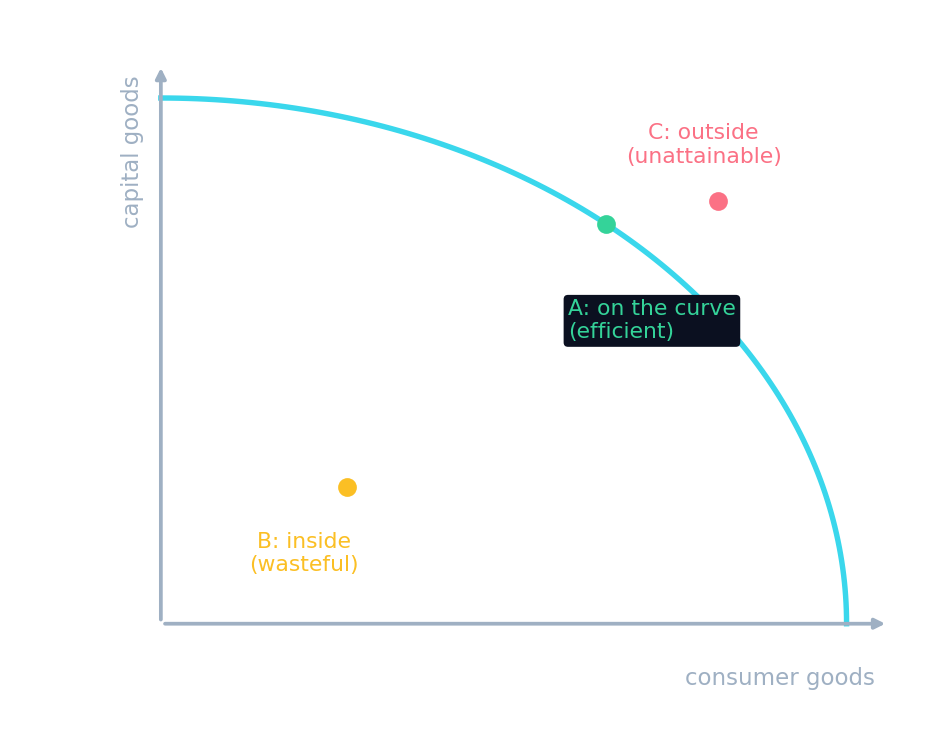
On the curve = efficient 有效率的; inside = resources wasted; beyond = impossible with current resources.
The production possibility curve
Frontier = maximum efficient combinations
The PPF is concave — a trade-off between two goods.
A point on the PPC represents an economy that is:
Difficulty 1/5 · 100 coins + a small bonus on first completion today
On the curve = full, efficient use; inside = waste; beyond = unattainable.
Opportunity cost on the curve
- Moving along the PPC to make more of one good means giving up some of the other — that's the opportunity cost.
- A point inside the curve means resources are unemployed 闲置的 or wasted.
A point inside the PPC shows:
Difficulty 1/5 · 100 coins + a small bonus on first completion today
Inside the curve, resources are not fully used.
Moving along the PPC to produce more of one good has no opportunity cost.
Difficulty 1/5 · 100 coins + a small bonus on first completion today
False. On the PPC all resources are used, so producing more of one good means giving up some of the other: that is the opportunity cost.
Shifts: economic growth 经济增长
- The whole curve shifts outward with economic growth — more or better resources, or new technology 技术.
- It shifts inward if resources are lost (war, disaster).
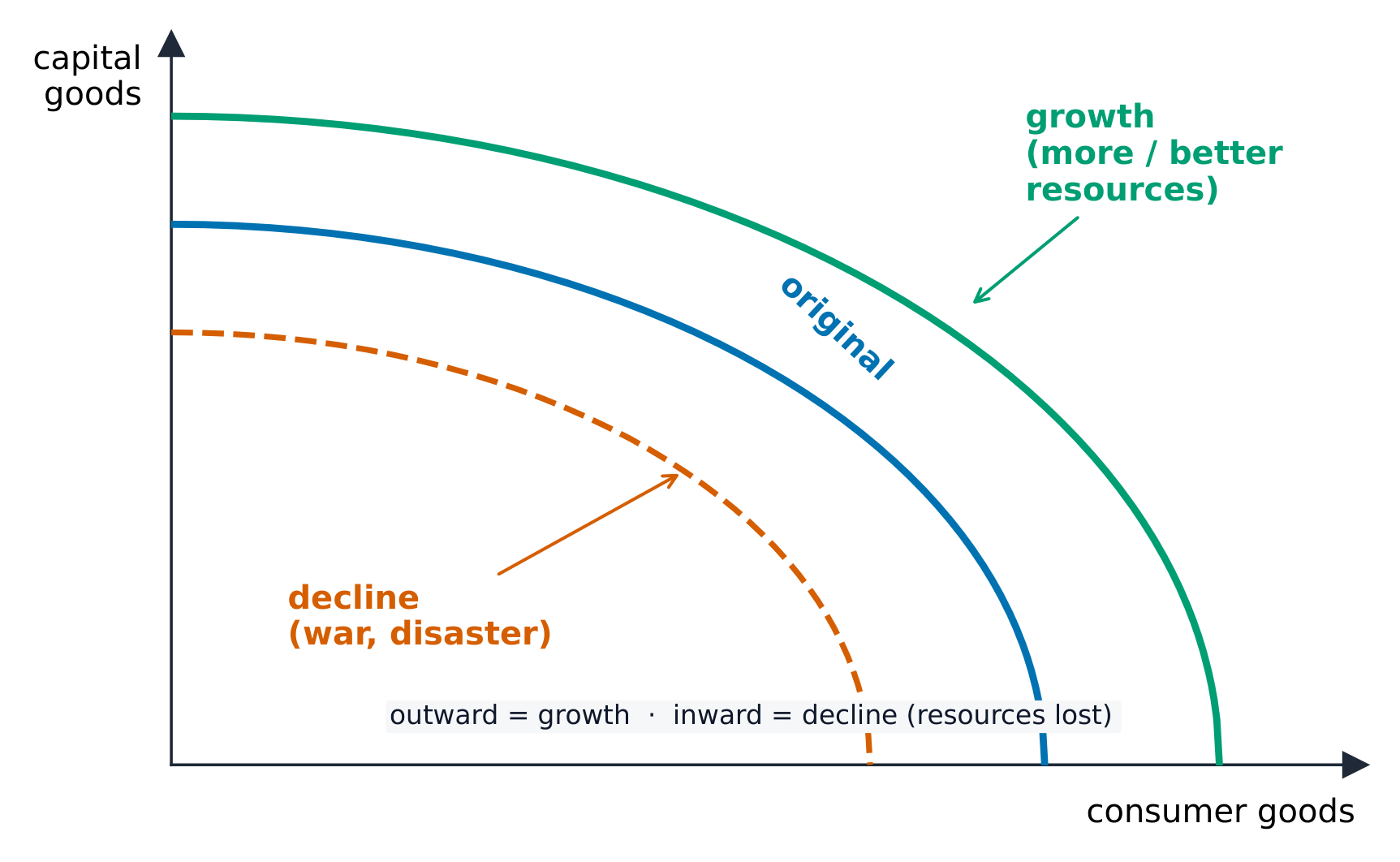
Economic growth shifts the whole PPC outward; losing resources shifts it inward
Moving along ≠ shifting the curve. Changing the mix of goods is a move along the PPC; only more/better resources shift the whole curve outward.
Which shifts the whole PPC outward?
Difficulty 1/5 · 100 coins + a small bonus on first completion today
More/better resources or technology shift the curve out; changing the mix is a move along it.
Economic growth shifts the PPC ______.
Difficulty 1/5 · 100 coins + a small bonus on first completion today
More capacity moves the whole curve outward.
You've got it
- the PPC shows max output combinations: on = efficient, inside = wasteful, beyond = unattainable
- moving along it has an opportunity cost
- economic growth shifts the whole curve outward
Write from 2 butter per gun
- An economy can move from 100 butter and 0 guns to 80 butter and 10 guns.
- Find the opportunity cost of one gun.
Moving from 100 butter and 0 guns to 80 butter and 10 guns, what is the opportunity cost of one gun, in butter?
20 divided by 10 is 2.
What is the opportunity cost of one gun?
Difficulty 1/5 · 100 coins + a small bonus on first completion today
20 butter divided by 10 guns is 2 butter per gun. Other options — 20 butter (the whole loss); 0 (because the economy can make both).