Group VII properties
Introduced| English | Meaning |
|---|---|
| Group VII/ɡruːp ˈsevn/ | Group VII |
| halogens/ˈhælədʒnz/ | Elements in Group VII in this course’s notation, or Group 17 in IUPAC numbering, including chlorine, bromine and iodine. |
| diatomic molecules/ˌdaɪəˈtɒmɪk ˈmɒlɪkjuːlz/ | diatomic molecules |
| displace/dɪˈspleɪs/ | To replace another element in a compound during a chemical reaction. |
The reactive Group VII 第七族 non-metals
- Chlorine bleaches, iodine stains — the Group VII elements (the halogens 卤素) are reactive non-metals.
- They show clear trends down the group.
Group VII trend lab
Follow halogens down the group and watch reactivity decrease.
How many electrons are in the outer shell of a Group VII element?
Difficulty 2/5 · 140 coins + a small bonus on first completion today
Halogens have seven outer electrons.
Halogens gain one electron to form ions with a charge of:
Difficulty 1/5 · 100 coins + a small bonus on first completion today
Gaining one electron gives a −1 ion.
Halogens exist as molecules made of two atoms, described as ______.
Difficulty 1/5 · 100 coins + a small bonus on first completion today
Cl₂, Br₂ and I₂ are diatomic.
Properties of the halogens
- They exist as diatomic molecules 双原子分子 (Cl₂, Br₂, I₂).
- They have seven outer electrons and gain one to form −1 ions.
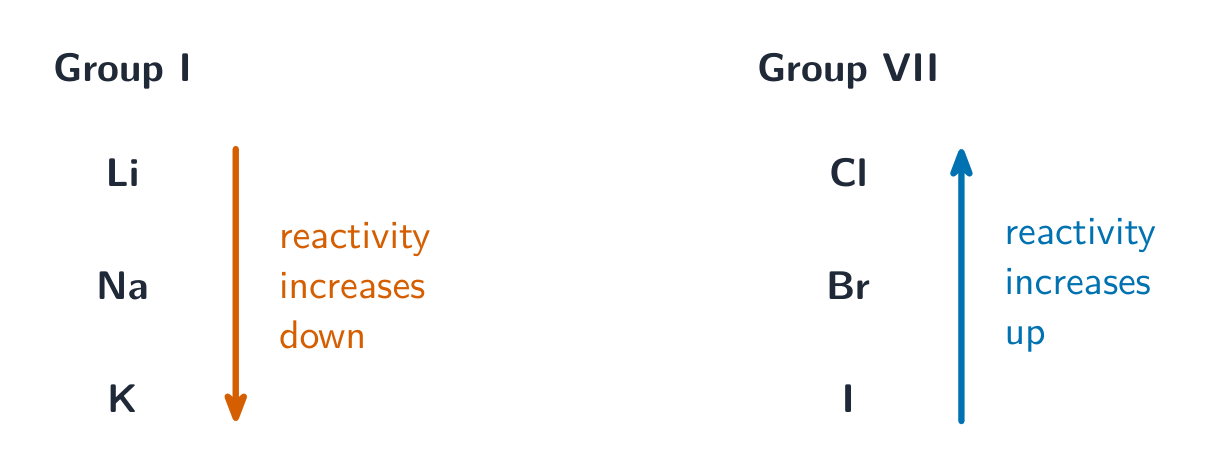
Group I gets more reactive down the group; Group VII gets less reactive down
Going down Group VII, reactivity:
Difficulty 1/5 · 100 coins + a small bonus on first completion today
Halogens get less reactive down the group.
Trends down the group
- Going down: colour gets darker and they become less reactive.
- The melting and boiling points increase (fluorine gas → bromine liquid → iodine solid).
A more reactive halogen will:
Difficulty 1/5 · 100 coins + a small bonus on first completion today
More reactive halogens displace less reactive ones.
Displacement reactions
- A more reactive halogen will displace 置换 a less reactive one from its salt.
- For example, chlorine displaces bromine from a bromide solution.
Worked example. Add chlorine to potassium bromide solution. Chlorine is more reactive, so it displaces the bromine: the solution turns orange as bromine is released. Reactivity decreases down the group.

Chlorine is more reactive, so it displaces bromine; the released bromine turns the colourless solution orange
You've got it
- Group VII (halogens) are diatomic, with seven outer electrons (form −1 ions)
- down the group: darker colour, less reactive, higher melting/boiling points
- a more reactive halogen displaces a less reactive one from its salt
Write from chlorine displacing bromine
- Chlorine gas is bubbled into potassium bromide solution.
- Both halogens have seven outer electrons. Chlorine is above bromine in the group.
What happens?
A more reactive halogen displaces a less reactive halide.
What does chlorine do to potassium bromide?
Difficulty 1/5 · 100 coins + a small bonus on first completion today
Chlorine is the more reactive halogen.