How DNA makes proteins
Introduced| English | Meaning |
|---|---|
| bases/ˈbeɪsɪz/ | Nitrogen-containing components of nucleotides, such as adenine, cytosine, guanine, thymine and uracil. |
| double helix/ˈdʌbl ˈhiːlɪks/ | The structure formed by two strands coiled around a common axis, as in DNA. |
| base sequence/beɪs ˈsiːkwəns/ | The order of nucleotide bases along a strand of DNA or RNA. |
| amino acid/əˈmiːnəʊ ˈæsɪd/ | An organic molecule containing amino and carboxyl groups; these molecules join to form proteins. |
Reading the genetic code
- DNA holds a code — but how does that code actually build a protein?
- The answer lies in DNA's elegant structure and the order of its bases 碱基.
The shape of a DNA molecule is a:
Difficulty 1/5 · 100 coins + a small bonus on first completion today
DNA is a double helix — two twisted strands.
The structure of DNA
- DNA is a double helix 双螺旋: two strands twisted together.
- The strands are linked by pairs of bases, like rungs on a twisted ladder.
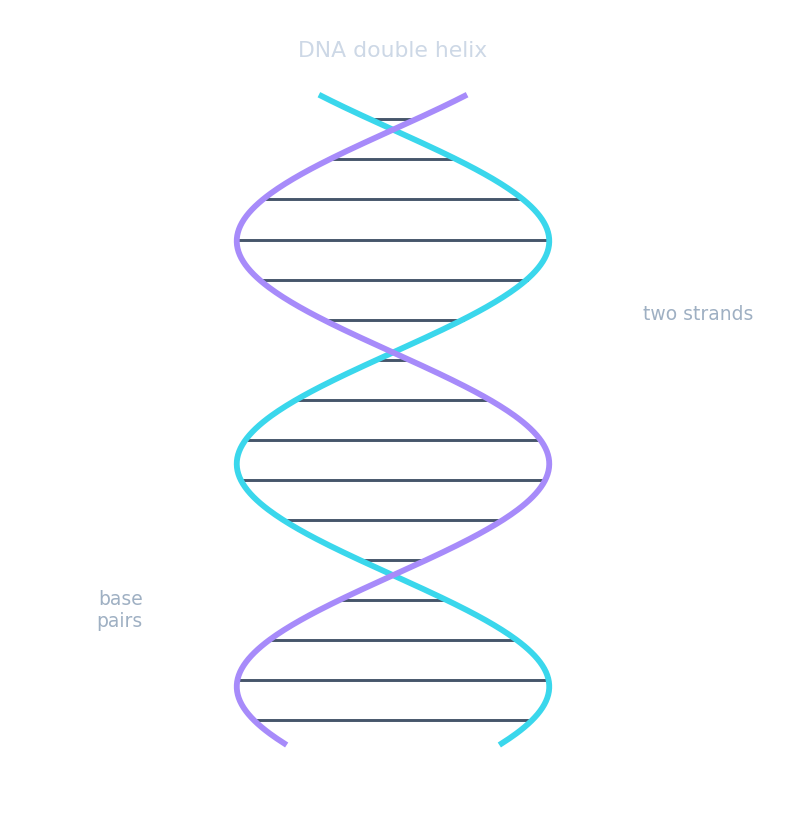
DNA is two strands held together by paired bases — a twisted ladder.
From gene to protein
Step through the central dogma: the DNA template is transcribed into mRNA by base pairing (A→U, T→A, G→C, C→G), then read in codons and translated into a chain of amino acids.
In DNA, base A always pairs with:
Difficulty 1/5 · 100 coins + a small bonus on first completion today
A pairs with T; C pairs with G.
The number of genes on a chromosome, not the order of bases, determines the protein made.
Difficulty 1/5 · 100 coins + a small bonus on first completion today
False. The order of bases in a gene sets the order of amino acids, and so determines which protein is made.
In DNA, base C always pairs with base ______.
Difficulty 1/5 · 100 coins + a small bonus on first completion today
C-G and A-T are the base pairs.
The base sequence 碱基序列
- There are four bases (A, T, C, G), and they pair up: A with T, C with G.
- The order of bases along a gene is the code.
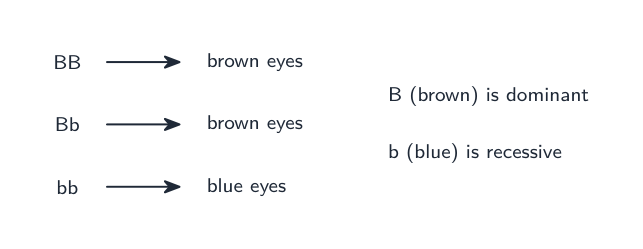
A dominant allele shows with one copy; a recessive needs two
How many bases code for one amino acid?
Difficulty 1/5 · 100 coins + a small bonus on first completion today
A triplet of three bases codes for one amino acid.
From code to protein
- Each group of three bases codes for one amino acid 氨基酸.
- The order of bases sets the order of amino acids, which determines the protein made.
Worked example. A gene's base sequence is copied and read three bases at a time. Each triplet adds one amino acid to a growing chain. The finished chain folds into a specific protein — say, an enzyme.
You've got it
- DNA is a double helix of two strands joined by base pairs
- bases pair A-T and C-G; the order of bases is the code
- every three bases code for one amino acid, building a protein
Write from base pairs
- One strand has the base A.
- The opposite strand pairs with it.
Which base pairs with A, which pairs with C, and how many bases code for one amino acid?
The pairing rules keep the code readable on both strands.
Which base pairs with adenine?
Difficulty 1/5 · 100 coins + a small bonus on first completion today
A pairs with T, and C pairs with G.