Sex hormones in humans
Introduced| English | Meaning |
|---|---|
| sex hormones/seks ˈhɔːməʊnz/ | sex hormones |
| menstrual cycle/ˈmenstruːəl ˈsaɪkl/ | The roughly monthly cycle of ovulation and womb-lining changes in women. |
| oestrogen/ˈiːstrədʒn/ | A group of steroid hormones involved in reproductive development and regulation of the menstrual cycle. |
| ovulation/ˌɒvjʊˈleɪʃn/ | The release of an egg cell from an ovary. |
| progesterone/prəʊˈdʒestərəʊn/ | A hormone that helps maintain the uterine lining and supports pregnancy. |
The hormones of growing up
- At puberty, the body changes dramatically — driven by sex hormones 性激素.
- These same hormones control the monthly menstrual cycle 月经周期.
Testosterone is produced mainly in the:
Difficulty 1/5 · 100 coins + a small bonus on first completion today
Testosterone comes from the testes.
Oestrogen causes female puberty changes and is made in the:
Difficulty 1/5 · 100 coins + a small bonus on first completion today
The ovaries produce oestrogen.
Testosterone and oestrogen 雌激素
- Testosterone (from the testes) causes male puberty changes (deeper voice, body hair).
- Oestrogen (from the ovaries) causes female puberty changes and controls the menstrual cycle.
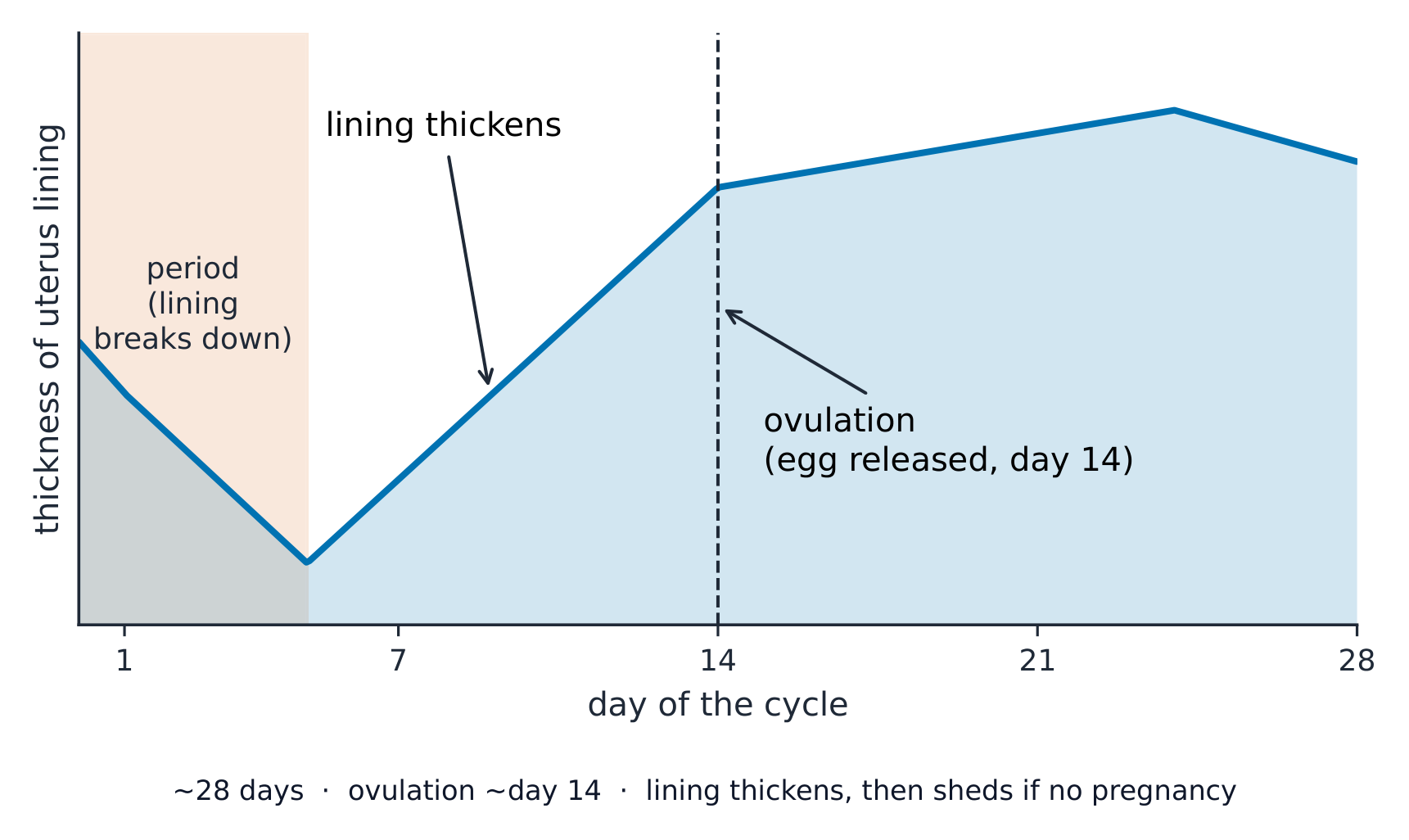
Hormones drive the menstrual cycle each month
The menstrual cycle
Hormones control a roughly monthly cycle that prepares the uterus for a possible pregnancy.
The release of an egg during the menstrual cycle is called:
Difficulty 1/5 · 100 coins + a small bonus on first completion today
Ovulation is the release of an egg, around day 14.
If the egg is not fertilised, the uterus lining breaks down (a period).
Difficulty 1/5 · 100 coins + a small bonus on first completion today
The lining is shed if there is no pregnancy.
The roughly monthly cycle controlled by sex hormones is the ______ cycle.
Difficulty 1/5 · 100 coins + a small bonus on first completion today
It lasts about 28 days.
The menstrual cycle
- About every 28 days: the uterus lining thickens, an egg is released (ovulation 排卵), and if no fertilisation occurs the lining breaks down (a period).
- Hormones including oestrogen and progesterone 孕酮 control these stages.
Pregnancy and hormones
- If the egg is fertilised, progesterone keeps the uterus lining in place.
- Hormone levels then stop the cycle during pregnancy.
Worked example. Around day 14 of the cycle, a surge of hormones triggers ovulation — the release of an egg. This is when fertilisation is most likely if sperm are present.
You've got it
- testosterone drives male puberty; oestrogen drives female puberty
- the menstrual cycle (≈28 days): lining thickens → ovulation → period (if no fertilisation)
- oestrogen and progesterone control the cycle and maintain pregnancy
Write from a cycle with no fertilisation
- An egg was released.
- No sperm fertilised it.
What happens to the uterus lining, and which hormones run the cycle?
No embryo means the thickened lining is not kept.
If an egg is not fertilised, what happens to the uterus lining?
Difficulty 1/5 · 100 coins + a small bonus on first completion today
The period is the lining being lost.