What enzymes are
Introduced| English | Meaning |
|---|---|
| enzymes/ˈenzaɪmz/ | Biological catalysts that increase reaction rates without being used up overall. |
| catalysts/ˈkætəlɪsts/ | A substance that increases a reaction rate without being used up overall. |
| substrate/ˈsʌbstreɪt/ | A substance on which an enzyme acts. |
| active site/ˈæktɪv saɪt/ | The region of an enzyme where a substrate binds and the reaction is catalysed. |
| specific/spəˈsɪfɪk/ | Acting on or binding to a particular target or type, rather than a wide range of alternatives. |
| products/ˈprɒdʌkts/ | The substances formed by a chemical reaction. |
How does washing powder remove a protein stain?
- Some washing powders contain enzymes 酶 that help break down stains. A protease acts on protein; it does not digest every kind of stain equally well.
- Enzymes are biological catalysts 催化剂: they speed up reactions without being used up. Their shape helps explain which reactions they catalyse.
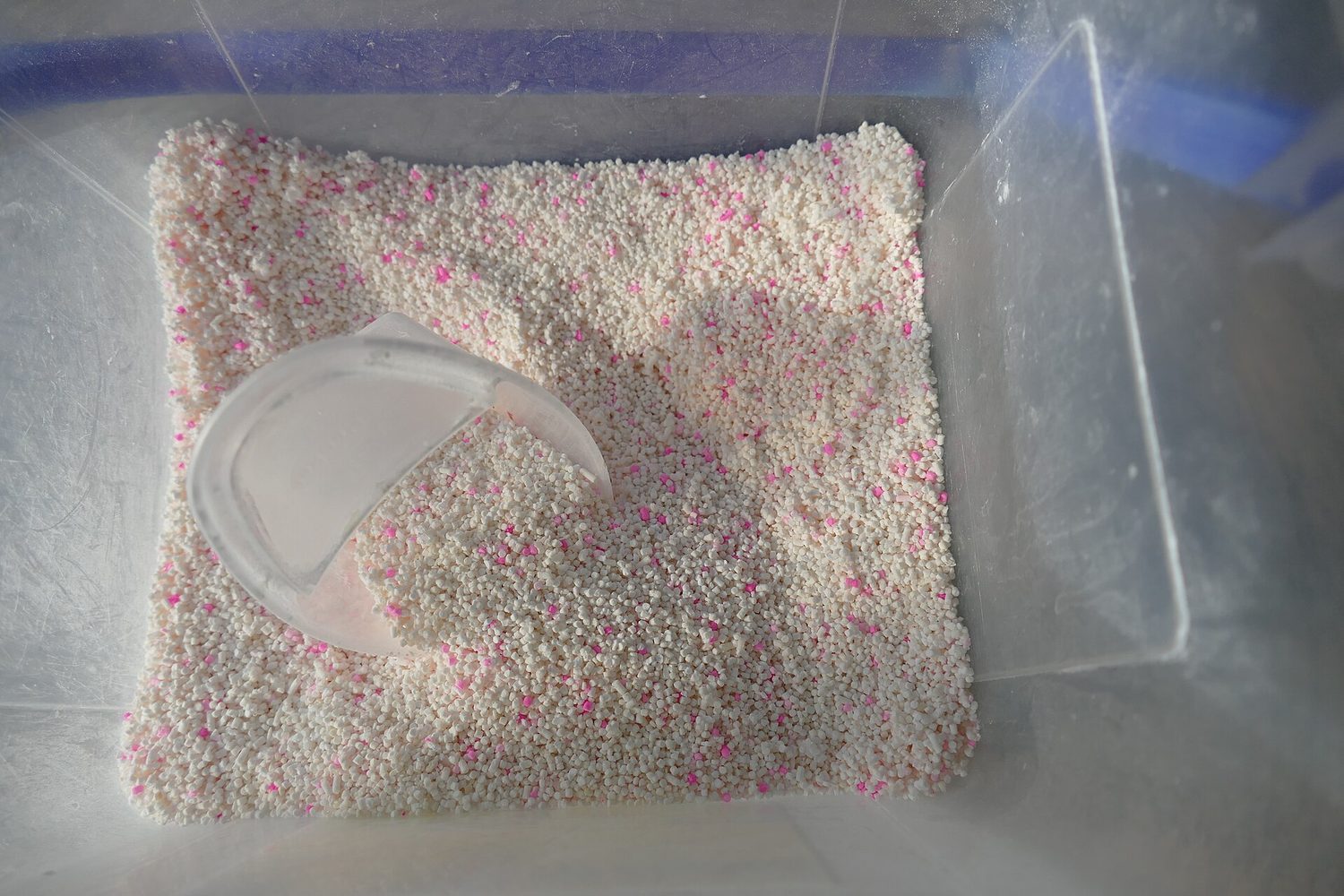
Different stain materials need enzymes with different specificities.
A catalyst can be used again
- At this level, enzymes are described as proteins that function as biological catalysts. They increase reaction rate and remain available after the reaction.
- The reacting substance is the substrate 底物. More enzyme is not made simply because a reaction occurs; the original molecules can catalyse further reactions.
An enzyme is a biological catalyst, which means it:
Difficulty 1/5 · 100 coins + a small bonus on first completion today
Catalysts speed up reactions and are reusable.
Enzymes are made of:
Difficulty 1/5 · 100 coins + a small bonus on first completion today
Enzymes are proteins.
Match a substrate to an active site
- The active site 活性位点 is the region where a substrate binds. Its complementary shape makes the enzyme specific 专一 to suitable substrates.
- In the lock-and-key model, the substrate fits like a key fitting a lock. This is a model of specificity, not a claim that enzymes are rigid metal objects or that all enzymes break molecules apart.
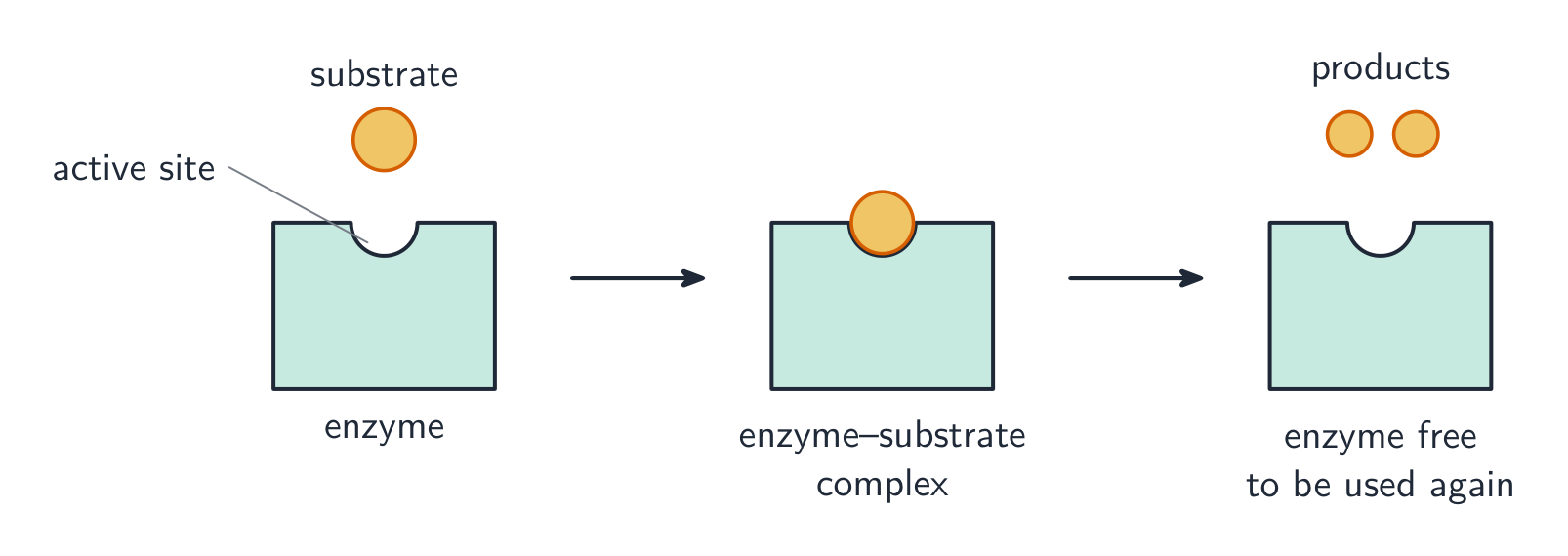
Follow the enzyme through the stages: it remains after the products leave.
The temperature effect is developed in the next lesson; first explain the normal reaction.
The part of an enzyme where the substrate binds is the:
Difficulty 1/5 · 100 coins + a small bonus on first completion today
The substrate fits into the active site.
Each enzyme can break down many different types of substrate.
Difficulty 1/5 · 100 coins + a small bonus on first completion today
False. Each enzyme is specific: only a substrate with a complementary shape fits its active site.
The model where only a matching substrate fits an enzyme is the ______-and-key model.
Difficulty 1/5 · 100 coins + a small bonus on first completion today
Lock-and-key explains enzyme specificity.
Follow binding, reaction and release
- A complementary substrate binds to the active site, forming an enzyme–substrate complex. The enzyme catalyses its reaction, and the products 产物 leave.
- The enzyme is not used up and its active site can bind another suitable substrate. Keep substrate, enzyme and product as three different roles.
Amylase catalyses the breakdown of starch to maltose. Starch is the substrate, maltose is the product and amylase is the enzyme. After products leave, amylase can act again; it does not become maltose.
What enzymes do
rate rises then plateaus
More substrate means a faster reaction — until the enzymes can't keep up.
Amylase catalyses starch breakdown to maltose. Which statement is correct?
Difficulty 1/5 · 100 coins + a small bonus on first completion today
Amylase is the enzyme; the substrate reacts and the products leave.
Describe one complete enzyme reaction cycle, from a free substrate to an enzyme ready to act again.
A complementary substrate binds to the active site, forming an enzyme–substrate complex. The reaction occurs, products leave, and the enzyme remains available for another substrate.
Make a prediction from specificity
- A protease breaks down proteins, whereas amylase acts on starch. A protein stain remaining after amylase treatment does not by itself show that the amylase has stopped working.
- To investigate specificity, compare suitable and unsuitable substrates under the same temperature and pH. Include a sample without enzyme so a change is not automatically attributed to the enzyme.
Do not say “the enzyme is used up” when a reaction stops. The substrate may have run out, or conditions may have changed. Specificity explains substrate choice; being a catalyst explains reuse.
Amylase does not remove a protein stain. What is the best next check before claiming it is inactive?
Difficulty 1/5 · 100 coins + a small bonus on first completion today
An unsuitable substrate is different from an inactive enzyme. Test a suitable substrate under controlled conditions.
Diagnose a reaction that stops
- Amylase and starch react under suitable conditions. The reaction stops when all the starch has been broken down; the enzyme has not been denatured.
- Predict what happens if more starch is added. Explain using the active site and the enzyme's role as a catalyst.
Amylase breaks down all the starch in a sample without being denatured. The reaction stops. Predict what happens if fresh starch is added under the same suitable conditions, and explain.
The reaction can start again because amylase is a catalyst and was not used up. Fresh starch binds to its complementary active site, reacts, and products are released. Running out of substrate explains the earlier stop; it does not show that the enzyme was consumed.
Explain choice and reuse separately
- An enzyme is a biological catalyst: it speeds a reaction without being used up.
- A complementary substrate binds at the active site, reacts and leaves as products.
- Specificity explains which substrate reacts; release of products leaves the enzyme available to act again.
Why does one enzyme usually act on one substrate?
Difficulty 1/5 · 100 coins + a small bonus on first completion today
The shape of the active site makes the enzyme specific.