Classifying living things
Introduced| English | Meaning |
|---|---|
| classify/ˈklæsɪfaɪ/ | To place organisms into groups according to shared features. |
| species/ˈspiːsiːz/ | A group of organisms whose members can usually interbreed to produce fertile offspring. |
| fertile/ˈfɜːtaɪl/ | fertile |
| binomial system/baɪˈnəʊmɪəl ˈsɪstəm/ | The naming system giving every species a genus name and a species name. |
| genus/ˈdʒenəs/ | A taxonomic group containing one or more closely related species. |
| kingdom/ˈkɪŋdəm/ | A broad taxonomic rank below domain and above phylum. |
| dichotomous key/daɪˈkɒtəməs kiː/ | dichotomous key |
Bringing order to millions
- Scientists have named over a million kinds of living thing — and there are millions more.
- To make sense of them, we classify 分类: sort them into groups by shared features.
Classification rank lab
Place examples at the right level in the biological hierarchy.
A species is a group of organisms that can:
Difficulty 1/5 · 100 coins + a small bonus on first completion today
Members of a species breed to give fertile offspring.
Members of the same species breed to produce ______ offspring.
Difficulty 1/5 · 100 coins + a small bonus on first completion today
Fertile offspring can themselves reproduce.
Species 物种 and naming
- A species is a group of organisms that can breed together to make fertile 可育的 offspring.
- Each species has a two-word Latin name (the binomial system 双名法): genus 属 then species, e.g. Homo sapiens.
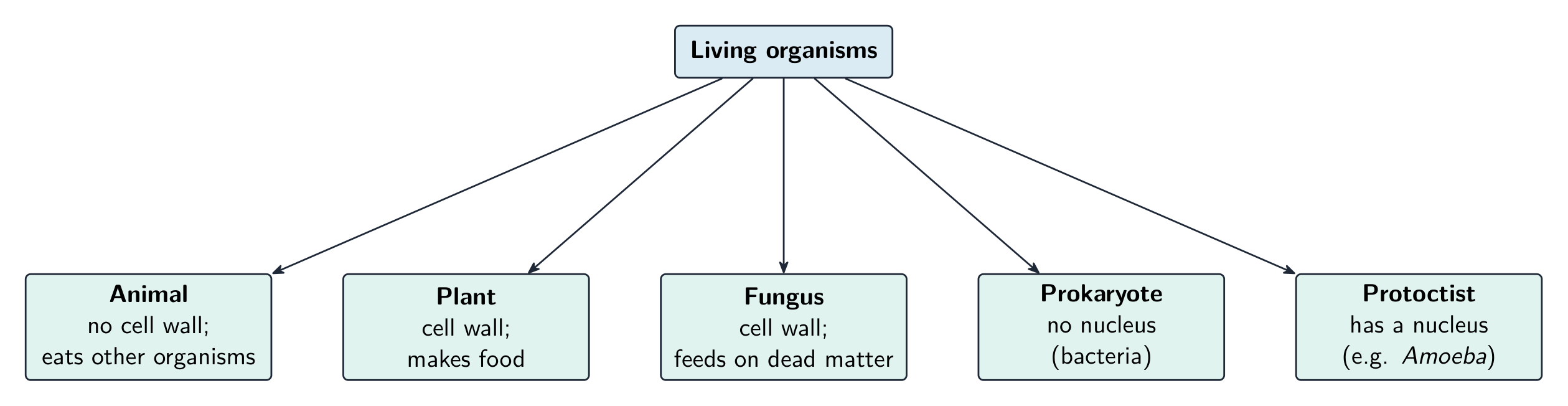
Living organisms are sorted into five kingdoms 界 by their main features
In the binomial system, the first word of the name is the:
Difficulty 1/5 · 100 coins + a small bonus on first completion today
The binomial is genus then species, e.g. Homo sapiens.
Put these classification groups in order from largest to smallest.
Difficulty 3/5 · 200 coins + a small bonus on first completion today
Kingdom → phylum → class → order → family → genus → species.
The classification hierarchy
- Organisms are sorted into ever-smaller groups: kingdom → phylum → class → order → family → genus → species.
- The more features two organisms share, the more groups they share — and the more closely related they are.
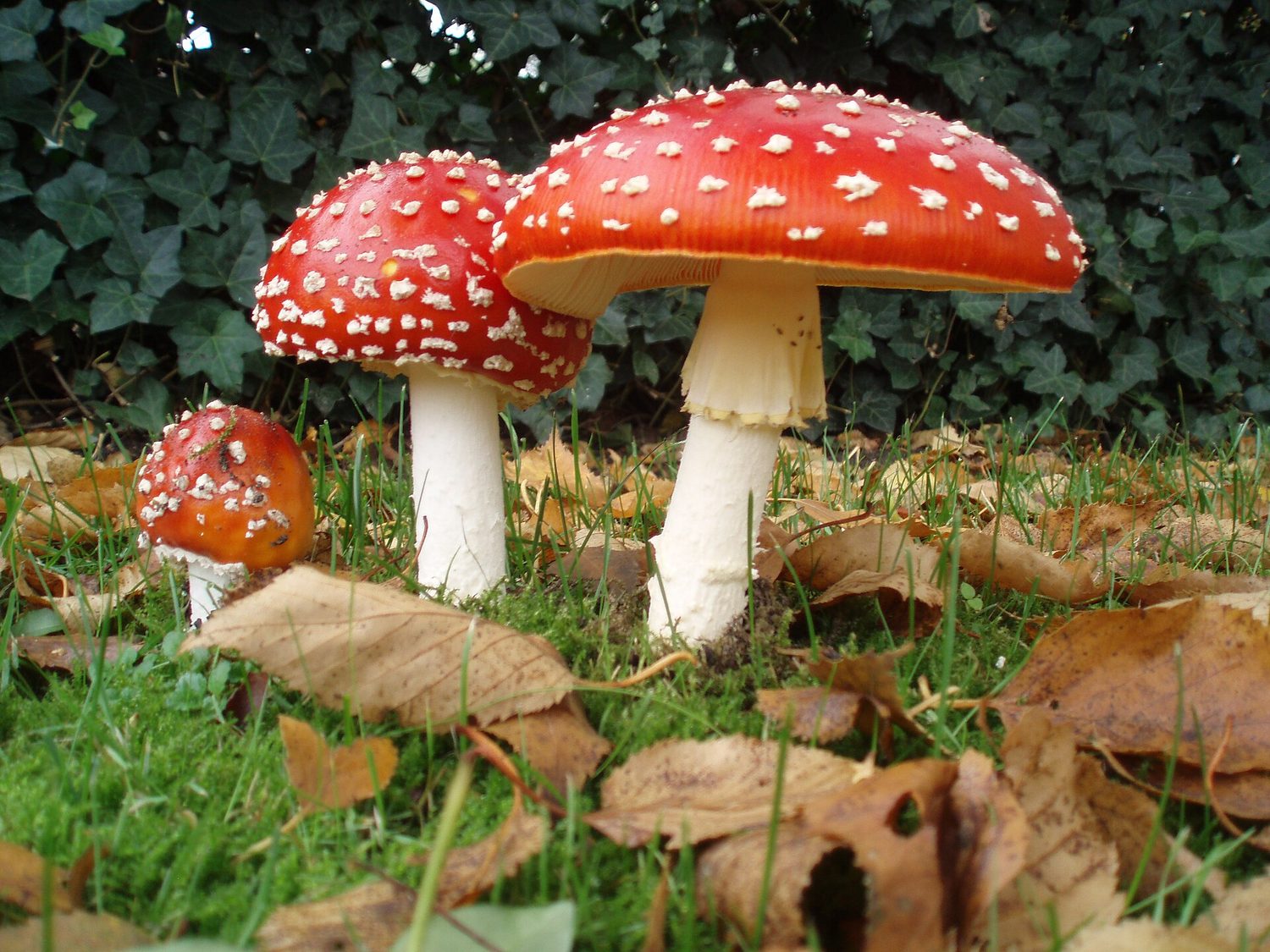
A fungus: the fly agaric, a mushroom
A dichotomous key identifies an organism using:
Difficulty 1/5 · 100 coins + a small bonus on first completion today
Each step offers two choices, narrowing down the organism.
Using a dichotomous key 二歧检索表
- A dichotomous key identifies an organism through a series of paired (either/or) questions.
- Each answer leads to the next question, until the organism is named.
Worked example. The binomial name Panthera leo (lion) shares its genus (Panthera) with Panthera tigris (tiger) — telling you at a glance that lions and tigers are closely related.
You've got it
- a species can breed to make fertile offspring; named by the binomial system (genus + species)
- classification hierarchy: kingdom → phylum → class → order → family → genus → species
- a dichotomous key identifies organisms through paired questions
Write from a binomial name
- An organism is named Panthera leo.
- A key offers two descriptions at each step.
What does the two-word name tell you, and what is the key for?
The first word is the genus and the second is the species.
In Panthera leo, which word is the species?
Difficulty 1/5 · 100 coins + a small bonus on first completion today
The species is the second word.