Your learning plan · Continue · Review →
一直 vs 一向 (continuously vs habitually)
IntroducedYour saved position stays in this browser. Resuming does not complete the lesson or answer its questions.
All day, or always?
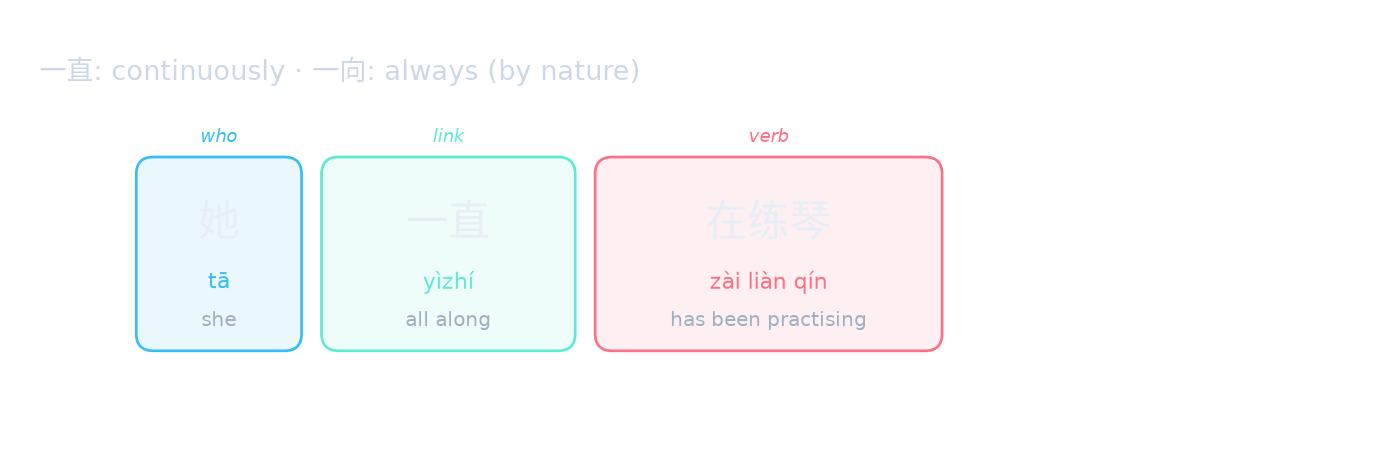
- Your neighbour has been practising piano all morning; she has always been hard-working.
- she / her她always一直at / in在练琴,she / her她has always been一向very很to make an effort努力。 — "She's been practising the piano all along; she's always been hard-working."
always一直 = continuously (a stretch of time)
- always一直 = without a break over a stretch, past or future: always一直at / in在to rain下雨, I我will会always一直wait for等you你.
- It can also mean "straight": always一直to walk走.
I我will会always一直wait for等you你。
Build: “I will wait for you all along.”
Difficulty 3/5 · 200 coins + a small bonus on first completion today
会 + 一直 + verb.
has always been一向 = habitually, consistently (character)
- has always been一向 describes long-standing habits or character from past to present: he他has always been一向very很punctual准时.
- It does not look to the future: I我will会has always been一向wait for等you你 ✗.
he他has always been一向very很punctual准时。
Promise: “I'll always support you.” 我会____支持你。
Difficulty 1/5 · 100 coins + a small bonus on first completion today
Future promises take 一直.
Future and activities
- Future promises take always一直: I我will会always一直to be in favor of支持you你. has always been一向 is past-to-present only.
- An ongoing activity (at / in在 + verb) usually takes always一直: always一直at / in在wait for等; has always been一向 is about habits and traits.
Which is wrong?
Difficulty 1/5 · 100 coins + a small bonus on first completion today
一向 does not look to the future.
Both possible
- he他always一直 / has always been一向not不liked喜欢eating吃spicy food辣 — both fine: a long-standing preference.
- has always been一向 sounds more like a character trait; always一直 more like continuity.
he他has always一向not不liked喜欢eating吃spicy food辣。
他一直不喜欢吃辣 and 他一向不喜欢吃辣 are both acceptable.
Difficulty 1/5 · 100 coins + a small bonus on first completion today
For a long-standing preference, both work.
Recap
- always一直 = continuously (past or future; activities; also "straight ahead").
- has always been一向 = habitually, consistently (character, past to present, not future).
Read the full reference: HSK 6 grammar — Comparing similar adverbs.
Your neighbour has been practising piano all morning; she has always been hard-working. Close the examples. Say a Mandarin response, then write it in Chinese. Explain briefly in English what the lesson’s pattern adds. Compare with the model, then change one detail and try again.
This is supported productive practice. Compare meaning and structure; your answer need not copy the model. A partner or teacher must hear the spoken response to comment on pronunciation.