Your learning plan · Continue · Review →
反而 vs 却 (instead vs however)
IntroducedYour saved position stays in this browser. Resuming does not complete the lesson or answer its questions.
Yet versus instead
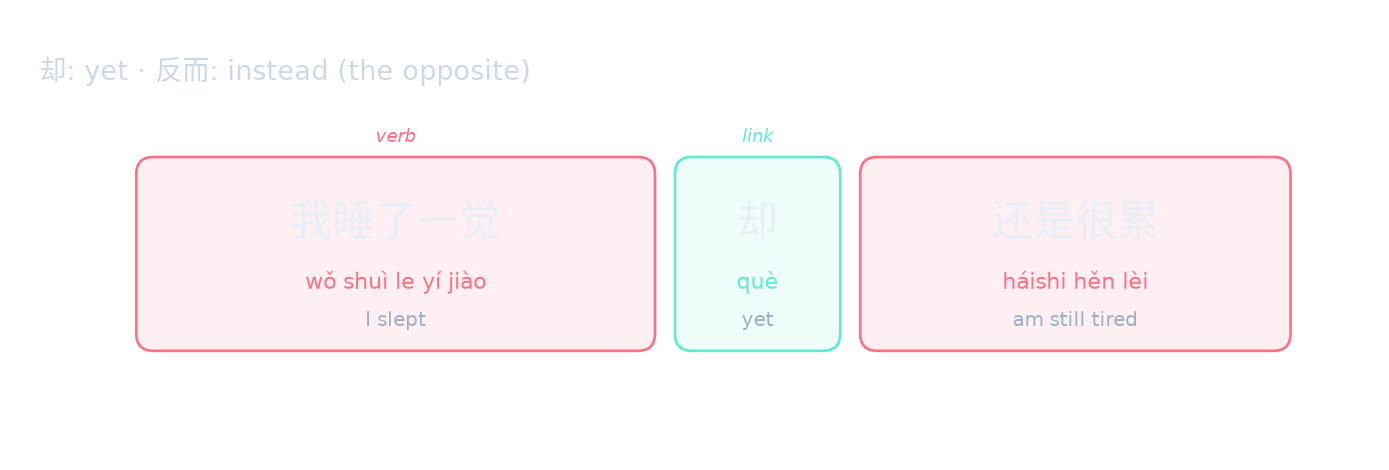
- You took a nap to feel better, but woke up even more tired.
- I / me我to sleep睡(completed / change)了one / a一to feel觉,yet却or / still还是very很rope累;not only (... but also ...)不但没好,instead反而more更rope累(completed / change)了。 — "I took a nap, yet I'm still tired; far from better, I'm actually more tired."
yet却 = but, yet (a contrast)
- yet却 marks a contrast with the first clause; it goes after the subject: he他very很rope累,yet却to sleep睡not不(ongoing -ing)着.
- The second part simply goes against what you'd expect, without being the opposite.
already已经spring春天了,the weather天气yet却still还very很cold冷。
Build: “It's already spring, yet it's still cold.”
Difficulty 3/5 · 200 coins + a small bonus on first completion today
Subject + 却 + predicate.
instead反而 = instead, the opposite happened
- instead反而 says the result went the opposite way: took吃(completed / change)了medicine药,the illness病instead反而more更serious重(completed / change)了.
- It often follows not only (... but also ...)不但not不 / not only (... but also ...)不但not / haven't没: he他not only (... but also ...)不但没生气,instead反而to laugh笑(completed / change)了.
took吃了medicine药,the illness病instead反而more更serious重了。
Complete: “After the medicine, the illness got worse instead.” 吃了药,病____更重了。
Difficulty 1/5 · 100 coins + a small bonus on first completion today
The opposite of the expected result = 反而.
Contrast or reversal?
- A plain "but": yet却. The opposite of the expected result: instead反而.
- Both follow the subject: he他yet却…, he他instead反而…; neither starts the clause.
“He's clever, but he doesn't work hard.” Which fits? 他很聪明,____不努力。
Difficulty 1/5 · 100 coins + a small bonus on first completion today
却 marks a plain contrast after the subject: 他很聪明,却不努力. 反而 would mean the result goes against what was expected, and 因此 / 于是 show result or sequence.
Side by side
- he他very很got rich有钱,yet却not不happy快乐 — rich but not happy (contrast).
- he他got rich有钱(completed / change)了,instead反而not不happy快乐(completed / change)了 — he got rich and became unhappier (reversal).
he他got rich有钱了,instead反而not不happy快乐了。
反而 can start a clause before the subject.
Difficulty 1/5 · 100 coins + a small bonus on first completion today
False. 反而 is an adverb and goes after the subject, before the verb: 他反而笑了. It does not come before the subject.
Recap
- yet却 = but, yet (contrast); instead反而 = instead (the opposite of the expected result).
- Both after the subject; not only (... but also ...)不但not不…instead反而… is the classic reversal frame.
Read the full reference: HSK 6 grammar — Comparing similar adverbs.
You took a nap to feel better, but woke up even more tired. Close the examples. Say a Mandarin response, then write it in Chinese. Explain briefly in English what the lesson’s pattern adds. Compare with the model, then change one detail and try again.
This is supported productive practice. Compare meaning and structure; your answer need not copy the model. A partner or teacher must hear the spoken response to comment on pronunciation.