Your learning plan · Continue · Review →
不断 vs 不停 (continually vs non-stop)
IntroducedYour saved position stays in this browser. Resuming does not complete the lesson or answer its questions.
Steady growth versus non-stop
- A news report and a neighbour's complaint describe two kinds of "continually".
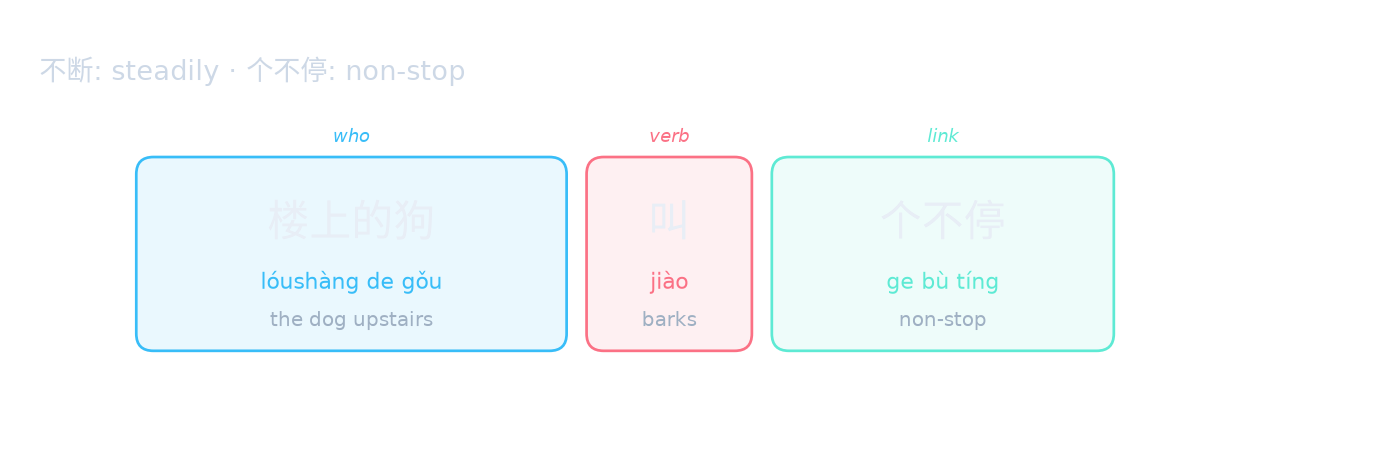
- city城市at / in在continually不断development发展。upstairs楼上(modifier / structural particle)的dog狗variant of 叫叫(on and)个non-stop不停。 — "The city keeps developing. The dog upstairs barks non-stop."
continually不断 = continually, ongoing (development)
- continually不断 + verb = keep on, with progress or repetition over time: continually不断progress进步, continually不断to raise提高, continually不断(intransitive) to change变化.
- It goes before the verb and suits formal contexts.
we我们must要continually不断learn学习。
Complete (formal): “Our level keeps improving.” 我们的水平在____提高。
Difficulty 1/5 · 100 coins + a small bonus on first completion today
Improvement over time = 不断.
non-stop不停 = without stopping (an action)
- non-stop不停((adverb -ly)地) + verb = keep doing an action with no pause: non-stop不停地说, non-stop不停(adverb -ly)地to rain下雨.
- V + (on and)个non-stop不停 = keep V-ing: variant of 说说(on and)个non-stop不停, cry哭(on and)个non-stop不停.
the baby孩子cry哭(on and)个non-stop不停。
Build: “The baby cries non-stop.”
Difficulty 3/5 · 200 coins + a small bonus on first completion today
V + 个不停.
Progress versus repetition
- Development or improvement over time → continually不断: continually不断to raise提高, not non-stop不停to raise提高.
- A physical action that won't stop → non-stop不停: (literary) to rain雨non-stop不停underground地下, variant of 说说(on and)个non-stop不停.
Which is wrong?
Difficulty 1/5 · 100 coins + a small bonus on first completion today
Verb + 个 + 不停 means “non-stop” (他说个不停). 不断 does not fit this pattern; it works as an adverb before verbs like 进步 or 提高.
(on and)个non-stop不停 only with non-stop不停
- variant of 说说(on and)个non-stop不停 ✓, variant of 说说(on and)个continually不断 ✗.
- continually不断 can describe things: continually不断(modifier / structural particle)的effort努力 — "constant effort"; non-stop不停 is mostly for actions.
after经过constant不断的effort努力,he他succeeded成功了。
不断的努力 means “constant effort”.
Difficulty 1/5 · 100 coins + a small bonus on first completion today
True. 不断 can also describe a noun with 的: 不断的努力 “constant effort”.
Recap
- continually不断 = continually (development, improvement, formal); non-stop不停 = non-stop (an action).
- V(on and)个non-stop不停 only with non-stop不停; continually不断(modifier / structural particle)的effort努力 = constant effort.
Read the full reference: HSK 6 grammar — Comparing similar adverbs.
A news report and a neighbour's complaint describe two kinds of "continually". Close the examples. Say a Mandarin response, then write it in Chinese. Explain briefly in English what the lesson’s pattern adds. Compare with the model, then change one detail and try again.
This is supported productive practice. Compare meaning and structure; your answer need not copy the model. A partner or teacher must hear the spoken response to comment on pronunciation.