Your learning plan · Continue · Review →
非(要) … 不可 (simply must / insist on)
IntroducedYour saved position stays in this browser. Resuming does not complete the lesson or answer its questions.
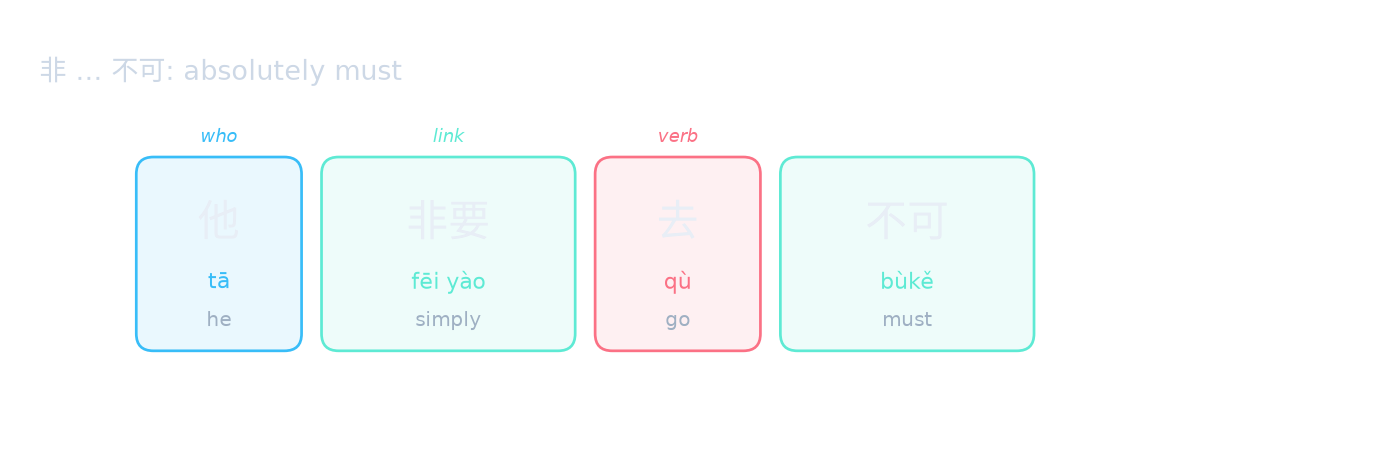
He simply must go
- Your little brother wants to go to the amusement park in the rain and won't take no for an answer.
- down下so much这么see 大夫大(modifier / structural particle)的(literary) to rain雨,he他to want absolutely非要go去(must)不可。 — "It's pouring, and he simply insists on going."
(must)非 (want / will / need要) + verb + (must)不可 = must, insist on
- (must)非…(must)不可 is a double negative: "not doing it is not allowed" → must, absolutely have to.
- With want / will / need要, it often shows insistence: he他to want absolutely非要go去(must)不可.
this matter这件事(must)非he他go去(must)不可。
Complete: “This problem absolutely must be solved.” 这个问题非解决____。
Difficulty 1/5 · 100 coins + a small bonus on first completion today
非…不可.
Necessity and stubbornness
- Necessity: this这个problem问题(must)非be solved解决(must)不可。 — "This problem absolutely must be solved."
- Stubbornness: I / me我variant of 说说need not不用,she / her她to want absolutely非要to give a dinner party请客(must)不可。 — "I said there was no need, but she insisted on paying."
this这个problem问题(must)非be solved解决(must)不可。
Build: “She insisted on paying.”
Difficulty 3/5 · 200 coins + a small bonus on first completion today
非要 + verb + 不可.
Keep both parts
- In careful style, keep (must)不可 (or won't do不行 / won't do不成) at the end: (must)非go去(must)不可. In speech (must)不可 is sometimes dropped: he他to want absolutely非要go去.
- (must)非 + verb, then (must)不可: not (must)非(must)不可go去.
Which order is correct?
Difficulty 1/5 · 100 coins + a small bonus on first completion today
The frame is 非 + (要) + verb + 不可, meaning “must, insist on”: 他非要去不可. 非 comes before the verb phrase and 不可 closes the sentence.
(must)非…(must)不可 versus must必须 and definitely一定want / will / need要
- must必须 / definitely一定want / will / need要 = must (plain).
- (must)非…(must)不可 is more emphatic, often with a sense of insistence or "no other way".
you你must必须on time按时finish完成。
非…不可 is more emphatic than 必须.
Difficulty 1/5 · 100 coins + a small bonus on first completion today
It stresses there is no other way.
Recap
- (must)非 (want / will / need要) + verb + (must)不可 = absolutely must / insist on (emphatic double negative).
- Plainer: must必须 / definitely一定want / will / need要.
Read the full reference: HSK 6 grammar — Sentence patterns.
Your little brother wants to go to the amusement park in the rain and won't take no for an answer. Close the examples. Say a Mandarin response, then write it in Chinese. Explain briefly in English what the lesson’s pattern adds. Compare with the model, then change one detail and try again.
This is supported productive practice. Compare meaning and structure; your answer need not copy the model. A partner or teacher must hear the spoken response to comment on pronunciation.