Your learning plan · Continue · Review →
是否 (whether or not)
IntroducedYour saved position stays in this browser. Resuming does not complete the lesson or answer its questions.
An application form
- The form asks a yes-or-no question about your previous applications.
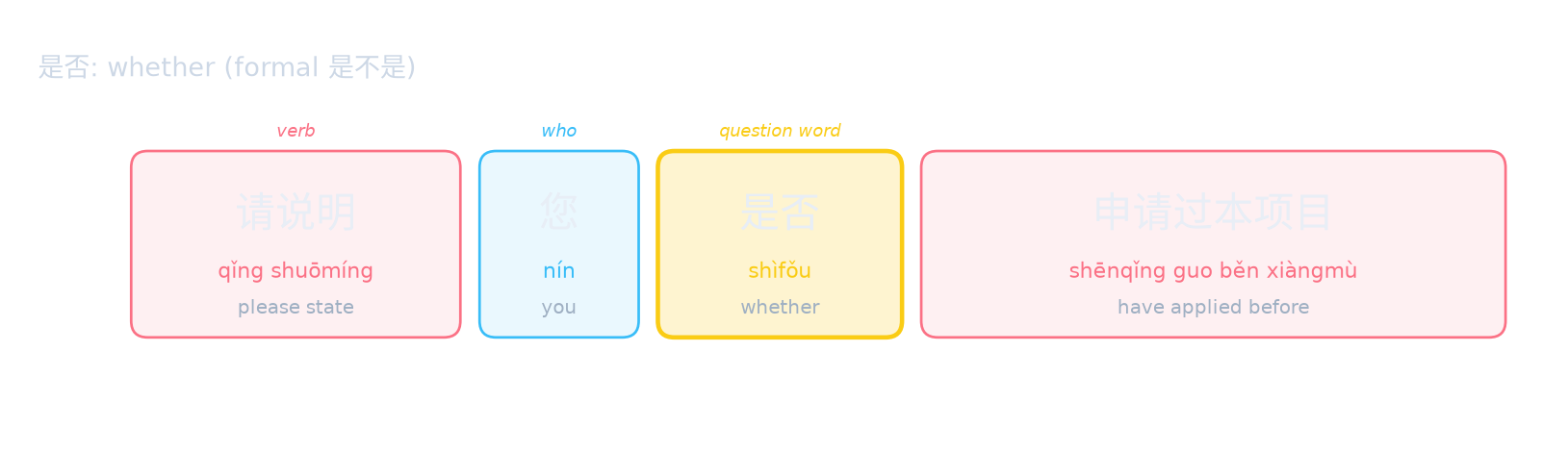
- please请to explain说明you您whether是否to apply for sth申请过本item项目。 — "Please state whether you have applied for this programme before."
whether是否 + verb = whether or not
- whether是否 = "whether (or not)", the formal form of is or isn't是不是: whether是否to agree同意, whether是否will attend参加, whether是否to need需要.
- It goes before the verb or adjective.
please请tell告诉us我们you您whether是否will attend参加。
Complete (form): “Please state whether you need a receipt.” 请说明您____需要发票。
Difficulty 1/5 · 100 coins + a small bonus on first completion today
是否 + verb.
Questions and embedded questions
- Direct: you您whether是否to agree同意this这个plan方案? — "Do you agree with this proposal?"
- Embedded: I我don't不know知道he他whether是否will会come来。 — "I don't know whether he'll come."
I我don't不know知道he他whether是否will会come来。
Build: “I don't know whether he'll come.”
Difficulty 3/5 · 200 coins + a small bonus on first completion today
Embedded question with 是否.
No (yes/no ?)吗, no second negative
- whether是否 already makes it a question: you您whether是否to agree同意?, not you您whether是否to agree同意(yes/no ?)吗?
- Do not add don't不 after it: whether是否to agree同意, not whether是否don't不to agree同意 (unless you really mean "whether you disagree").
Which is correct?
Difficulty 1/5 · 100 coins + a small bonus on first completion today
是否 already makes the question; no 吗.
whether是否 versus is or isn't是不是 and whether we can能否
- is or isn't是不是 is the spoken form: you你is or isn't是不是rope累(completed / change)了?
- whether we can能否 = whether (one) can, also formal: whether we can能否on time按时finish完成still还don't不certain确定.
whether we can能否on time按时finish完成still还not不certain确定。
是不是 is the spoken equivalent of 是否.
Difficulty 1/5 · 100 coins + a small bonus on first completion today
True. 是否 (“whether”) is formal and written: 是否参加. In speech the same meaning is expressed by the affirmative-negative form 是不是 (or 参加不参加).
Recap
- whether是否 + verb = whether (or not) (formal is or isn't是不是); no (yes/no ?)吗 with it.
- whether we can能否 = whether one can.
Read the full reference: HSK 6 grammar — Particles.
The form asks a yes-or-no question about your previous applications. Close the examples. Say a Mandarin response, then write it in Chinese. Explain briefly in English what the lesson’s pattern adds. Compare with the model, then change one detail and try again.
This is supported productive practice. Compare meaning and structure; your answer need not copy the model. A partner or teacher must hear the spoken response to comment on pronunciation.