Your learning plan · Continue · Review →
一律 (uniformly / without exception)
IntroducedYour saved position stays in this browser. Resuming does not complete the lesson or answer its questions.
Same price for everyone
- At the museum entrance, a sign explains the ticket policy.
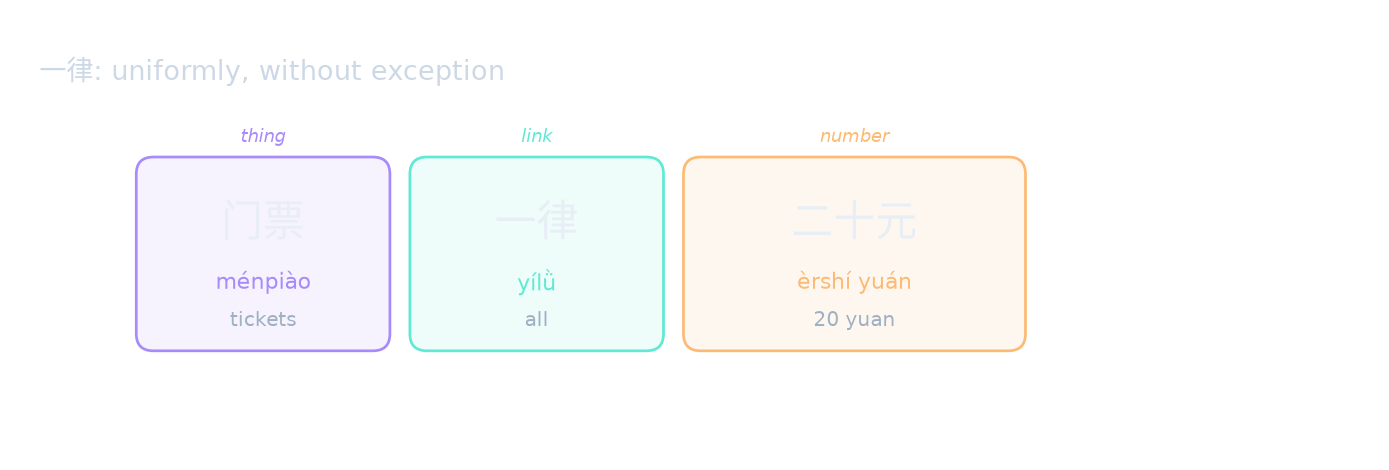
- ticket (for theater, cinema…门票all一律二十元。 — "Tickets are twenty yuan, without exception."
all一律 + verb / predicate = uniformly, without exception
- all一律 applies a rule to everyone or everything in the same way: all一律free (of charge)免费, all一律not不to retreat退.
- It is formal and common on signs, rules and notices.
this shop's本店goods商品all一律20% off八折。
Complete (notice): “All goods are 20% off.” 本店商品____八折。
Difficulty 1/5 · 100 coins + a small bonus on first completion today
一律 applies a rule uniformly.
Rules and policies
- students学生all一律wear穿school uniform校服。 — "All students must wear school uniform."
- to be overdue过期(modifier / structural particle)的ticket票all一律not valid无效。 — "Expired tickets are invalid without exception."
students学生all一律wear穿school uniform校服。
Build: “All students must wear school uniform.”
Difficulty 3/5 · 200 coins + a small bonus on first completion today
Group + 一律 + verb.
Rules, not descriptions
- all一律 states a rule or uniform treatment; for "all" in a description, use all / both都: students学生all / both都to come来(completed / change)了.
- It goes before the verb, after the group: students学生all一律…, not all一律students学生….
“All my classmates came to the party.” Which fits best?
Difficulty 1/5 · 100 coins + a small bonus on first completion today
A description takes 都; 一律 states a rule.
all一律 versus all / both都 and whole全部
- all / both都 = all (neutral).
- all一律 = all, by rule, no exceptions: deliveries外卖all一律go放at the door门口 — "All deliveries go at the door."
deliveries外卖all一律go放at the door门口。
一律 is common on signs and in rules.
Difficulty 1/5 · 100 coins + a small bonus on first completion today
It is formal and rule-like.
Recap
- Group + all一律 + predicate = uniformly, by rule, no exceptions (formal).
- Plain "all" in descriptions = all / both都.
Read the full reference: HSK 6 grammar — Adverbs.
At the museum entrance, a sign explains the ticket policy. Close the examples. Say a Mandarin response, then write it in Chinese. Explain briefly in English what the lesson’s pattern adds. Compare with the model, then change one detail and try again.
This is supported productive practice. Compare meaning and structure; your answer need not copy the model. A partner or teacher must hear the spoken response to comment on pronunciation.