Your learning plan · Continue · Review →
Verb / Adj + 坏了 (broken / to an extreme)
IntroducedYour saved position stays in this browser. Resuming does not complete the lesson or answer its questions.
Worn out
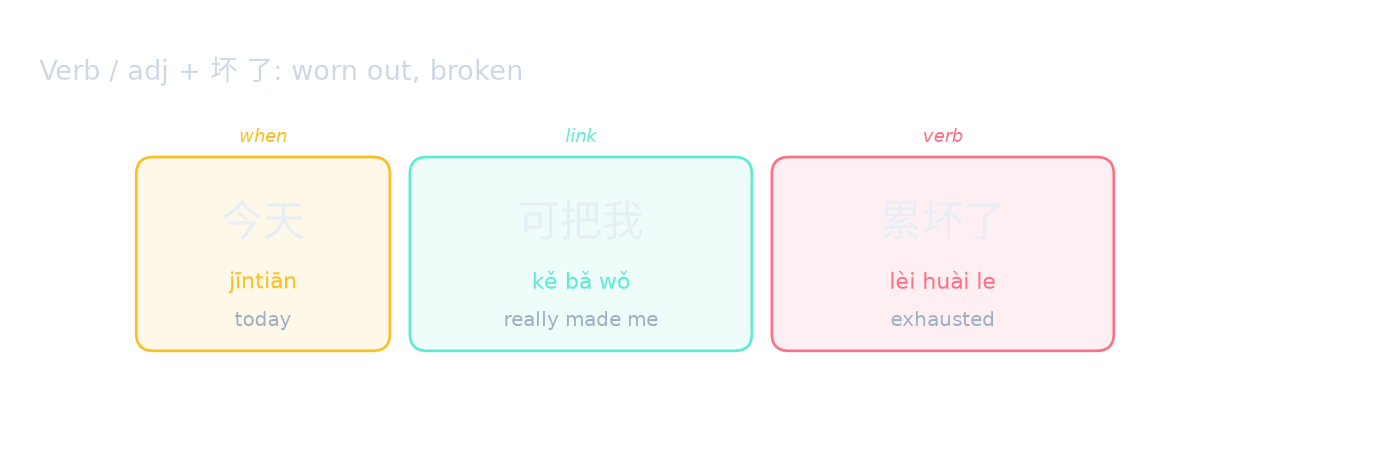
- Your mum comes home after a twelve-hour shift and collapses on the sofa.
- today今天used in 可汗可(把: marks the object)把my我to become exhausted累坏(completed / change)了! — "Today absolutely wore me out!"
Verb + broken坏 = broken (a result)
- Verb + broken坏((completed / change)了) = the action broke something: to drop and break摔坏 (broke by dropping), to use / with用broken坏 (wore out by using), broke弄坏 (damaged).
- my我(modifier / structural particle)的phone手机to drop and break摔坏(completed / change)了。 — "I dropped my phone and broke it."
my我的phone手机drop摔broken坏了。
Adj / feeling + broken坏(completed / change)了 = extremely
- With feelings and states, broken坏(completed / change)了 means "terribly": to become exhausted累坏(completed / change)了, to be hungry饿broken坏(completed / change)了, urgent急broken坏(completed / change)了, happy高兴broken坏(completed / change)了.
- hearing听到this这个news消息,she她happy高兴broken坏(completed / change)了。 — "When she heard the news, she was thrilled."
hearing听到this这个news消息,she她happy高兴extremely坏了。
Complete: “The kids are starving.” 孩子们饿____了。
Difficulty 1/5 · 100 coins + a small bonus on first completion today
Feeling / state + 坏了 = extremely.
Which meaning?
- Action verb + broken坏 = something is physically broken: computer电脑to wear out (tools)用坏(completed / change)了.
- Feeling / state + broken坏(completed / change)了 = an extreme degree, nothing broken: to be hungry饿broken坏(completed / change)了. (completed / change)了 is usually needed.
In 电脑用坏了, what does 坏 express?
Difficulty 1/5 · 100 coins + a small bonus on first completion today
Action verb + 坏 = broken by that action.
In 高兴坏了, something is broken.
Difficulty 1/5 · 100 coins + a small bonus on first completion today
With feelings, 坏了 just means “extremely”.
With (把: marks the object)把
- broken坏 results often appear in (把: marks the object)把 sentences: my brother弟弟(把: marks the object)把my我(modifier / structural particle)的glasses眼镜broke弄坏(completed / change)了。 — "My brother broke my glasses."
- used in 可汗可(把: marks the object)把…broken坏(completed / change)了 is a common spoken frame: used in 可汗可(把: marks the object)把my我urgent急broken坏(completed / change)了 — "I was worried sick."
my brother弟弟把my我的glasses眼镜broke弄坏了。
Build: “My brother broke my glasses.”
Difficulty 3/5 · 200 coins + a small bonus on first completion today
把 + object + verb + 坏 + 了.
Recap
- Action verb + broken坏((completed / change)了) = broken by that action (to drop and break摔坏, broke弄坏).
- Feeling / state + broken坏(completed / change)了 = extremely (to become exhausted累坏(completed / change)了, happy高兴broken坏(completed / change)了); used in 可汗可(把: marks the object)把my我…broken坏(completed / change)了 is spoken.
Read the full reference: HSK 5 grammar — Complements.
Your mum comes home after a twelve-hour shift and collapses on the sofa. Close the examples. Say a Mandarin response, then write it in Chinese. Explain briefly in English what the lesson’s pattern adds. Compare with the model, then change one detail and try again.
This is supported productive practice. Compare meaning and structure; your answer need not copy the model. A partner or teacher must hear the spoken response to comment on pronunciation.