Your learning plan · Continue · Review →
Advanced degree complements (得 + 很 / 要命 …)
IntroducedYour saved position stays in this browser. Resuming does not complete the lesson or answer its questions.
After a twenty-kilometre hike
- You finally reach the hostel after walking all day in the mountains.
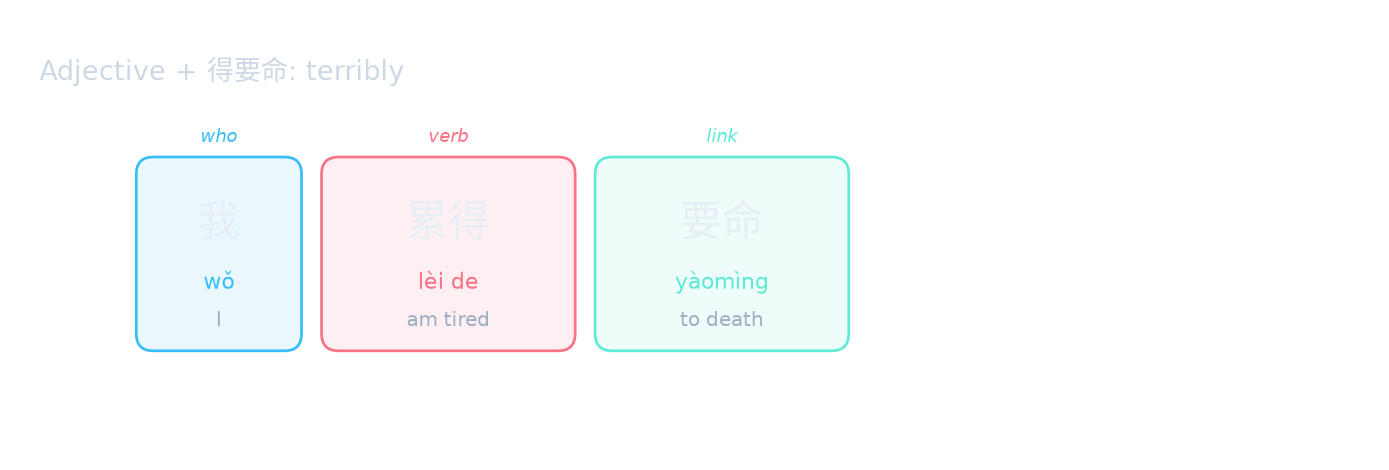
- I我tired累(degree marker)得terribly要命,what什么all / both都unexpectedly不想to make做(completed / change)了。 — "I'm dead tired; I don't feel like doing anything."
Adj + (degree marker)得 + degree / adjective linker很 / terribly要命 / unbearably不行 / desperately serious不得了
- These degree complements push an adjective to a high degree: good好(degree marker)得degree / adjective linker很, tired累(degree marker)得terribly要命, hungry饿(degree marker)得unbearably不行, busy忙(degree marker)得desperately serious不得了.
- They all follow the pattern Adj + (degree marker)得 + complement and end the clause.
I我hungry饿得unbearably不行了。
Complete: “I'm starving.” 我饿____不行了。
Difficulty 1/5 · 100 coins + a small bonus on first completion today
Adj + 得 + 不行.
Different flavours
- (degree marker)得degree / adjective linker很: emphatic but mild — here这里quiet安静(degree marker)得degree / adjective linker很. (degree marker)得terribly要命 / (degree marker)得unbearably不行: very colloquial, often a complaint — aching疼(degree marker)得terribly要命.
- (degree marker)得desperately serious不得了: very strong, good or bad — happy高兴(degree marker)得desperately serious不得了.
he他tooth牙aching疼得terribly要命。
Match each phrase to its meaning.
Difficulty 2/5 · 140 coins + a small bonus on first completion today
All are degree complements with different flavours.
Not literal, and no extra degree / adjective linker很
- terribly要命 does not mean real danger: 冷得terribly要命 just means "freezing".
- No degree / adjective linker很 before the adjective: tired累(degree marker)得terribly要命, not degree / adjective linker很tired累(degree marker)得terribly要命.
冷得要命 means it is literally dangerously cold.
Difficulty 1/5 · 100 coins + a small bonus on first completion today
要命 is just an intensifier here.
Versus the plain degree adverb
- very非常tired累 / unusual特别tired累 are neutral and fine in writing.
- The (degree marker)得 complements sound spoken and expressive; keep them out of formal essays.
I我today今天very非常tired累。
Which suits a formal essay?
Difficulty 1/5 · 100 coins + a small bonus on first completion today
The 得 complements are colloquial; essays use 非常.
Recap
- Adj + (degree marker)得 + degree / adjective linker很 / terribly要命 / unbearably不行 / desperately serious不得了 = very, extremely (spoken, expressive).
- Not literal; no degree / adjective linker很 before; use very非常 in writing.
Read the full reference: HSK 5 grammar — Complements.
You finally reach the hostel after walking all day in the mountains. Close the examples. Say a Mandarin response, then write it in Chinese. Explain briefly in English what the lesson’s pattern adds. Compare with the model, then change one detail and try again.
This is supported productive practice. Compare meaning and structure; your answer need not copy the model. A partner or teacher must hear the spoken response to comment on pronunciation.