Your learning plan · Continue · Review →
反而 (on the contrary / instead)
IntroducedYour saved position stays in this browser. Resuming does not complete the lesson or answer its questions.
It backfired
- You tried to help your little brother with maths, but he got more confused.
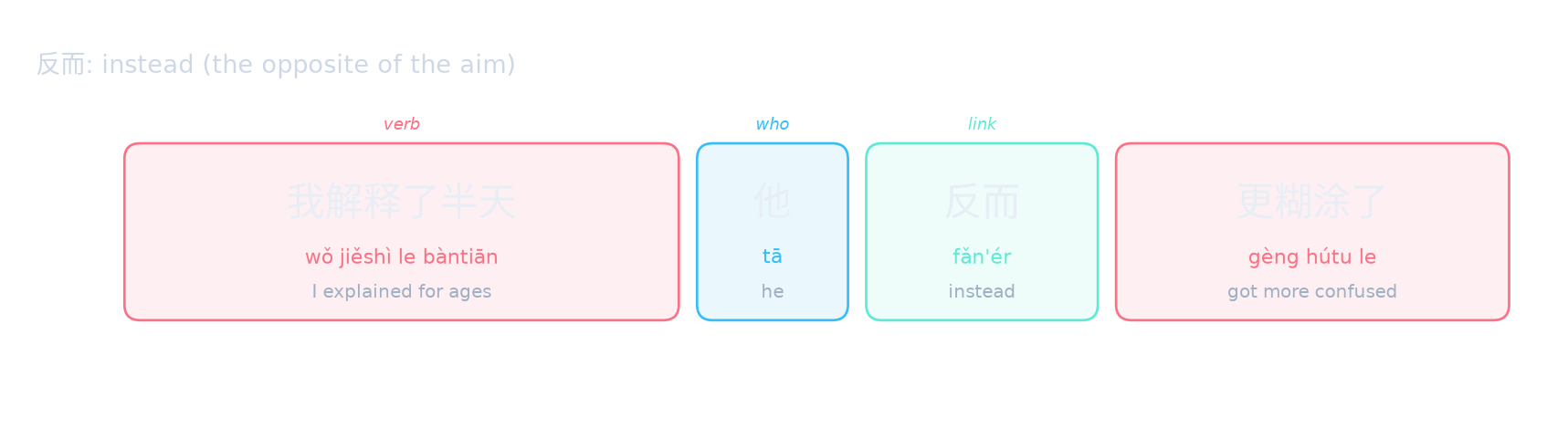
- I / me我explanation解释(completed / change)了half of the day半天,he他instead反而more更muddled糊涂(completed / change)了。 — "I explained for ages, and he only got more confused."
Subject + instead反而 + predicate
- instead反而 = "instead, on the contrary": the result goes the opposite way to what was expected.
- It sits after the subject, before the verb: he他instead反而…, not instead反而he他….
take吃了medicine药,the illness病instead反而more更serious重了。
Complete: “After the rain, it got hotter instead.” 下了雨,天气____更热了。
Difficulty 1/5 · 100 coins + a small bonus on first completion today
反而 marks the opposite of what you'd expect.
not only不但not不 / didn't没…,instead反而…
- he他not only不但didn't没get angry生气,instead反而laughed笑(completed / change)了。 — "Far from getting angry, he actually laughed."
- The first half says what didn't happen; the second, the opposite that did.
he他not only不但didn't没get angry生气,instead反而laughed笑了。
Build: “Far from getting angry, he actually laughed.”
Difficulty 3/5 · 200 coins + a small bonus on first completion today
不但没…,反而….
After the subject
- instead反而 is an adverb: (literary) to rain雨instead反而more更see 大夫大(completed / change)了, not instead反而(literary) to rain雨more更see 大夫大(completed / change)了.
- It needs an expectation to go against; for a plain contrast use but但是 / but却.
Which sentence is correct?
Difficulty 1/5 · 100 coins + a small bonus on first completion today
不但没…,反而… with 反而 after the (omitted) subject.
instead反而 versus on the contrary相反
- instead反而 is an adverb inside the clause: he他instead反而not不happy高兴(completed / change)了.
- on the contrary相反 is "the opposite" or "on the contrary" starting a sentence: on the contrary相反,he他very很happy高兴.
on the contrary相反,he他very很happy高兴。
相反 can open a sentence followed by a comma.
Difficulty 1/5 · 100 coins + a small bonus on first completion today
True. 相反 can open a sentence, followed by a comma, to mean “on the contrary”: 他没生气,相反,他很高兴.
Recap
- Subject + instead反而 + predicate = instead, on the contrary (the opposite of what was expected).
- Often after not only不但not不/didn't没…; on the contrary相反 opens a sentence.
Read the full reference: HSK 5 grammar — "But" statements.
You tried to help your little brother with maths, but he got more confused. Close the examples. Say a Mandarin response, then write it in Chinese. Explain briefly in English what the lesson’s pattern adds. Compare with the model, then change one detail and try again.
This is supported productive practice. Compare meaning and structure; your answer need not copy the model. A partner or teacher must hear the spoken response to comment on pronunciation.