Your learning plan · Continue · Review →
刚 vs 刚才 (adverb vs time-word)
IntroducedYour saved position stays in this browser. Resuming does not complete the lesson or answer its questions.
Just now, or just?
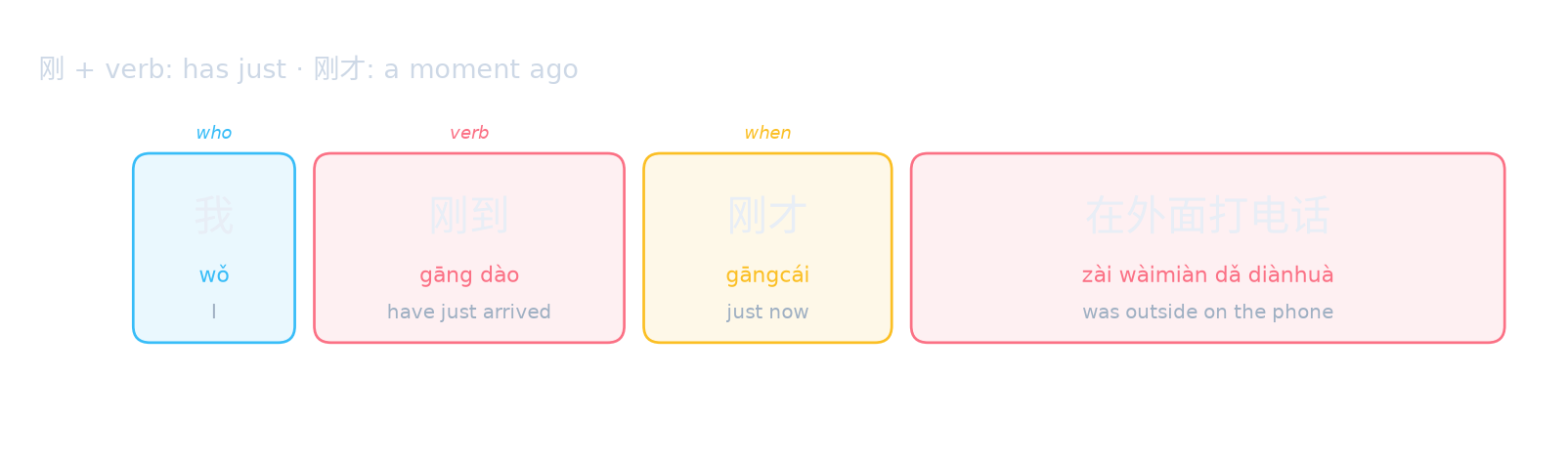
- You arrive at the café and your friend says he has only just sat down; a moment ago he was outside on the phone.
- I / me我just刚to / arrive到,a moment ago刚才at / in在outside (also pr. for this…外面to make a telephone call打电话。 — "I've just arrived; a moment ago I was outside on the phone."
just刚 is an adverb
- just刚 + verb = have just (done): just刚to / arrive到, just刚variant of 吃吃to finish完. It stands right before the verb.
- It can stretch to "recently": he他just刚came to来Beijing北京两个moon月.
he他just刚came to来Beijing北京two months两个月。
a moment ago刚才 is a time word
- a moment ago刚才 = a moment ago, like yesterday昨天: it can start the sentence and works with adjectives and not / haven't没.
- a moment ago刚才very很hot热,now现在cool凉快(completed / change)了。 — "It was hot a moment ago; now it's cooler."
a moment ago刚才very很hot热,now现在cool凉快了。
Complete: “I didn't hear you just now.” ____我没听见。
Difficulty 1/5 · 100 coins + a small bonus on first completion today
Only 刚才 starts the sentence and goes with 没.
Build: “It was hot a moment ago.”
Difficulty 3/5 · 200 coins + a small bonus on first completion today
刚才 + adjective.
Three tests
- Start of the sentence? Only a moment ago刚才. Before an adjective or not / haven't没? Only a moment ago刚才: a moment ago刚才not / haven't没to hear听见.
- With a duration after the verb (two months)? Only just刚: just刚came to来两个moon月.
Which says “She's only been working here for a week”?
Difficulty 1/5 · 100 coins + a small bonus on first completion today
刚 goes before the verb, and the duration follows the verb with 了; 刚才 means “a moment ago” and cannot carry a duration.
Both possible
- he他just刚left走。 / he他a moment ago刚才left走(completed / change)了。 — both mean he left a moment ago.
- just刚 sentences usually have no (completed / change)了; a moment ago刚才 sentences take (completed / change)了 normally.
he他a moment ago刚才left走了。
他刚走 and 他刚才走了 can both describe someone who left a moment ago.
Difficulty 1/5 · 100 coins + a small bonus on first completion today
True. 刚 is an adverb (“just”): 他刚走. 刚才 is a time noun (“a moment ago”) and usually takes 了: 他刚才走了. Both fit someone who left a moment ago.
Recap
- just刚 + verb = have just (adverb; can stretch to "recently"; usually no (completed / change)了).
- a moment ago刚才 = a moment ago (time word; can start the sentence; works with adjectives and not / haven't没).
Read the full reference: HSK 4 grammar — Comparing similar adverbs.
You arrive at the café and your friend says he has only just sat down; a moment ago he was outside on the phone. Close the examples. Say a Mandarin response, then write it in Chinese. Explain briefly in English what the lesson’s pattern adds. Compare with the model, then change one detail and try again.
This is supported productive practice. Compare meaning and structure; your answer need not copy the model. A partner or teacher must hear the spoken response to comment on pronunciation.