Your learning plan · Continue · Review →
少 + Verb (do less)
IntroducedYour saved position stays in this browser. Resuming does not complete the lesson or answer its questions.
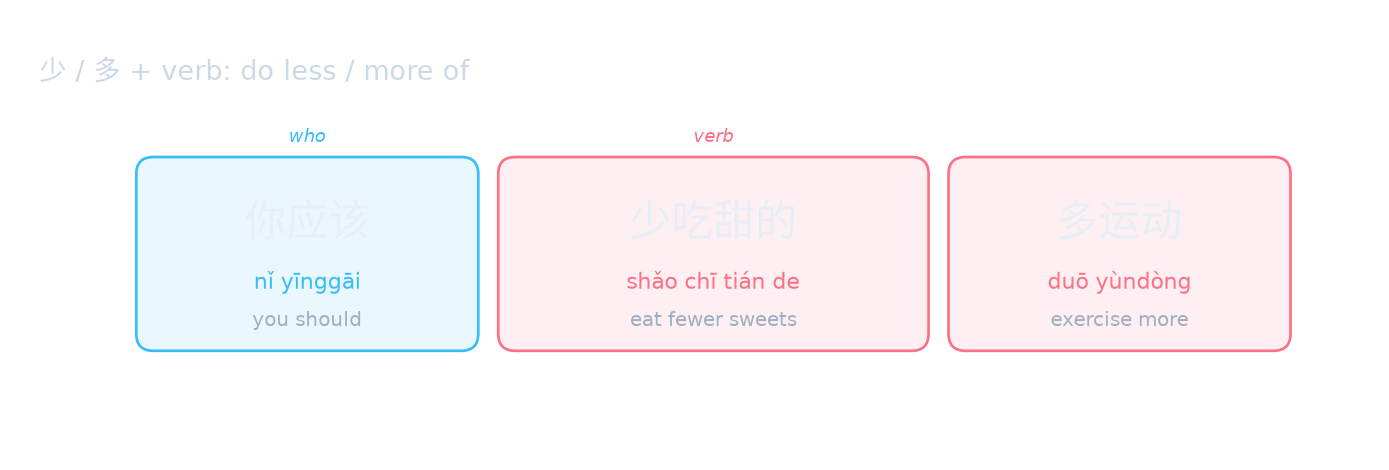
Doctor's orders
- Your doctor looks at your test results and gives you some advice.
- you你should应该less少eat吃sweet甜(modifier / structural particle)的,many多to move运动。 — "You should eat less sugar and exercise more."
less少 + Verb = do less
- less少 + Verb = do less of it: less少eat吃, less少drink喝, less少variant of 说说.
- less少 goes directly before the verb, like an adverb.
in the evening晚上less少drink喝coffee咖啡。
Advise: “Play less on your phone.” ____玩手机。
Difficulty 1/5 · 100 coins + a small bonus on first completion today
少 + verb = do less.
Advice and quantity
- With an amount: to add less (of a spice etc)少放a little一点儿salt盐。 — "Put in a little less salt."
- you你less少variant of 说说(say) a few words两句(suggestion)吧! — "Say less (stop talking)!" — a firm request.
less少put in放a little一点儿salt盐。
Build: “Put in a little less salt.”
Difficulty 3/5 · 200 coins + a small bonus on first completion today
少 + verb + amount + object.
Before the verb
- "Eat less" is less少eat吃, not eat吃less少: eat吃less少(completed / change)了 means "ate too little".
- An amount comes after the verb: less少eat吃a little一点儿, less少drink喝两杯.
What does 我吃少了 mean?
Difficulty 1/5 · 100 coins + a small bonus on first completion today
Verb + 少了 = did too little; advice is 少 + verb.
less少 + Verb versus doesn't不 + Verb
- less少eat吃meat肉 = eat less meat (some is fine).
- doesn't不eat吃meat肉 = don't eat meat at all.
he他doesn't不eat吃meat肉。
少吃肉 means “don't eat meat at all”.
Difficulty 1/5 · 100 coins + a small bonus on first completion today
少吃 = eat less; 不吃 = not at all.
Recap
- less少 + Verb (+ amount) = do less: less少eat吃, to add less (of a spice etc)少放a little一点儿.
- less少 goes before the verb; eat吃less少(completed / change)了 = ate too little; doesn't不 + Verb = not at all.
Read the full reference: HSK 4 grammar — Verb phrases.
Your doctor looks at your test results and gives you some advice. Close the examples. Say a Mandarin response, then write it in Chinese. Explain briefly in English what the lesson’s pattern adds. Compare with the model, then change one detail and try again.
This is supported productive practice. Compare meaning and structure; your answer need not copy the model. A partner or teacher must hear the spoken response to comment on pronunciation.