Your learning plan · Continue · Review →
只 (only)
IntroducedYour saved position stays in this browser. Resuming does not complete the lesson or answer its questions.
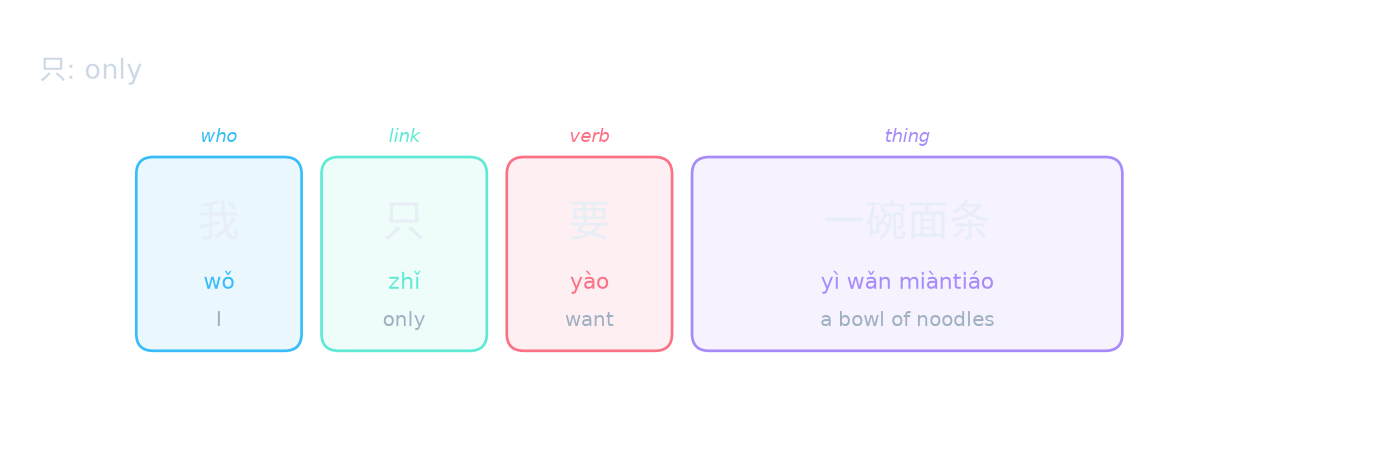
Just one bowl, please
- At a noodle shop your friend orders three dishes. You are not hungry.
- I我if only只要一碗noodles面条。 — "I only want a bowl of noodles."
Subject + only只 + Verb
- only只 = "only, just" and goes before the verb, even when "only" in English seems to belong to the object.
- I我only只to drink tea喝茶 — "I only drink tea." he他only只has been to去过Beijing北京 — "He has only been to Beijing."
he他only只has been to去过Beijing北京。
Complete: “I only drink green tea.” 我____喝绿茶。
Difficulty 1/5 · 100 coins + a small bonus on first completion today
只 goes before the verb 喝.
Only a small amount
- With a number: I我only只有ten十yuan块money钱。 — "I only have ten yuan."
- With a completed action: yesterday昨天I我only只to sleep睡(completed / change)了五个hour小时。 — "Yesterday I only slept five hours."
I我only只have有ten十yuan块money钱。
Build: “Yesterday I only slept five hours.”
Difficulty 3/5 · 200 coins + a small bonus on first completion today
Time + subject + 只 + verb + 了 + duration.
only只 never stands before the subject
- "Only I went" is only只有I我to go去(completed / change)了, not only只I我to go去(completed / change)了: before a noun or the subject, use only只有.
- Keep only只 before the verb, not after it: I我only只to shout喝(completed / change)了一杯, not I我to shout喝(completed / change)了only只一杯.
Which says “Only Xiao Wang came.”?
Difficulty 1/5 · 100 coins + a small bonus on first completion today
To limit a person, use 只有 + noun. 小王只来了 would mean he only came (and did nothing else).
我喝了只一杯咖啡 is correct.
Difficulty 1/5 · 100 coins + a small bonus on first completion today
只 goes before the verb: 我只喝了一杯咖啡.
only只 versus only只有
- only只 limits the action: I我only只can / will会variant of 说说erhua variant of 一点一点儿Chinese language中文 — "I can only speak a little Chinese."
- only只有 limits a person or thing: only只有she她knows知道the answer答案。 — "Only she knows the answer."
only只有she她knows知道the answer答案。
Recap
- only只 + Verb = only, just; it stands before the verb.
- To make a noun or subject "only", use only只有 + noun: only只有I我, only只有一个.
Read the full reference: HSK 3 grammar — Adverbs.
At a noodle shop your friend orders three dishes. You are not hungry. Close the examples. Say a Mandarin response, then write it in Chinese. Explain briefly in English what the lesson’s pattern adds. Compare with the model, then change one detail and try again.
This is supported productive practice. Compare meaning and structure; your answer need not copy the model. A partner or teacher must hear the spoken response to comment on pronunciation.