Sequences and series
Introduced| English | Meaning |
|---|---|
| sequence/ˈsiːkwəns/ | An ordered list; a series adds its terms. |
| arithmetic sequence/əˈrɪθmətɪk ˈsiːkwəns/ | A sequence whose consecutive terms differ by a constant amount. |
| geometric sequence/ˌdʒiːəʊˈmetrɪk ˈsiːkwəns/ | A sequence in which each term is obtained by multiplying the previous term by a fixed common ratio. |
| series/ˈsɪəriːz/ | A sum of the terms of a sequence, which may contain finitely or infinitely many terms. |
| common difference/ˈkɒmən ˈdɪfrəns/ | The constant amount added to each term to obtain the next term in an arithmetic sequence. |
| common ratio/ˈkɒmən ˈreɪʃɪəʊ/ | The factor multiplying each term to obtain the next term in a geometric sequence. |
| sum to infinity/sʌm tʊ ɪnˈfɪnɪti/ | The limiting value of the partial sums of a convergent infinite series. |
Match the rule to the sequence
- Saving a fixed amount each period gives an arithmetic sequence 等差数列 if nothing else changes. Multiplying the current amount by a fixed factor gives a geometric sequence 等比数列.
- A financial problem may include fixed payments, interest or both. Identify its stated rule rather than assuming every money problem is geometric.
An investment grows by 4% each year. Which family is it?
Difficulty 1/5 · 100 coins + a small bonus on first completion today
A percentage is a factor, not an amount, so each year multiplies by 1.04.
Keep the term index explicit
- A sequence 数列 is an ordered list; a series 级数 adds its terms. Arithmetic uses common difference 公差 d and $u_n=a+(n-1)d$.
- Geometric uses common ratio 公比 r and $u_n=ar^{n-1}$. If the starting value is $u_1$, five completed multiplications give $u_6$; if a model uses time n starting at zero, write that convention instead.
An arithmetic sequence starts at 5 with common difference 3. What is the 10th term?
Difficulty 2/5 · 140 coins + a small bonus on first completion today
u₁₀ = 5 + 9 × 3 = 32. Nine steps from the first term, not ten.
Compare the same first eight terms
- Start both rules at 5. Adding 3 gives 5, 8, 11, …, so $u_8=5+7(3)=26$. Multiplying by 1.5 gives 5, 7.5, 11.25, …, so $v_8=5(1.5)^7\approx85.43$. Both use seven changes from term 1 to term 8.
- The arithmetic total is $S_8=5+8+\cdots+26=124$. The geometric total is about 246.29. These totals add eight terms; neither is the eighth term alone. A ratio below 1, a negative ratio or a different starting value can change the comparison.
Arithmetic against geometric
Both rules start at 5. Compare adding 3 with multiplying by 1.5, and distinguish the eighth term from the total of eight terms.
A geometric sequence starts at 4 and multiplies by 0.5. Find its sixth term.
Difficulty 2/5 · 140 coins + a small bonus on first completion today
Six terms require five multiplications: v₆ = 4 × 0.5⁵ = 0.125.
A sum is different from a term
- Arithmetic totals use $S_n=n[2a+(n-1)d]/2$. Geometric totals use $S_n=a(1-r^n)/(1-r)$ for $r\ne1$, or na when $r=1$.
- For nonzero a, a finite sum to infinity 无穷和 exists only when $|r|<1$, giving $S_\infty=a/(1-r)$. If a is zero, every term and sum is zero.
For a nonzero first term, a geometric series has a finite sum to infinity only when...
Difficulty 1/5 · 100 coins + a small bonus on first completion today
For nonzero a, convergence requires |r| < 1. When |r| ≥ 1, terms do not tend to zero; partial sums may diverge or oscillate, rather than always growing to positive infinity.
An arithmetic sequence starts at 5 and adds 3. Find the total of the first 10 terms.
Difficulty 2/5 · 140 coins + a small bonus on first completion today
The tenth term is 32. The total is S₁₀ = 10(5 + 32)/2 = 185, not 32.
Find the total of the first four terms of the geometric sequence 4, 2, 1, ... .
Difficulty 2/5 · 140 coins + a small bonus on first completion today
The fourth term is 0.5. The finite total is 4 + 2 + 1 + 0.5 = 7.5; the sum to infinity would be 8.
A stated depreciation model. Starting value 80000 units loses 12% per year, with no other changes. $V(n)=V_0(1-r)^n$, so $V(5)=80000(0.88)^5=42218.553344$ units. This is 42200 to the nearest 100, not an exact value of 42200.
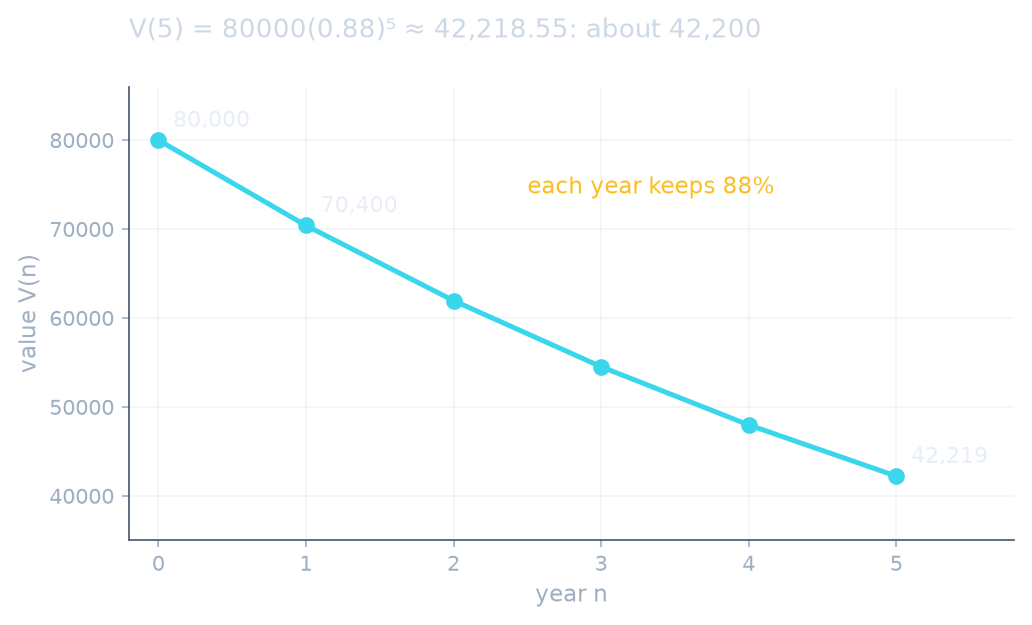
A machine worth 80000 loses 12% a year. What is it worth after 5 years, to the nearest 100?
Difficulty 2/5 · 140 coins + a small bonus on first completion today
80000 × 0.88⁵ = 42218.553344, which rounds to 42200 to the nearest 100. The retained proportion is multiplied five times.
Use the sum for a combined capacity. Rows with counts 12, 14, 16 and so on give $u_{15}=40$, but $S_{15}=390$. Sheet 2.1 compares an individual term, a finite total and an infinite-horizon mathematical model.
For nonzero first term, ratios of magnitude at least 1 prevent convergence of the infinite geometric series. They do not all produce sums growing to positive infinity: ratio negative 1 makes partial sums alternate. State the convergence failure precisely.
Losing 12% a year for five years means losing 60% in total.
Difficulty 1/5 · 100 coins + a small bonus on first completion today
0.88⁵ = 0.528, so about 47% is lost. Each year's loss applies to a smaller amount than the last.