Your learning plan · Continue · Review →
Gerunds and infinitives
IntroducedYour saved position stays in this browser. Resuming does not complete the lesson or answer its questions.
-ing or to …?
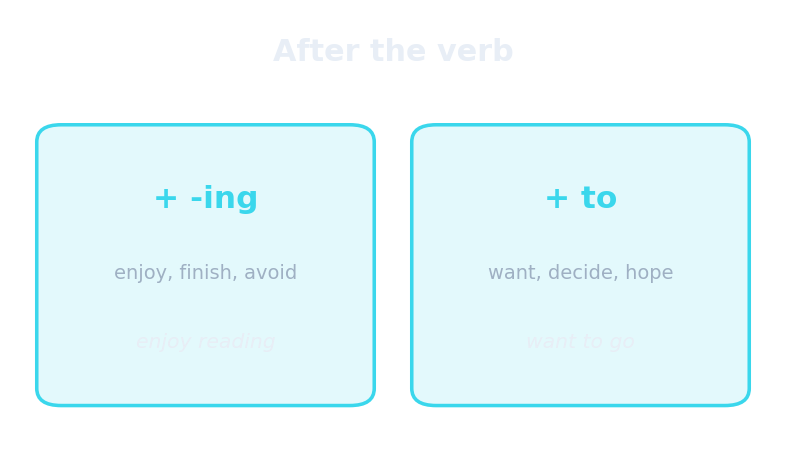
- Outcome: choose an action form from its full verb/preposition frame and explain a meaning contrast. Compare an -ing action with to + base verb; a verb may allow other complements or another action form.
- Start with basic clause order. Starting check: does every to introduce an infinitive? Compare hope to see with look forward to seeing. Learn the complete expression and intended meaning.
I enjoy reading, but I keep forgetting to return the books.
verb + -ing
- enjoy, finish, stop, mind, suggest, avoid + -ing.
- I enjoy reading. She finished doing her homework.
- In I enjoy reading, the -ing clause names the activity enjoyed. Enjoy can also take a noun phrase: I enjoyed the concert.
Complete this direct action pattern: “I enjoy ___ to music.”
Difficulty 1/5 · 100 coins + a small bonus on first completion today
For the action after enjoy in this frame, use listening: I enjoy listening to music. Enjoy can also take a noun phrase, such as the concert.
Use the -ing form of “pack”: “We finished ___ the boxes before lunch.”
Difficulty 1/5 · 100 coins + a small bonus on first completion today
Packing supplies the requested -ing action after finished: finished packing the boxes.
verb + to-infinitive
- want, need, decide, hope, promise, learn, would like + to + base verb.
- I want to learn English. They decided to stay.
- Some verbs allow both forms, with differences depending on meaning and context: I like reading / I like to read before bed. Compare I stopped talking (I ended the talking) with I stopped to talk (I paused another activity in order to talk).
Which action frame is shown?
Identify the displayed direct-action frame in these worked phrases; the verbs can also have other complements.
Supply one word before the base verb: “They decided ___ stay.”
Difficulty 1/5 · 100 coins + a small bonus on first completion today
“decide” is followed by a to-infinitive: “decided to stay”.
Translate into English: 我想学英语。
Difficulty 3/5 · 200 coins + a small bonus on first completion today
I want to learn English is one answer. I’d like to learn English also expresses the wish with a grammatical pattern; translation does not require one exact sentence.
Complete the intention frame with one word: “We hope ___ visit the workshop next week.”
Difficulty 1/5 · 100 coins + a small bonus on first completion today
Hope to visit uses the to-infinitive frame. The base verb visit follows infinitive to.
After a preposition: noun, pronoun or action
- A preposition can have a noun or pronoun after it: about the plan, for her. When an action directly follows the ordinary prepositions in the patterns here, use -ing: good at drawing, thank you for helping.
- She's good at drawing. Thank you for helping.
- Distinguish the to in look forward to seeing you from infinitive to in hope to see you. Before I leave is a full clause; it does not need changing to before I leaving.
Is this standard action pattern correct? “She is good at draw.”
Difficulty 1/5 · 100 coins + a small bonus on first completion today
With the action directly after at in this frame, use drawing: good at drawing. A preposition can also be followed by a noun or pronoun in other examples.
Choose the complete action pattern after look forward to.
Difficulty 1/5 · 100 coins + a small bonus on first completion today
To is a preposition in look forward to; a directly following action uses seeing. This differs from infinitive to see after hope.
The complete clause “before I leave” must become “before I leaving” because every word after before has to be an -ing form.
Difficulty 1/5 · 100 coins + a small bonus on first completion today
Before I leave is a full clause with its own subject and finite verb. Compare before leaving, a different construction. Do not apply the preposition + action pattern to every clause.
Common mistakes
- ❌ I enjoy to read. → ✓ I enjoy reading. — in this direct action pattern, enjoy takes reading; it can also take a noun, such as the book.
- ❌ I want reading. → ✓ I want to read. — to express this wish with a following action, use want to read. Want can also take a noun or another person: I want a book. I want you to read it.
- ❌ I look forward to see you. → ✓ …look forward to seeing you. — this to is a preposition.
Match each verb and meaning cue to the ending that expresses that meaning. Other grammatical pairings may express different messages.
Difficulty 2/5 · 140 coins + a small bonus on first completion today
The cues select reading as the enjoyed book activity, to travel as the hoped-for trip, eating late as the avoided habit, and to help as the promised assistance. Enjoy/avoid take -ing in these direct-action frames; hope/promise take to + base verb. Other grammatical combinations can express different meanings.
The teacher came in and the class went quiet. Choose the form meaning that the talking ended then: “Everyone stopped ___.”
Difficulty 1/5 · 100 coins + a small bonus on first completion today
Stopped talking means the talking ended then; it does not promise permanent silence. Stopped to talk would present a pause in another activity for the purpose of talking.
A cyclist pauses the ride in order to read a notice. Which phrase presents that purpose?
Difficulty 1/5 · 100 coins + a small bonus on first completion today
Stopped to read presents a pause in the ride for the purpose of reading. Stopped reading would mean ending the reading; the last option lacks the required frame.
- Some verbs take -ing (enjoy, finish, avoid).
- Some take to + base verb (want, decide, hope).
- Check the full frame: at drawing, to seeing after look forward, but to see after hope. Nouns and pronouns are also possible after prepositions.
- Check what the speaker wants to communicate. Ending an action, pausing for a purpose, recalling an event and remembering a task are different meanings.
Write one English sentence about an activity someone enjoys, using a suitable verb + -ing or preposition + -ing pattern. You may invent the person and activity.
Difficulty 3/5 · 200 coins + a small bonus on first completion today
Example: “I enjoy playing basketball with my friends.”
Worked contrasts: form changes the viewpoint
- Ending or purpose: during a cycle ride, Nils stopped to adjust his saddle: he paused the ride for that purpose. He stopped adjusting the saddle ends the adjusting activity instead. Neither frame proves the adjustment solved the problem, and ending it then is not a lifetime ban.
- Memory or task: I remember bringing a spare battery recalls an earlier event. Remember to bring a spare battery reminds someone of a task before doing it. Read the full situation rather than choosing only from the verb remember.
- A method or effort: Try cleaning the lens with a soft cloth presents a method to test. I tried to loosen the hinge, but it would not move presents an unsuccessful effort. An experiment can involve effort too; these are useful viewpoints, not a claim that every context permits only one grammatical form.
Fresh frames and meanings
- Try twenty fresh independent written decisions without copying the examples. Some ask for a particular form; others ask what an existing phrase means or what it does not prove.
- Read before and after the gap. A noun, pronoun or full clause can fit a different construction; do not force an -ing action after every preposition-like word, or a base verb after every to.
Use the -ing form of “take”: “Please avoid ___ photographs during the performance.”
Difficulty 1/5 · 100 coins + a small bonus on first completion today
Taking is the direct action form after avoid; take loses its final e before -ing.
Supply one word: “The manager promised ___ replace the broken handle.”
Difficulty 1/5 · 100 coins + a small bonus on first completion today
Promised to replace uses a to-infinitive. This reports the promise; it does not confirm the replacement happened.
Complete with “in” or “to”: “The students are interested ___ learning about local birds.”
Difficulty 1/5 · 100 coins + a small bonus on first completion today
Interested in learning is the supplied adjective/preposition pattern. The action form follows in here.
Use the -ing form of “share”: “They saved money by ___ the equipment.”
Difficulty 1/5 · 100 coins + a small bonus on first completion today
By sharing describes the method. Share loses final e in sharing; a noun phrase could follow by in another example.
Supply one word: “I would like ___ reserve a quiet table.”
Difficulty 1/5 · 100 coins + a small bonus on first completion today
Would like to reserve expresses this wish. It does not use the same direct-action frame as enjoy doing.
Complete the reminder with one word before the base verb: “Remember ___ charge the torch before tonight’s walk.”
Difficulty 1/5 · 100 coins + a small bonus on first completion today
Remember to charge asks the listener to remember a task before doing it. It is not a memory of an earlier charging event.
Which sentence shows that enjoy can take a noun phrase, rather than proving it only ever takes an -ing form?
Difficulty 1/5 · 100 coins + a small bonus on first completion today
The concert is a noun phrase and can follow enjoyed directly. The useful enjoy + -ing action pattern is not the verb’s only possible complement.
Choose the complete frame expressing a wish for another person to check a label.
Difficulty 1/5 · 100 coins + a small bonus on first completion today
Want + person + to-infinitive gives want you to check. This is a different full frame from I want to check, where the speaker does the checking.
In “They look forward to meeting the neighbours”, how does to work?
Difficulty 1/5 · 100 coins + a small bonus on first completion today
Look forward to has prepositional to. Meeting follows it in this action frame; the phrase does not assert that the future meeting already happened.
In “They hope to meet the neighbours”, which account fits?
Difficulty 1/5 · 100 coins + a small bonus on first completion today
Hope to meet has an infinitive with the base verb meet. Read the full expression rather than treating every to as the same grammatical item.
Choose the pair of complete patterns.
Difficulty 1/5 · 100 coins + a small bonus on first completion today
Before leaving and before you leave are different complete constructions. One has an -ing action; the other has a full clause. The other pairs mix incomplete frames.
A drummer was practising. When the neighbour called, the drummer ended the drumming. Which phrase reports that ending?
Difficulty 1/5 · 100 coins + a small bonus on first completion today
Stopped practising ends the practising activity in this context. Stopped to practise would instead present a pause in another activity for practising.
While moving furniture, you pause that work in order to measure a doorway. Choose the phrase with that purpose meaning.
Difficulty 1/5 · 100 coins + a small bonus on first completion today
Stopped to measure presents the pause in furniture moving for a purpose. It does not by itself prove a measurement was accurate; stopped measuring gives a different ending meaning.
A person says “I remember visiting that island as a child.” What is the relation between remembering and the visit?
Difficulty 1/5 · 100 coins + a small bonus on first completion today
Remember visiting presents memory of an earlier event. It differs from remember to visit, which concerns remembering a task before doing it.
A person says “I remembered to bring the adaptor this morning.” Which reading fits?
Difficulty 1/5 · 100 coins + a small bonus on first completion today
Remembered to bring reports that the task was remembered before being carried out. Do not replace it mechanically with remembering an earlier bringing event.
A gardener says “I tried moving the pot into the shade to see whether the leaves improved.” What viewpoint does moving present here?
Difficulty 1/5 · 100 coins + a small bonus on first completion today
The context frames moving as a tested method. An experiment can involve effort; the -ing form does not guarantee success or rule effort out.
A stuck drawer would not open despite an attempt. Choose the complete try + to-infinitive frame requested for that effort.
Difficulty 1/5 · 100 coins + a small bonus on first completion today
Tried to open is the requested effort frame; the stated outcome is failure. Trying does not guarantee achievement. Try opening can describe a tested method in another context.
Both “I like sketching” and “I like to sketch before breakfast” can be grammatical action patterns.
Difficulty 1/5 · 100 coins + a small bonus on first completion today
Like allows both forms in suitable contexts. Differences of emphasis and context can matter; a verb list should not turn the first useful pattern into its only possible one.
Seeing the word “to” always proves that the next action must use a base verb, even after “look forward to”.
Difficulty 1/5 · 100 coins + a small bonus on first completion today
Infinitive to takes a base verb, but prepositional to in look forward to takes an -ing action here. Identify the whole pattern first.
“She stopped running when the whistle sounded.” guarantees she can never run again on another occasion.
Difficulty 1/5 · 100 coins + a small bonus on first completion today
The running ended at that point in the described event. The frame is not a lifetime ban on later running.
Transfer a faithful update
- Keep the completed action, future plan and expected meeting separate in the new volunteer update. In the journey example, identify whose activity ended and what purpose the train’s pause served.
- Write the English radio-workshop update before revealing a model. Preserve Saturday and the expected meeting; compare each full expression and repair a real frame or fact mismatch.
Facts: a volunteer finished sorting maps, hopes to lead a walk next week and is looking forward to meeting the group. Choose the faithful English update.
Difficulty 1/5 · 100 coins + a small bonus on first completion today
The first preserves the completed sorting, future hope and expected meeting with their full patterns. The others break frames, reverse actions or change the time.
During a train journey, the passengers were chatting. They then became quiet; separately, the train paused so people could buy refreshments. Choose the pair preserving both changes.
Difficulty 1/5 · 100 coins + a small bonus on first completion today
Stopped chatting ends the chatting. Stopped to let … presents the train’s pause for a purpose, without making the train the buyer. The complete frames preserve who did what.
Write a 2–3 sentence English update from these facts before showing the model: you enjoy repairing old radios, have decided to join a workshop that takes place this coming Saturday, and look forward to meeting the instructor. Keep the activity and Saturday; do not claim you already met the instructor. Compare and revise one full frame.
Compare the full frames, intended meanings and given times. A model supports revision; self-review does not automatically establish correctness or proficiency.
Retrieve the complete expression later
- Tomorrow, try the frame check and charger/book-fair message before rereading. Separate the future task from the earlier memory; compare, then revise one mismatch or explain why both frames fit.
- Next: connected stories and opinions. Planning time is provisional across sessions. These written checks are not a speaking assessment or proof of proficiency; independent grammar/key specialist, accessibility and learner reviews remain pending.
Usage checked 21 October 2026: British Council -ing forms and meaning contrasts. Earlier reference: Cambridge patterns after verbs. New contexts and models are original.
Because “hope to see” is grammatical, “look forward to see” must be the correct action pattern too.
Difficulty 1/5 · 100 coins + a small bonus on first completion today
The first to marks an infinitive; the second belongs to look forward to and takes seeing in this action pattern. Retrieve the whole expression rather than a rule from to alone.
Later, without rereading, write two English sentences: remind a friend to bring a charger before tomorrow’s trip; then describe your memory of meeting that friend at a book fair last year. Use remember + to-infinitive for the task and remember + -ing for the earlier event. Compare and revise a time or frame mismatch.
Compare the full frames, intended meanings and given times. A model supports revision; self-review does not automatically establish correctness or proficiency.