Your learning plan · Continue · Review →
Word order for Chinese speakers
IntroducedYour saved position stays in this browser. Resuming does not complete the lesson or answer its questions.
| English | Meaning |
|---|---|
| I like this book/aɪ laɪk ðɪs bʊk/ | A statement saying which book the speaker likes. |
| I go to school at eight/aɪ ɡəʊ tə skuːl æt eɪt/ | A routine statement giving the school journey and its time. |
| my book/maɪ bʊk/ | A book belonging to the speaker. |
| his name/hɪz neɪm/ | The name of the person referred to as he. |
| Do you like tea?/duː juː laɪk tiː/ | A question asking whether the listener likes tea. |
A useful starting order: subject, verb, object
- In ordinary statements with an object, Subject → Verb → Object is a useful starting order: I like this book. Some verbs have no object: The baby sleeps.
- Both languages can bring a topic forward. This book I like; that one I don’t is possible English with contrast. Begin with I like this book for a straightforward statement rather than treating every fronted topic as an error.
- I like this book. She drinks tea. We play football.
- I like this book — a statement saying which book the speaker likes.
- Outcome: preserve who does what, when and where in a clear statement or question. Start with present simple. Check: does The baby sleeps need an object? No. Allow 45–60 minutes across sessions for study, practice and later review.
In “The dog follows Maya”, who does the following?
Difficulty 1/5 · 100 coins + a small bonus on first completion today
The subject the dog names who follows. Maya is the object: the person followed. Swapping them changes the message.
Time can come first or last
- A neutral example is I go to school at eight. At eight, I go to school is also grammatical; the opening time phrase sets the scene.
- In the simple pattern practised here, avoid inserting at eight between I and go. This does not ban initial time phrases or every possible mid-clause adverbial.
- One useful order is We eat dinner at home at six; another is At six, we eat dinner at home. Choose an order that makes the message clear.
- I go to school at eight — a routine statement giving the school journey and its time.
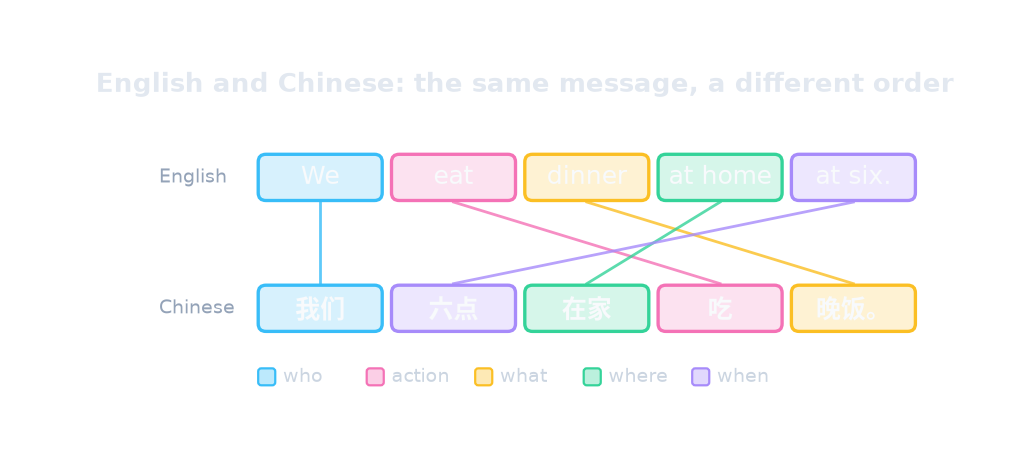
Which option has the straightforward subject–verb–place–time order practised here?
Difficulty 1/5 · 100 coins + a small bonus on first completion today
I go to school at eight has that requested order. At eight, I go to school is also grammatical, but it is not the order requested in this item.
Translate into English: 我每天八点去学校。
Difficulty 3/5 · 200 coins + a small bonus on first completion today
I go to school at eight every day is one answer. Every day, I go to school at eight also preserves the routine and time.
Which revision moves the time to the beginning and keeps “We eat lunch at one” unchanged in meaning?
Difficulty 1/5 · 100 coins + a small bonus on first completion today
At one is a complete time phrase. Moving it to the beginning keeps the lunch time; exchanging lunch and one changes their roles.
Describing things: adjective before noun
- English: adjective + noun — a red apple, my new book.
- In a noun phrase, use a red apple, not an apple red. In the complete clause The apple is red, the adjective follows is; adjective-before-noun is not a rule for every position.
- my book means 我的书. his name means 他的名字. In these noun phrases, my or his comes before the noun, with any describing adjective between: my new book. Compare the standalone possessive in The book is mine.
- my book — a book belonging to the speaker.
- his name — the name of the person referred to as he.
Choose the noun phrase with one adjective before the noun.
Difficulty 1/5 · 100 coins + a small bonus on first completion today
Her introduces the phrase; green describes coat before the noun. Compare the different clause Her coat is green, where green follows is.
always, usually, often
- A common position is before an ordinary main verb: I always drink tea. With be, use She is often tired; after an auxiliary, I have always liked tea.
- ❌ I drink always tea. → ✓ I always drink tea.
- I always go to bed early is a useful neutral pattern. Words such as often can also begin a sentence: Often, I walk home. Position depends on the particular adverb and the intended focus.
Put “always” in the right place: I ___ drink tea in the morning.
Difficulty 1/5 · 100 coins + a small bonus on first completion today
In the gap given, always comes before drink. With be, a common pattern is She is always ready; some other adverb positions depend on the word and context.
Use the common position after be: The station ___ busy.
Difficulty 1/5 · 100 coins + a small bonus on first completion today
The station is often busy places often after is and before busy. The other choices repeat a word; do not infer a ban on every other adverb position.
Choose the question pattern
- Chinese can use a question particle in some yes/no questions. English has several question patterns too.
- For ordinary present-simple yes/no questions with like, use do / does: Do you like tea? Does he like tea? With be or a modal, use Is she ready? Can he swim?; Who lives here? asks about the subject without do.
- Do you like tea? — a question asking whether the listener likes tea.
- The main verb goes back to the base form: ❌ Does he likes tea? → ✓ Does he like tea?
Choose the ordinary yes/no question with does, rather than an echo or confirmation question.
Difficulty 1/5 · 100 coins + a small bonus on first completion today
Does he like tea? is the ordinary auxiliary-first question requested. He does like tea? can be a confirmation question with suitable intonation; it is not ungrammatical in every context.
Choose the ordinary yes/no question with can.
Difficulty 1/5 · 100 coins + a small bonus on first completion today
Can comes before Jo; drive stays in its base form. Do not add does to this can question or add -s to drive.
Revise a simple message
- ❌ I very like it. → ✓ I like it very much. — for this meaning use I like it very much or I really like it.
- He goes to school every day is a neutral routine sentence. Every day, he goes to school is also natural; a fronted time phrase is not wrong simply because Chinese also allows it.
- ❌ You are what name? → ✓ What is your name? — question word first, then the verb.
- I have lunch at home is a straightforward order. At home, I have lunch at twelve is also possible; do not require every place phrase to be last.
Choose the clear routine pattern
Distinguish the straightforward patterns practised here; a marked or context-dependent order is not automatically a Chinese-language error.
Match each example to its straightforward neutral version. These models are not the only grammatical ways to express the ideas.
Difficulty 2/5 · 140 coins + a small bonus on first completion today
The right-hand examples use straightforward patterns. Every day, he goes to school and At home, I have lunch are also possible; do not turn these model revisions into a universal position rule.
Is this sentence correct? “My new schoolbag is big.”
Difficulty 1/5 · 100 coins + a small bonus on first completion today
“my” and “new” both come before the noun — correct order.
Worked contrasts: preserve the message
- Who acts: Leo follows the guide makes Leo the follower. The guide follows Leo exchanges subject and object and reverses their roles. The word list alone does not preserve the meaning.
- Time and questions: We practise at six and At six, we practise preserve the same practice time. Contrast Does Kim practise?, Is Kim ready? and Can Kim help?: choose the auxiliary for the verb pattern; do not add does to is or can.
Write two true sentences about your day: one with a time, one with a place.
Difficulty 3/5 · 200 coins + a small bonus on first completion today
Example: “I have breakfast at seven. I study English at home.”
Apply a pattern, then check its scope
- Write two true English sentences about your day: one with a time, one with a place. Keep the facts unchanged if you move a complete time phrase to the beginning.
- Check an ordinary statement or question, rather than banning every possible alternative order. In a useful neutral sentence, keep the main verb and its object together; a verb such as sleep may have no object.
Independent decisions
- Use the requested frame and the stated meaning. Separate a wrong form from a grammatical sentence that answers a different question.
- After a miss, name the cause: a changed subject/object, a lost time/place detail, an adjective or possessive phrase, or the wrong question auxiliary. Then try a fresh context.
Choose the straightforward subject–verb–object statement.
Difficulty 1/5 · 100 coins + a small bonus on first completion today
Noor is the subject, cooks the verb and rice the object. The requested neutral statement puts them in that order.
“The children sleep.” What is missing for this to be a complete ordinary sentence?
Difficulty 1/5 · 100 coins + a small bonus on first completion today
Sleep does not require an object here. The subject and verb give a complete statement; a place or time can add information but is not required.
Which sentence keeps “We meet at four on Tuesday” but starts with the day?
Difficulty 1/5 · 100 coins + a small bonus on first completion today
On Tuesday is the day phrase, and at four gives the time. Moving the day phrase keeps the meeting facts; swapping the phrases or actor does not.
“At home, I read after dinner.” What does this sentence say?
Difficulty 1/5 · 100 coins + a small bonus on first completion today
The opening place phrase sets the scene. After dinner gives when the reading happens; it does not reverse the order of dinner and reading.
Complete with the common frequency-adverb position: Lin ___ the bus to work.
Difficulty 1/5 · 100 coins + a small bonus on first completion today
Usually takes places the adverb before the ordinary main verb takes. The other choices repeat a verb. With be the common position differs.
Complete with often after be: The students ___.
Difficulty 1/5 · 100 coins + a small bonus on first completion today
Are often ready uses the requested position without repeating a word. This item practises one common pattern, rather than banning every other adverb position.
Complete with always after the auxiliary: I ___ this small bag.
Difficulty 1/5 · 100 coins + a small bonus on first completion today
Have always liked puts always after have and before liked. The other choices repeat always or liked; the complete verb phrase matters.
Choose the ordinary does question.
Difficulty 1/5 · 100 coins + a small bonus on first completion today
Does carries the present-simple agreement, so work is the base form. Works after does repeats the agreement marking.
Choose the ordinary yes/no question about whether the shop is open.
Difficulty 1/5 · 100 coins + a small bonus on first completion today
With be, put is before the subject the shop. Do not add does; open remains the complement after the subject.
Choose the ordinary question asking about the possibility of sitting here.
Difficulty 1/5 · 100 coins + a small bonus on first completion today
Can comes before we, followed by the base form sit. This question does not use do or an -s ending on sit.
Choose the ordinary question asking which person lives upstairs.
Difficulty 1/5 · 100 coins + a small bonus on first completion today
Who is the subject, so Who lives upstairs? does not need do. Do not turn the do/does pattern for other questions into a rule for every question.
Choose the noun phrase that describes a bike as new and belonging to me.
Difficulty 1/5 · 100 coins + a small bonus on first completion today
My goes before the adjective new and the noun bike. Mine stands alone in a different frame such as The bike is mine.
Complete the ordinary sentence with a standalone possessive: This seat is ___.
Difficulty 1/5 · 100 coins + a small bonus on first completion today
Yours stands for your seat. Your needs a following noun, so it does not complete the standalone possessive slot.
Choose the straightforward statement expressing strong liking.
Difficulty 1/5 · 100 coins + a small bonus on first completion today
Really can modify like in I really like this song. Another natural choice is I like this song very much; very alone does not modify like in that way.
Choose the neutral order that keeps read next to its object, the email, before giving the time.
Difficulty 1/5 · 100 coins + a small bonus on first completion today
The requested neutral pattern keeps read the email together, then adds after class. After class, I read the email is another possible order, but is not among these choices.
Choose the ordinary question asking the time of your departure.
Difficulty 1/5 · 100 coins + a small bonus on first completion today
What time comes first, followed by do, you and the base form leave. You leave at what time? can be an echo question, but that is a different pattern from the one requested.
A learner says “Every English sentence must have an object.” Which reply is accurate?
Difficulty 1/5 · 100 coins + a small bonus on first completion today
Laughs is the verb and does not require an object in this sentence. The example disproves the universal claim without changing the useful subject–verb–object pattern for other verbs.
Compare “Sara helps Dan” and “Dan helps Sara”. What changes?
Difficulty 1/5 · 100 coins + a small bonus on first completion today
The subject and object exchange roles. Using the same words in another order can change the message, even though neither sentence gives a time.
The speaker wants to contrast two books: “This book I like; that one I don’t.” Which advice fits?
Difficulty 1/5 · 100 coins + a small bonus on first completion today
Contrast can bring the object forward. The two clauses explicitly differ in liking; a useful neutral model does not justify an absolute ban on fronting.
Compare “a blue door” and “The door is blue”. Which explanation is right?
Difficulty 1/5 · 100 coins + a small bonus on first completion today
A blue door is a noun phrase; The door is blue is a clause with subject, be and complement. The adjective-before-noun pattern does not ban adjectives after be.
Transfer to a short message
- A new message combines a meeting place and time with a question. Write in English from the notes, then reveal the comparison and revise one mismatch.
- Models show possible answers. A clear initial time phrase is allowed; the question must still use the particular does or can pattern the task requests. Written self-review does not establish correctness or proficiency.
Studio notes: I help Bo; at the studio; on Fridays. Choose the message that preserves who helps whom, where and when.
Difficulty 1/5 · 100 coins + a small bonus on first completion today
On Fridays can begin the sentence while I remains the helper and Bo the person helped. Reversing I and Bo changes the roles; moving words at random loses their relationships.
Notes: I meet Rosa; at the gallery; every Saturday; at ten. I want to ask whether Rosa likes the new display. Write two English sentences: a statement preserving the meeting facts and an ordinary yes/no question with does. Compare your answer, then revise one point.
Compare the facts, word order and question pattern with your English. Revise one actual mismatch or explain why no change is needed. This written self-review does not award correctness or certify proficiency.
Keep the order working
- Tomorrow, before rereading: recall one statement beginning with a time phrase, one does question and one can question. Try the club-message task and revise your actual wording.
- Next: comparatives, spoken routines and requests or routines listening. Typed practice supports sentence planning; it does not check spoken fluency.
Usage references checked 20 October 2026: Cambridge: word order and focus, British Council: adverbial position. Independent language and learner review remain pending.
Recall the ordinary present-simple question with does.
Difficulty 1/5 · 100 coins + a small bonus on first completion today
Does comes before the subject the bus, followed by the base form stop. Here comes after the verb in this neutral question.
“At nine, the lesson begins.” Which judgement is accurate?
Difficulty 1/5 · 100 coins + a small bonus on first completion today
The lesson is still the subject and begins is the verb. At nine sets the time before that clause; initial time phrases are allowed.
Later recall, before rereading: Notes: the club is often busy; Amir reads there after lunch. You want to ask whether Amir can help. Write three English sentences: put often after is in the first; begin the second with After lunch; make the third an ordinary can question. Do not change the people or the place.
Compare the facts, word order and question pattern with your English. Revise one actual mismatch or explain why no change is needed. This written self-review does not award correctness or certify proficiency.