The Indian Ocean
Introduced| English | Meaning |
|---|---|
| monsoon winds/mɒnˈsuːn wɪndz/ | Seasonally reversing winds associated with differences in heating between land and sea. |
| compass/ˈkʌmpəs/ | compass |
| astrolabe/ˈæstrəleɪb/ | An instrument used to find latitude from the stars. |
| diasporic communities/ˌdaɪəˈspɒrɪk kəˈmjuːnɪtiz/ | Communities living away from an ancestral homeland while maintaining connections to it. |
| Zheng He/ʒeŋ hiː/ | The Ming admiral who led major maritime expeditions across the Indian Ocean region. |
A trade route made of weather
- The expansion and intensification of long-distance trade routes often depended on environmental knowledge, including advanced knowledge of the monsoon winds 季风.
- The monsoons reverse twice a year, so a ship sails out on one season and home on the other.
- That makes the whole network seasonal — and the CED counts environmental knowledge as a cause of trade growth.
The monsoon winds mattered because they...
Difficulty 1/5 · 100 coins + a small bonus on first completion today
The CED counts environmental knowledge as a cause of trade growth.
Instruments and ships
- Innovations in previously existing transportation and commercial technologies here include the compass 罗盘, the astrolabe 星盘, and larger ship designs.
- The compass gives direction out of sight of land; the astrolabe gives latitude.
- Bigger hulls make each voyage carry more, which is the same volume argument as the Silk Roads' credit.

The three networks compared by what they carried, what enabled them, and what they changed
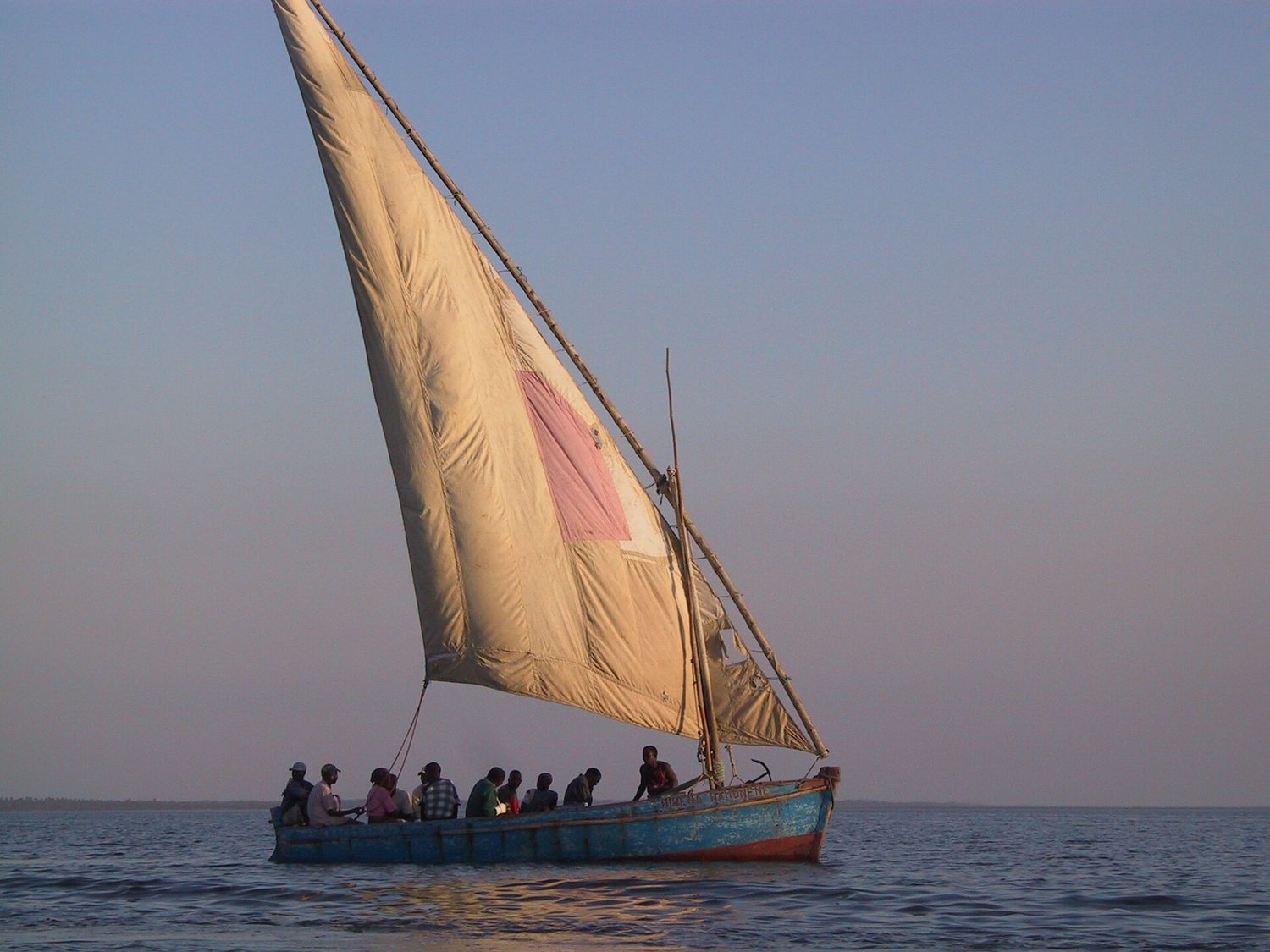
A dhow under lateen sail- the rig that let a ship work across the monsoon system
Select all the technologies the CED names for the Indian Ocean.
Difficulty 2/5 · 140 coins + a small bonus on first completion today
The camel saddle belongs to trans-Saharan trade, subtopic 2.4.
The network built states
- The Indian Ocean trading network fostered the growth of states.
- The CED's examples: the city-states of the Swahili Coast, Gujarat, and the Sultanate of Malacca.
- Each sits where the network needs a stop — and taxing that stop is a state's revenue.
Cause, state, or cultural exchange?
Sort each item by its role in the Indian Ocean subtopic.
Select all the states the CED says the network fostered.
Difficulty 2/5 · 140 coins + a small bonus on first completion today
Mali belongs to trans-Saharan trade.
Cultural influence in diasporic communities 侨居社群 ran both ways. The CED says merchants introduced their traditions into indigenous cultures and, in turn, indigenous cultures influenced merchant cultures. An answer that describes only what merchants brought has used half the sentence.
In diasporic communities, cultural influence ran in both directions.
Difficulty 1/5 · 100 coins + a small bonus on first completion today
The CED's in turn is load-bearing — indigenous cultures influenced merchant cultures too.
Merchants settled and mixed
- In key places along important trade routes, merchants set up diasporic communities where they introduced their own cultural traditions into the indigenous cultures and, in turn, indigenous cultures influenced merchant cultures.
- The CED's in turn is load-bearing: influence ran both ways.
- Examples: Arab and Persian communities in East Africa, Chinese merchant communities in Southeast Asia, Malay communities across the basin.
Ming Admiral ____ led state maritime expeditions into a merchant-built network.
Difficulty 1/5 · 100 coins + a small bonus on first completion today
They moved envoys, goods and prestige rather than founding colonies.
Zheng He 郑和 as a state-scale voyage
- Interregional contacts and conflicts encouraged significant technological and cultural transfers, including during Chinese maritime activity led by Ming Admiral Zheng He.
- These were state expeditions on an unprecedented scale, moving envoys, goods and prestige rather than founding colonies.
- They show a state entering a network that merchants had already built — which is the shape of this whole subtopic.
On the Swahili Coast, Arab and Persian merchants brought Islam and Arabic script; local Bantu language, kinship and building practice shaped what the resulting Swahili society looked like. Neither side stayed as it arrived — which is exactly what "in turn" is describing.
Indian Ocean trade depended on environmental knowledge, especially the monsoon winds, plus the compass, astrolabe and larger ships. The network fostered the growth of states — Swahili city-states, Gujarat, Malacca — and merchants' diasporic communities exchanged cultural influence in both directions. Zheng He shows a state entering a merchant-built network.
Write from a reversing monsoon
- A ship in the Indian Ocean sailed west on one seasonal wind.
- Months later the wind blew the other way.
How did the wind make a return voyage possible?
A seasonal reversal made scheduled ocean trade possible.
What did the monsoon do for sailors?
Difficulty 1/5 · 100 coins + a small bonus on first completion today
The seasonal turn of the wind is the monsoon pattern.