Comparing State Formation
IntroducedThe unit's whole point arrives here
- Explain the similarities and differences in the processes of state formation from c. 1200 to c. 1450.
- The CED's own review sentence is: state formation and development demonstrated continuity, innovation and diversity in various regions.
- So the comparison is not an add-on — it is what the six regional subtopics were assembled for.
The objective asks about the ____ of state formation.
Difficulty 1/5 · 100 coins + a small bonus on first completion today
How states came to be and held together — not a list of who ruled where.
Compare processes, not lists
- The objective says processes of state formation — how states came to be and held together.
- So the comparable things are: how power was justified, how revenue was collected, and how distance was managed.
- Two states compared on those three questions produce a real answer; two states described in turn do not.
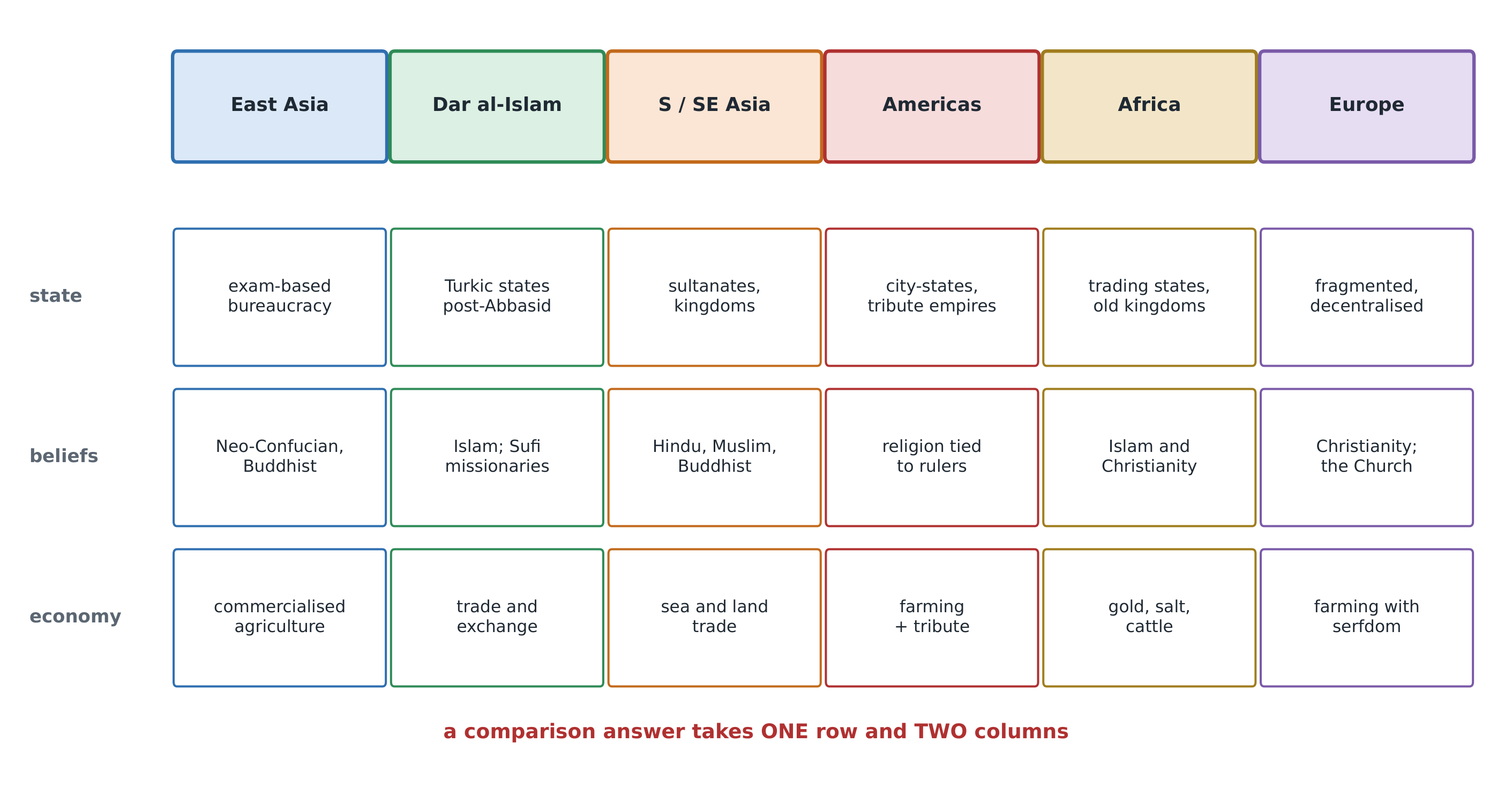
One framework, six regions: state, belief system, and economic base are what comparison questions actually ask about

Belief systems by what they did for authority, not by what they taught
Select all three portable comparison questions.
Difficulty 2/5 · 140 coins + a small bonus on first completion today
Population is a fact; the other three are processes.
Justification is the most portable comparison
- Song China justified rule through Confucianism; Ethiopia through a Christian royal tradition; the Delhi sultanates through Islamic legitimacy.
- Every state in the unit justified itself somehow, so this question always has an answer.
- That makes it the safest comparison to reach for when a prompt gives you free choice of regions.
Which comparison question does this belong to?
Sort each observation by the three portable questions.
Only differences count in a comparison answer.
Difficulty 1/5 · 100 coins + a small bonus on first completion today
The objective asks for similarities and differences, in that order.
Describing two states in turn is not comparing them. The objective asks about processes of state formation — so the paragraph must run one question at a time (justification, revenue, distance) across both states, not one state at a time across all questions.
A comparison paragraph runs one ____ at a time across both states.
Difficulty 1/5 · 100 coins + a small bonus on first completion today
Describing one state at a time across all questions is not comparing.
Similarity is worth as much as difference
- The objective asks for similarities and differences, in that order.
- A shared problem — extracting a surplus from farmers and keeping order far from the centre — is a similarity across every region in this unit.
- Answers that only list contrasts have addressed half the objective.
Put the comparison routine in order.
Difficulty 3/5 · 200 coins + a small bonus on first completion today
The last sentence is the analysis; the first three are the setup.
A comparison routine
- Pick two states from different regions. Name the shared problem in one sentence.
- Compare them on justification, revenue and distance — three sentences, one each.
- Then say which difference mattered most, and why. That last sentence is the analysis.
Shared problem: both the Song state and a European monarchy had to extract from farmers and keep order far from the centre. Justification: Confucian merit against sacred kingship. Revenue: coin and canal against land and dues. Distance: transferable officials against hereditary lords — and that last difference is the one that decided how each state could change.
Explain the similarities and differences in the processes of state formation — the CED's review sentence is that state formation showed continuity, innovation and diversity in various regions. Compare on justification, revenue and distance, run one question at a time across both states, and treat similarity as equal in value to difference.
Write from religion used to justify rule
- Song officials studied Confucian texts for the civil-service exam.
- Aztec rulers used religious ritual as well as tribute.
What similar claim did both states make about rule?
Both states explained why rulers deserved obedience.
What did Song China and the Aztec empire both use?
Difficulty 1/5 · 100 coins + a small bonus on first completion today
The shared process is justifying rule. The exam is the difference.