The Nervous System
Introduced| English | Meaning |
|---|---|
| central nervous system/ˈsentrəl ˈnɜːvəs ˈsɪstəm/ | The brain and spinal cord, which process information and coordinate responses. |
| spinal cord/ˈspaɪnl kɔːd/ | The part of the central nervous system inside the vertebral column that carries signals and coordinates some reflexes. |
| peripheral nervous system/pəˈrɪfərəl ˈnɜːvəs ˈsɪstəm/ | The nerves and associated structures outside the brain and spinal cord. |
| somatic/səˈmætɪk/ | somatic |
| autonomic/ɔːtəˈnɒmɪk/ | autonomic |
| sympathetic/ˌsɪmpəˈθetɪk/ | sympathetic |
| parasympathetic/ˌpærəˌsɪmpəˈθetɪk/ | parasympathetic |
Pull your hand back before you feel the heat
- Touch something hot and your hand moves before you notice the pain.
- Two different parts of the body did those two jobs, at two different speeds.
- Unit 1 is about which part does what.
The central nervous system
- The central nervous system 中枢神经系统 (CNS) is the brain and the spinal cord 脊髓.
- It interacts with every process in the body.
- It is where decisions are made and where most sensation is finally registered.
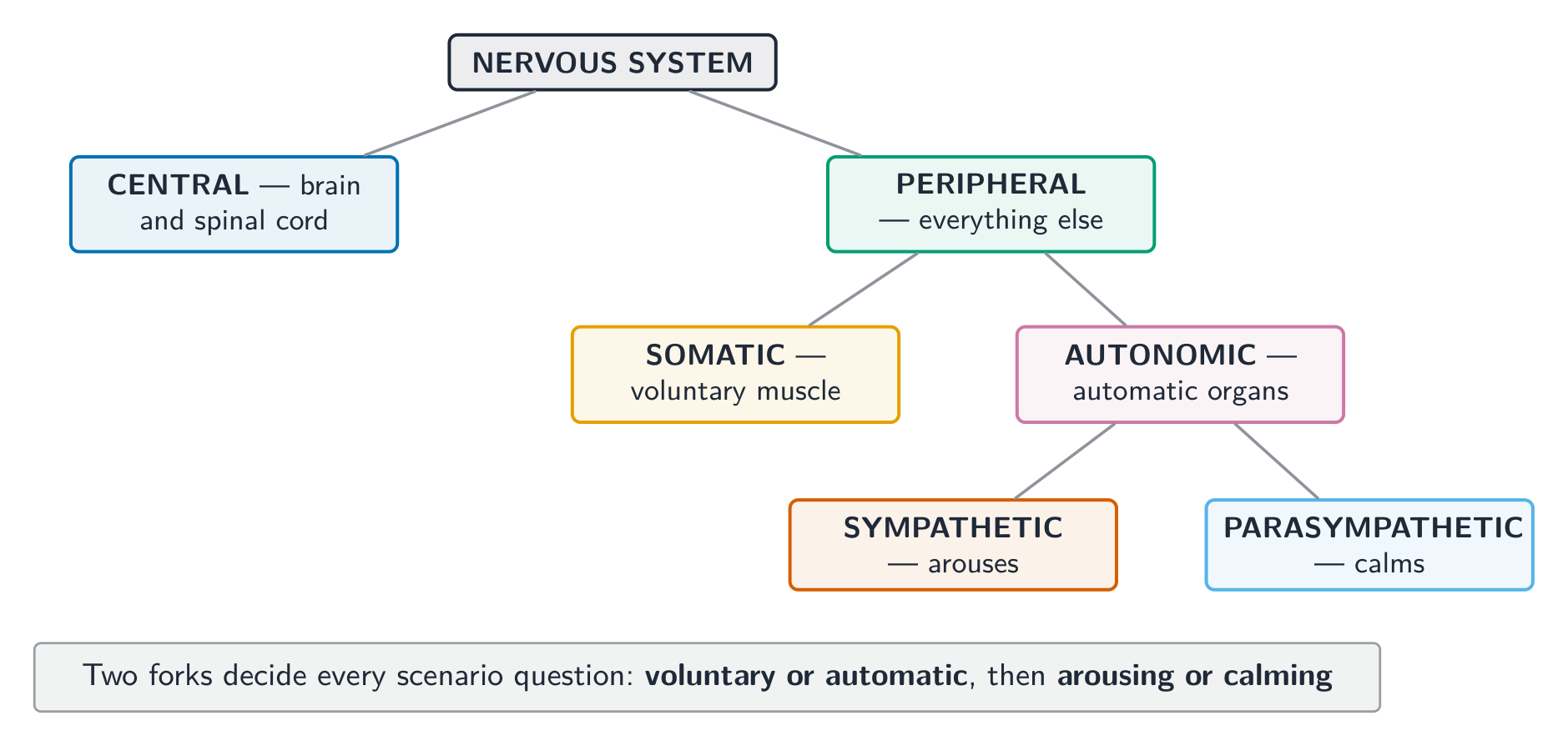
Two forks decide every scenario question: voluntary or automatic, then arousing or calming
The central nervous system consists of...
Difficulty 1/5 · 100 coins + a small bonus on first completion today
The CNS is the brain plus the spinal cord; everything else is peripheral.
The peripheral nervous system
- The peripheral nervous system 周围神经系统 (PNS) relays messages between the CNS and the rest of the body.
- Its somatic 躯体的 branch carries voluntary movement — raising your hand.
- Its autonomic 自主的 branch runs involuntary processes — heartbeat, digestion.
Which part of the nervous system?
Place each structure or job in the right branch.
The ____ branch of the peripheral nervous system runs involuntary processes such as digestion.
Difficulty 1/5 · 100 coins + a small bonus on first completion today
The autonomic branch handles involuntary processes; the somatic branch handles voluntary movement.
Select all processes run by the autonomic nervous system.
Difficulty 2/5 · 140 coins + a small bonus on first completion today
Choosing to stand up is voluntary, so it belongs to the somatic branch.
Do not treat autonomic as meaning "automatic and unchangeable". Breathing is autonomic and you can still hold your breath; the two branches also overlap in time rather than switching cleanly from one to the other.
The parasympathetic branch prepares the body for fight or flight.
Difficulty 1/5 · 100 coins + a small bonus on first completion today
That is the sympathetic branch. The parasympathetic branch calms the body afterwards.
Two branches that work against each other
- The sympathetic 交感 branch prepares the body for action — the "fight or flight" response.
- The parasympathetic 副交感 branch calms the body afterwards.
- They oppose each other on purpose: one spends resources, the other restores them.
Match each branch to its job.
Difficulty 2/5 · 140 coins + a small bonus on first completion today
Somatic = voluntary; sympathetic = arouse; parasympathetic = calm.
Holding the whole tree
- Nervous system splits into central and peripheral.
- Peripheral splits into somatic (voluntary) and autonomic (involuntary).
- Autonomic splits into sympathetic (arouse) and parasympathetic (calm).
You hear a loud bang. Your heart rate jumps, your pupils widen and digestion slows — the sympathetic branch. A minute later you realise it was a door, and your heart slows again — the parasympathetic branch restoring the body.
The CNS is brain plus spinal cord. The PNS carries messages to and from it, splitting into somatic (voluntary) and autonomic (involuntary), and the autonomic splits again into sympathetic (arouse) and parasympathetic (calm).
Write from a heart-rate rise of 40
- Before a race, heart rate rises from 70 to 110 beats a minute. After the race it falls and digestion resumes.
- Name the two autonomic branches.
Heart rate rises from 70 to 110 before a race, then falls as digestion resumes. Which autonomic branches are at work?
110 minus 70 is 40. Arousal and the later calming are the two autonomic directions.
Which branch raises the heart rate here?
Difficulty 1/5 · 100 coins + a small bonus on first completion today
A rise from 70 to 110 is sympathetic arousal. Recovery is parasympathetic.