Disequilibrium and Changes in Equilibrium
Introduced| English | Meaning |
|---|---|
| surplus/ˈsɜːpləs/ | An amount exceeding what is required; in a market, quantity supplied above quantity demanded at a given price. |
| shortage/ˈʃɔːtɪdʒ/ | A situation in which quantity demanded exceeds quantity supplied at the prevailing price. |
| indeterminate/ˌɪndɪˈtɜːmɪnət/ | Not uniquely determined by the information supplied; for example, simultaneous curve shifts may leave a price change ambiguous. |
| simultaneous shift/ˌsɪməlˈteɪnɪəs ʃɪft/ | A change in both demand and supply curves, requiring both effects to be considered when predicting a new equilibrium. |
Too high, too low, or just right
- Leave a market alone and it drifts toward one special price.
- Set the price too high and unsold goods pile up; too low and buyers fight over too little.
- Either way, pressure builds that pushes the price back.
- Understanding that pressure lets you predict where a market will land.
Surplus and shortage
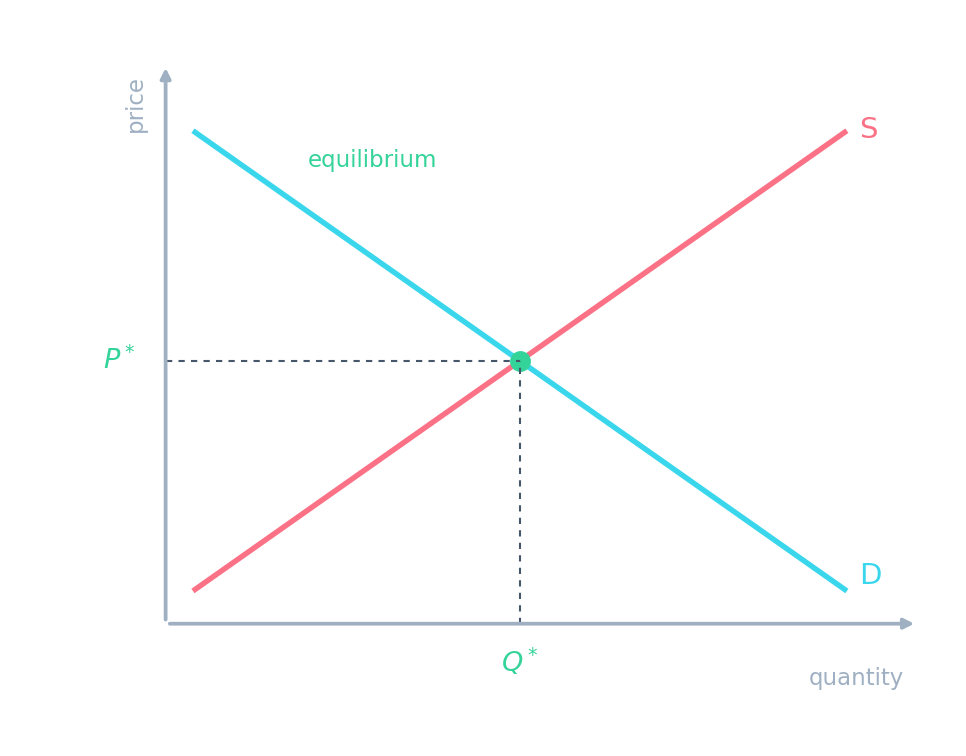
- Above equilibrium: quantity supplied exceeds quantity demanded — a surplus 过剩 (excess supply). Sellers cut prices.
- Below equilibrium: quantity demanded exceeds quantity supplied — a shortage 短缺 (excess demand). Buyers bid prices up.
- So a free market self-corrects: a surplus pushes the price down, a shortage pushes it up.
If the price is set above the equilibrium, the market has a:
Difficulty 1/5 · 100 coins + a small bonus on first completion today
Above equilibrium, quantity supplied exceeds quantity demanded — a surplus, so sellers cut prices.
When the price is below equilibrium, excess demand creates a ______.
Difficulty 1/5 · 100 coins + a small bonus on first completion today
A shortage pushes buyers to bid the price up toward equilibrium.
One shift moves the equilibrium
- When a determinant changes, a curve shifts and equilibrium moves. Trace it in two steps.
- Demand right: price up, quantity up. Demand left: price down, quantity down.
- Supply right: price down, quantity up. Supply left: price up, quantity down.
Shift a curve, move the equilibrium
Change a determinant and one curve shifts, moving the equilibrium to a new price and quantity. Try each shift and read the new crossing point.
Demand shifts right (supply unchanged). Price and quantity:
Difficulty 1/5 · 100 coins + a small bonus on first completion today
A rightward demand shift raises both the equilibrium price and quantity.
Put the steps to find a new equilibrium after a change in order.
Difficulty 3/5 · 200 coins + a small bonus on first completion today
Name the shifter, move the right curve the right way, then read the new crossing point.
Select all single shifts that raise the equilibrium price.
Difficulty 2/5 · 140 coins + a small bonus on first completion today
Demand-right and supply-left both raise price; the other two lower it.
When both curves shift
- If demand and supply move at once, one result is clear and the other is indeterminate 不确定 — it depends on which shift is bigger.
- Demand right and supply right → quantity definitely rises; price is indeterminate.
- Demand right and supply left → price definitely rises; quantity is indeterminate.
With a simultaneous shift 同时移动, always sketch both moves. The diagram fixes one variable but cannot fix the other without knowing the sizes of the two shifts.
When both demand and supply shift at once, both price and quantity are always determinate.
Difficulty 1/5 · 100 coins + a small bonus on first completion today
One is determinate; the other depends on which shift is larger — it is indeterminate.
Above equilibrium sits a surplus, below it a shortage, and the price self-corrects. A single shift moves both price and quantity predictably; a simultaneous shift pins down only one of them — the other is indeterminate.
Write from a quantity of 28 at the same price
- Equilibrium was quantity 20 at price 8.
- After two shifts, quantity is 28 and price is still 8.
Equilibrium was quantity 20 at price 8. After the curves shift, quantity is 28 and price is still 8. What pair of shifts fits that result?
28 minus 20 is 8, and an unchanged price needs both a demand and a supply shift.
Which shifts fit a higher quantity and the same price?
Difficulty 1/5 · 100 coins + a small bonus on first completion today
Matching rightward shifts can raise quantity from 20 to 28 and leave price at 8.