Marginal Analysis and Consumer Choice
Introduced| English | Meaning |
|---|---|
| margin/ˈmɑːdʒɪn/ | The point at which a decision involves a small additional unit or change rather than the entire activity. |
| marginal benefit/ˈmɑːdʒɪnl ˈbenɪfɪt/ | The additional benefit gained from consuming or undertaking one more unit of an activity. |
| marginal cost/ˈmɑːdʒɪnl kɒst/ | The additional total cost of producing one more unit of output. |
| utility/juːˈtɪlɪti/ | The satisfaction or benefit a consumer obtains from consuming goods or services. |
| law of diminishing marginal utility/lɔː ɒv dɪˈmɪnɪʃɪŋ ˈmɑːdʒɪnl juːˈtɪlɪti/ | The tendency for successive units of a good to provide less additional satisfaction over the relevant period, other conditions held constant. |
Why the fifth slice isn't worth it
- The first slice of pizza is amazing. The second, great. By the fifth... meh.
- Each extra slice gives less added enjoyment than the one before.
- Smart choices are rarely "all or nothing" — they happen one unit at a time.
- Economists call this thinking at the margin 边际.
Think at the margin
- Marginal benefit 边际收益 (MB) is the extra benefit from one more unit.
- Marginal cost 边际成本 (MC) is the extra cost of one more unit.
- The rule for any rational choice: keep going while $MB > MC$, and stop where $MB = MC$.
- That point gives the greatest total net benefit — go further and each extra unit costs more than it is worth.
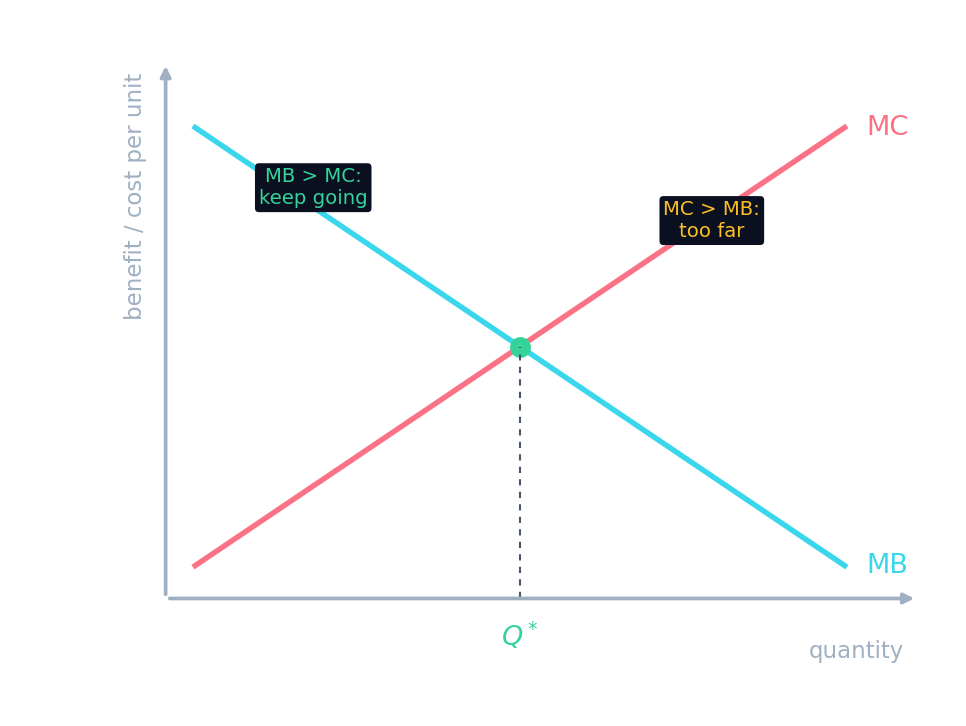
A rational decision-maker keeps doing an activity as long as:
Difficulty 1/5 · 100 coins + a small bonus on first completion today
Keep going while MB > MC; stop where MB = MC for the greatest net benefit.
The 4th cookie has a marginal benefit of 6 dollars and a marginal cost of 2 dollars. By how much (in dollars) does making it change your net benefit?
Difficulty 2/5 · 140 coins + a small bonus on first completion today
Net benefit rises by $MB - MC = 6 - 2 = 4$. Since MB > MC, it is worth making.
Select all true statements about the best quantity $Q^*$ where $MB = MC$.
Difficulty 2/5 · 140 coins + a small bonus on first completion today
At $Q^*$, MB = MC gives the maximum net benefit; MB is highest at the first unit, not at $Q^*$.
Diminishing marginal utility
- Utility 效用 is the satisfaction a good gives you.
- The law of diminishing marginal utility 边际效用递减规律 says each extra unit adds less satisfaction than the last.
- The first slice of pizza has high marginal utility; the fifth adds little.
- This is exactly why demand curves slope downward — you only buy more if the price falls to match the smaller benefit.
Watch marginal utility fall
Each extra unit adds less satisfaction than the last — a falling curve. That is the law of diminishing marginal utility, and it is why demand slopes down.
The law of diminishing marginal utility says that as you consume more of a good:
Difficulty 1/5 · 100 coins + a small bonus on first completion today
Marginal (extra) utility falls with each unit — total utility still rises, just more slowly.
Diminishing marginal utility helps explain why demand curves slope downward.
Difficulty 1/5 · 100 coins + a small bonus on first completion today
Because extra units are worth less, you only buy more when the price falls.
Spend a budget for the most satisfaction
- To get the most from a fixed budget, compare the marginal utility per dollar across goods.
- The utility-maximizing rule: set $\dfrac{MU_x}{P_x} = \dfrac{MU_y}{P_y}$.
- If one good gives more utility per dollar, shift spending toward it — until the ratios balance.
- That balance is the most satisfaction your money can buy.
To maximize utility from a budget, marginal utility per ______ should be equal across all goods.
Difficulty 1/5 · 100 coins + a small bonus on first completion today
The utility-maximizing rule equalises $MU/P$ across goods — marginal utility per dollar.
Worked examples
1. Good A costs 2 and its next unit gives 10 utils; good B costs 4 and its next unit gives 24 utils. Marginal utility per unit of money: A $= 10/2 = 5$, B $= 24/4 = 6$. Buy B next, because it gives more satisfaction per unit spent.
2. Keep buying the good with the higher $MU/P$ until $\dfrac{MU_A}{P_A} = \dfrac{MU_B}{P_B}$ and the budget is used up: that is the utility-maximizing bundle.
The 5th hour of revision has a marginal benefit of 9 dollars and a marginal cost of 4 dollars. By how much does that hour change net benefit, and should you do it?
9 minus 4 is 5, and 5 is positive.
By how much does the 5th hour change net benefit?
Difficulty 1/5 · 100 coins + a small bonus on first completion today
9 minus 4 is 5, so net benefit rises. Other options — It rises by 4 (the lesson cookie); It falls (because cost is positive).
Think at the margin: do one more unit while MB > MC, and stop at MB = MC. Extra units give less satisfaction (diminishing marginal utility), which is why demand slopes down. Spend a budget so marginal utility per dollar is equal across all goods.
Write from a net benefit of 5
- The 5th hour of revision has marginal benefit 9 and marginal cost 4.
- Find the change in net benefit.