Banking and the Expansion of the Money Supply
Introduced| English | Meaning |
|---|---|
| deposit/dɪˈpɒzɪt/ | Money placed in an account with a financial institution. |
| fractional reserve banking/ˈfrækʃənl rɪˈzɜːv ˈbæŋkɪŋ/ | A banking arrangement in which banks hold reserves equal to only a fraction of their deposit liabilities rather than backing every deposit fully with reserves. |
| required reserves/rɪˈkwaɪəd rɪˈzɜːvz/ | The minimum reserves a bank must hold under an applicable reserve rule; the amount depends on that rule and the relevant deposit base. |
| reserve ratio/rɪˈzɜːv ˈreɪʃɪəʊ/ | A bigger multiplier — banks lend more of each deposit. |
| money multiplier/ˈmʌni ˌmʌltɪˈplaɪə/ | In a stylised reserve-constrained banking model, the maximum deposit expansion per extra unit of reserves, equal to one divided by the reserve ratio under its simplifying assumptions. |
How banks create money
- Banks do not keep all your deposits locked in the vault.
- They keep a fraction and lend the rest out.
- Those loans become new deposits elsewhere — which are lent again.
- So the banking system actually creates money.
Fractional reserve banking
- Under fractional reserve banking 部分准备金银行制度, a bank keeps only a fraction as required reserves 法定准备金 and lends the rest.
- The fraction kept is the reserve ratio 准备金率.
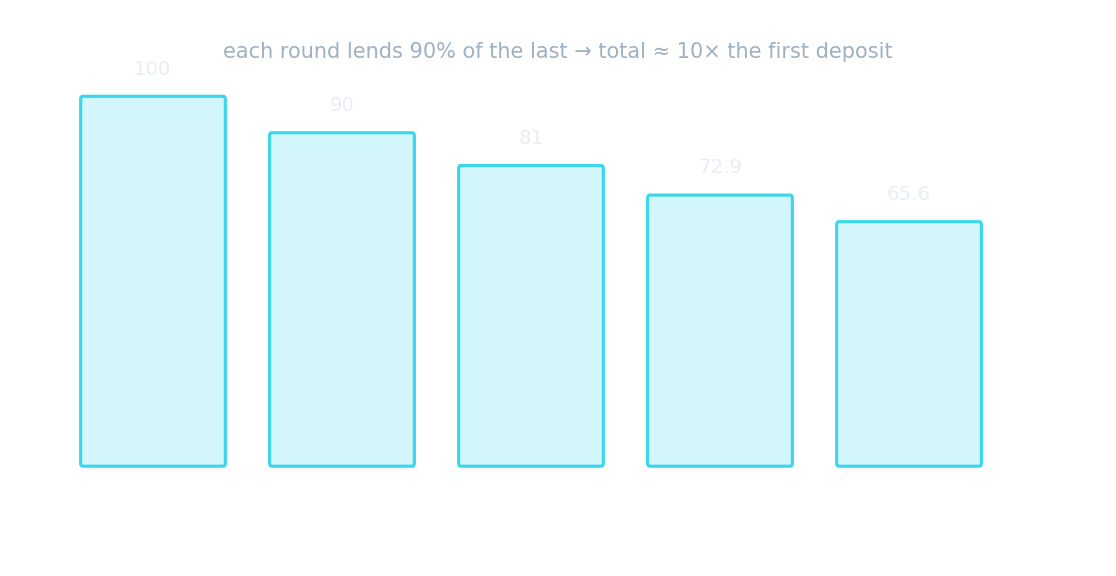
- A new deposit 存款 of reserves ripples outward: lent, redeposited, lent again — a shrinking chain.
Reserves or loans?
A bank keeps a fraction of each deposit as required reserves and lends out the rest, which becomes new deposits — creating money.
The fraction of deposits a bank must keep rather than lend is the ______ ratio.
Difficulty 1/5 · 100 coins + a small bonus on first completion today
The reserve ratio sets how much banks keep; the rest is lent out.
The money multiplier
- The most the money supply can grow from new reserves is the money multiplier 货币乘数.
- $\text{money multiplier} = \dfrac{1}{\text{reserve ratio}}$.
- Worked idea. A 10% reserve ratio gives a multiplier of $1/0.10 = 10$.
- So 1,000 of new reserves can grow the money supply by at most $1{,}000 \times 10 = 10{,}000$.
The money multiplier equals:
Difficulty 1/5 · 100 coins + a small bonus on first completion today
Money multiplier = 1 ÷ reserve ratio.
The reserve ratio is 10% (0.10). What is the money multiplier?
Difficulty 2/5 · 140 coins + a small bonus on first completion today
Money multiplier = 1 ÷ 0.10 = 10.
With a money multiplier of 10, what is the most the money supply can grow from 1,000 of new reserves?
Difficulty 2/5 · 140 coins + a small bonus on first completion today
Maximum growth = 1,000 × 10 = 10,000.
It is a maximum
- The multiplier gives the most money can grow, not the exact amount.
- In reality it grows less, because people hold some cash and banks may keep extra reserves.
- A smaller reserve ratio means a bigger multiplier — banks lend more of each deposit.
The money multiplier gives the exact growth in the money supply.
Difficulty 1/5 · 100 coins + a small bonus on first completion today
False. It gives the maximum growth. People hold some cash and banks may keep excess reserves, so actual growth is usually smaller.
A smaller reserve ratio makes the money multiplier:
Difficulty 1/5 · 100 coins + a small bonus on first completion today
A smaller reserve ratio means banks lend more of each deposit, so the multiplier is bigger.
Under fractional reserve banking, banks keep a reserve ratio and lend the rest, so the system creates money. The money multiplier = $\dfrac{1}{\text{reserve ratio}}$ gives the maximum growth in the money supply from new reserves.
Write from a money multiplier of 5 and growth of 2000
- The reserve ratio is 0.20. New reserves are 400.
- Find the multiplier and the largest possible rise in the money supply.
The reserve ratio is 0.20 and banks receive 400 of new reserves. What is the money multiplier, and what is the most the money supply can grow?
1 divided by 0.20 is 5, and 5 times 400 is 2000.
What is the largest possible rise in the money supply?
Difficulty 1/5 · 100 coins + a small bonus on first completion today
A multiplier of 5 turns 400 of reserves into at most 2000 of money. Other options — 10000 (the lesson maximum); 400 (the new reserves with no lending).