Dynamic and Unchanged Characters
IntroducedA dynamic character bends the plot
- A dynamic character who develops over the course of the narrative often makes choices that directly or indirectly affect the climax and/or the resolution.
- That is the CED's own link between character and plot.
- So "she changes" is only half an answer — the other half is what her change did to the ending.
A character’s choices are the plot wearing shoes: they actually go somewhere.
A dynamic character matters to plot because their choices...
Difficulty 1/5 · 100 coins + a small bonus on first completion today
So "she changes" is half an answer; the other half is what the change did.
Two kinds of change
- Changes can be visible and external — health, wealth, position.
- Or internal, psychological or emotional.
- And external changes can lead to internal changes, and vice versa — the causal arrow runs both ways.
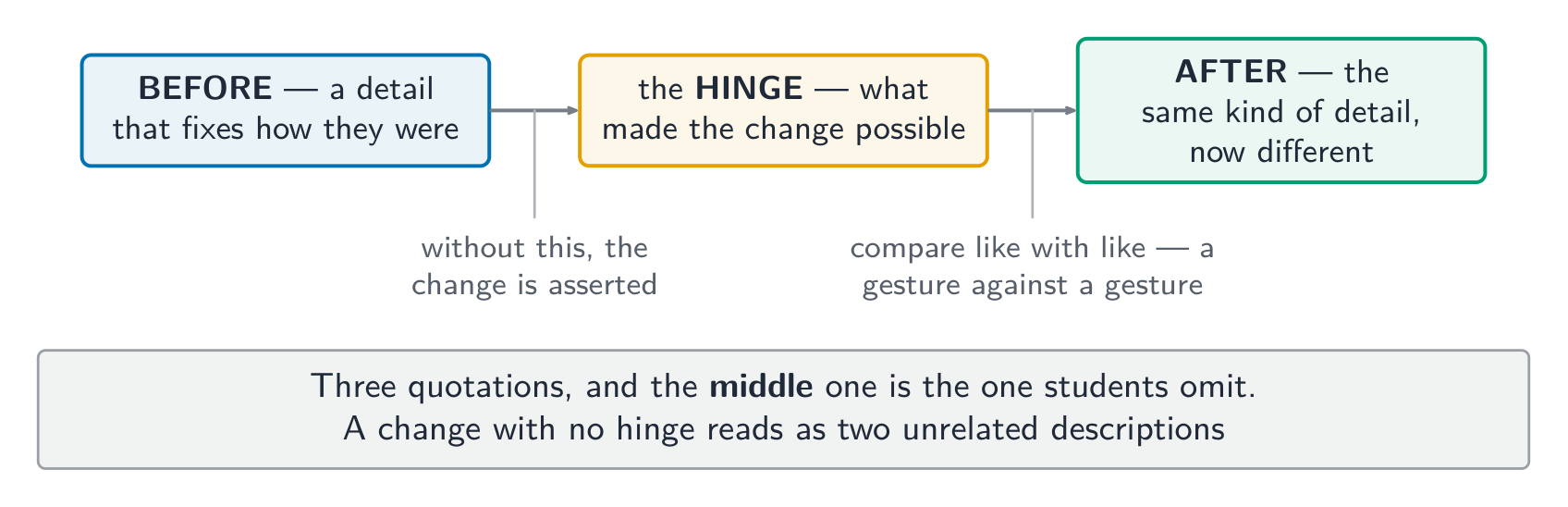
Three quotations, and the middle one is the one students omit
Prove a character changed, in three quotations
Before, hinge, after — and the hinge is the one students omit.
External changes can lead to internal changes, and internal to external.
Difficulty 1/5 · 100 coins + a small bonus on first completion today
The CED states the causal arrow runs both ways.
Some characters do not change
- Some characters remain unchanged or are largely unaffected by the events of the narrative.
- That is not a failure of characterisation — it is a choice with a function.
- An unchanged character often measures the change in everyone else.
A character who does not change is a weakness in the writing.
Difficulty 1/5 · 100 coins + a small bonus on first completion today
The CED names it as a real category; such a character usually measures everyone else's change.
An unchanged character is a choice, not an oversight. The CED says some characters remain largely unaffected — and such a character usually functions as a fixed measure against which everyone else's movement becomes visible. Treating them as underwritten misses their whole job.
To evidence a change, quote the character early and quote them ____.
Difficulty 1/5 · 100 coins + a small bonus on first completion today
One quotation shows a state; two show a difference.
Change needs two measurements
- To claim a character changed, quote them early and quote them late.
- One quotation shows a state; two show a difference.
- The essay that only quotes the ending has asserted a change rather than evidenced it.
Put the change pass in order.
Difficulty 3/5 · 200 coins + a small bonus on first completion today
The last step is the one the CED actually asks for.
A change pass
- Quote the character early. Quote them late. Name whether the change is external or internal.
- Say which caused which, if the text lets you.
- Then say what their choice did to the climax or the resolution.
The father loses the farm (external), and only afterwards stops speaking to his brother (internal) — the CED's arrow running from outside in. His sister, who changes in nothing across three hundred pages, is how the reader measures how far he has gone.
A dynamic character's choices affect the climax or resolution — so name what the change did, not just that it happened. Change may be external or internal, and each can cause the other. Some characters remain unchanged, and that is a function: they measure everyone else. Evidence a change with two quotations, early and late.