Coordination and Subordination
Introduced| English | Meaning |
|---|---|
| At least one clause must be independent/æt liːst wʌn klɔːz mʌst biː ˌɪndɪˈpendənt/ | Able to stand as a sentence alone. |
Same facts, different argument
- The measure was expensive, and it worked.
- Although the measure was expensive, it worked.
- Nothing factual changed. What changed is which fact the reader is asked to rank higher.
“Although” is a small word that can move the more important fact into the driver’s seat.
Clauses
- Writers express ideas in sentences, which are made of clauses.
- At least one clause must be independent 独立分句 — able to stand as a sentence alone.
- Everything else in the sentence is attached to it, and the attachment carries meaning.
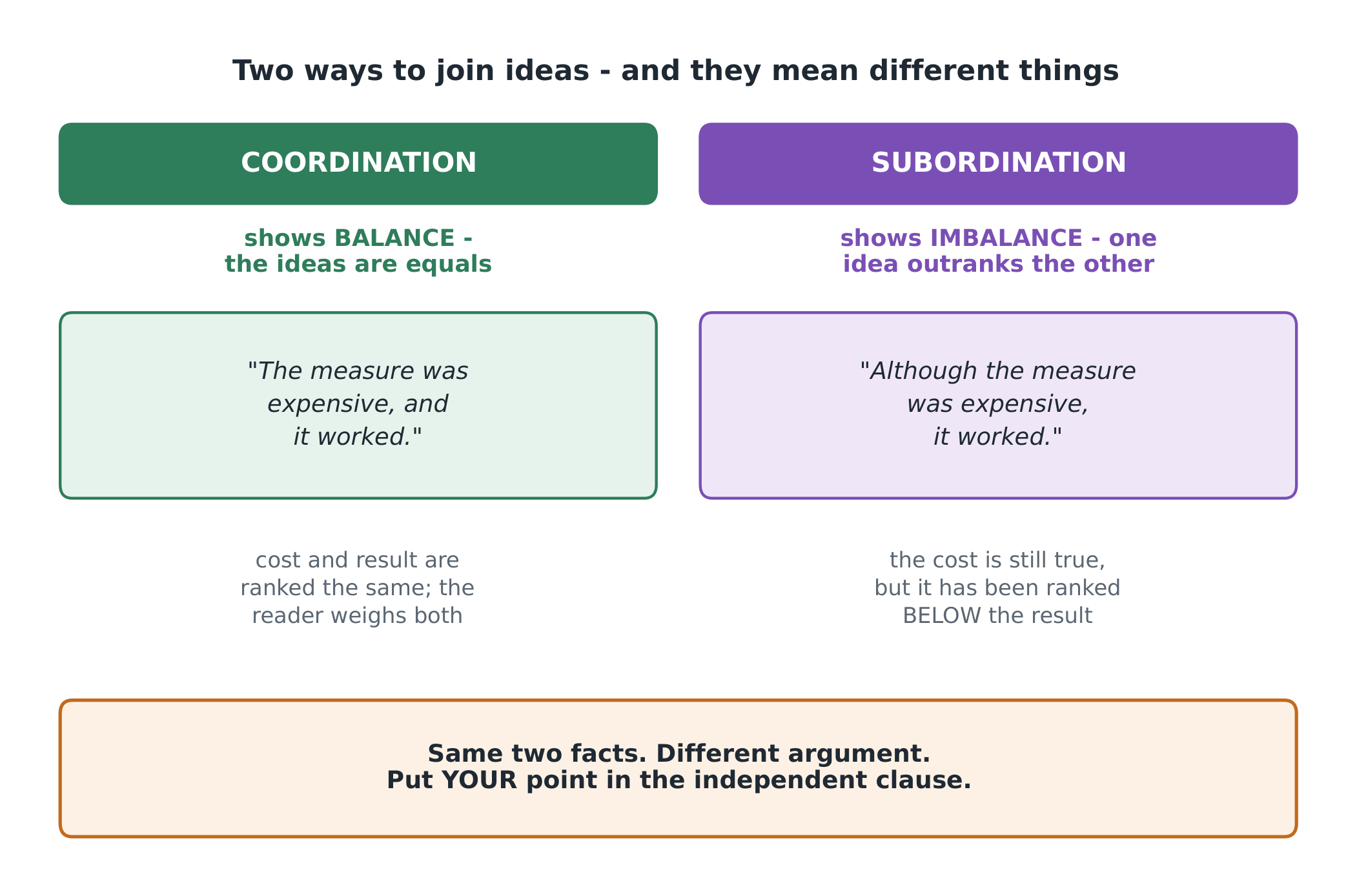
The CED is explicit- coordination shows balance, subordination shows imbalance
Every sentence must contain at least one ____ clause.
Difficulty 1/5 · 100 coins + a small bonus on first completion today
The independent clause is also the emphatic position.
The CED's two rules
- Writers use coordination to illustrate a balance or equality between ideas.
- Writers use subordination to illustrate an imbalance or inequality between ideas.
- These are unusually explicit rules, and they make syntax analysable rather than decorative.
Balance or imbalance?
Sort each sentence by how it ranks its two ideas.
Subordination is used to illustrate...
Difficulty 1/5 · 100 coins + a small bonus on first completion today
The CED is explicit: coordination = balance, subordination = imbalance.
Subordinating a fact does not deny it. Although the measure was expensive keeps the cost true and ranks it below the result. An analysis that says the writer "dismisses" the cost has misread what subordination does.
Subordinating a fact denies that it is true.
Difficulty 1/5 · 100 coins + a small bonus on first completion today
It keeps the fact true and ranks it below the idea in the independent clause.
Select all the arrangements the CED says can create emphasis.
Difficulty 2/5 · 140 coins + a small bonus on first completion today
Paragraph count is not an arrangement that emphasises an idea.
Arrangement creates emphasis
- The arrangement of sentences in a text can emphasise particular ideas.
- So can the arrangement of clauses, phrases and words within a sentence.
- The independent clause is the emphatic position; what sits there is what the sentence is really claiming.
Match each part of a sentence to what it carries.
Difficulty 2/5 · 140 coins + a small bonus on first completion today
Find the independent clause and you have found what the sentence really claims.
Analysing a sentence
- Find the independent clause — that is the claim.
- Find what was subordinated — that is what the writer conceded while keeping it true.
- Then say what the ranking does to the reader. That is syntax analysed as argument.
"The programme was popular; it was also, by every measure the department proposed, ineffective." The semicolon coordinates: both facts are true at once and neither outranks the other, so the reader cannot dismiss the failure as an objection to popularity.
A sentence needs at least one independent clause. Coordination illustrates balance; subordination illustrates imbalance. The arrangement of sentences, clauses and words creates emphasis, and the independent clause is the emphatic position — what sits there is the real claim.
Write from a queue that is longer
- The hall is new, which is a concession. The claim is that the queue is longer.
- Say which clause should be independent.
You want to concede that the hall is new and still claim that the queue is longer. Which point belongs in the independent clause, and why?
The point you are defending gets the main clause.
Which point should stand as the independent clause?
Difficulty 1/5 · 100 coins + a small bonus on first completion today
Subordination keeps the concession from becoming the claim.