How Claims Are Qualified
Introduced| English | Meaning |
|---|---|
| oversimplification/ˌəʊvəˌsɪmplɪfɪˈkeɪʃn/ | Presenting a complex issue as simpler than it is by leaving out important distinctions or qualifications. |
| generalisation/ˌdʒenərəlaɪˈzeɪʃn/ | In this argument lesson, a broad claim drawn from limited examples without enough support for its full scope. |
| ongoing discourse/ˈɒŋɡəʊɪŋ ˈdɪskɔːs/ | A continuing exchange of ideas in which participants respond to earlier claims and contribute new ones. |
| absolute terms/ˈæbsəluːt tɜːmz/ | Language presenting a claim as universally or unconditionally true, without allowing relevant exceptions or qualifications. |
The stronger-sounding claim is the weaker one
- Schools should ban phones invites a single exception and falls to it.
- Schools should restrict phone use during instructional time does not.
- Students assume force wins arguments. Precision does.
An absolute claim is a balloon: one small counterexample and the argument starts to hiss.
Where oversimplification 过度简化 comes from
- A lack of understanding of the complexities of a subject leads to oversimplification or generalisation 以偏概全.
- So an unqualified claim is not just risky — it is diagnostic.
- A reader takes it as a sign the writer has not looked closely.
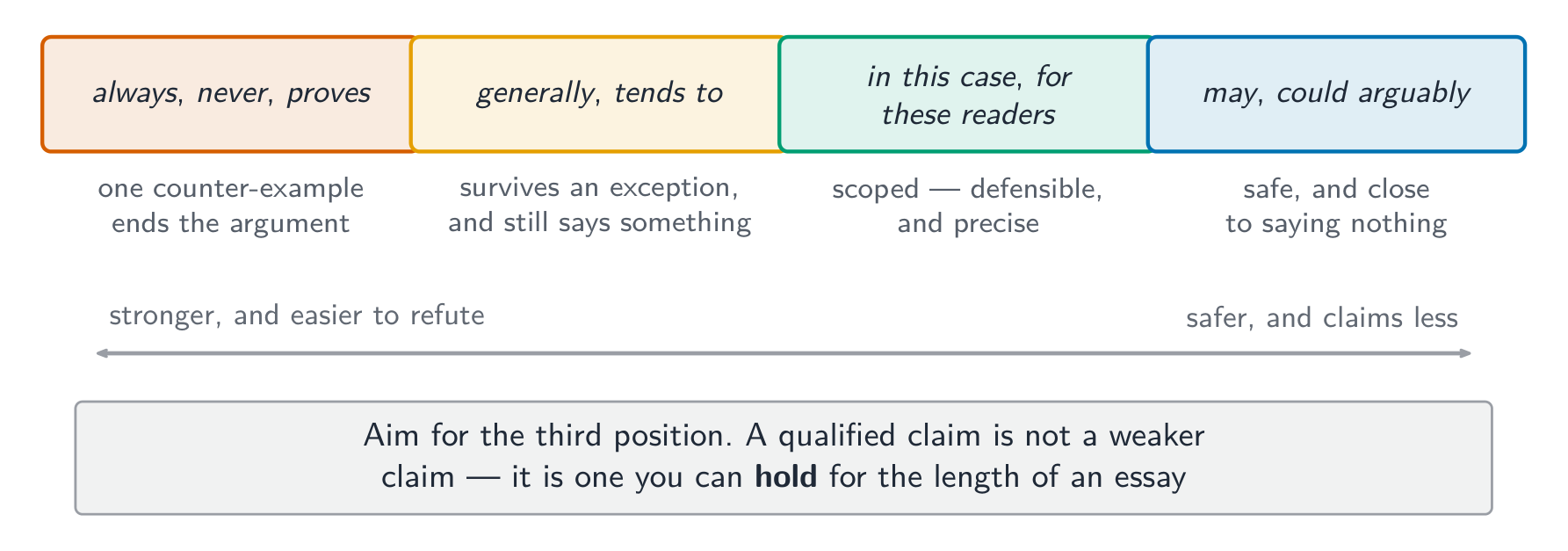
A qualified claim is not a weaker claim- it is one you can hold for a whole essay
The CED links oversimplification to a lack of understanding of a subject's complexities.
Difficulty 1/5 · 100 coins + a small bonus on first completion today
That is why a sweeping claim tells a reader something about the writer.
Arguments are part of a conversation
- Because arguments are usually part of an ongoing discourse 持续讨论, effective ones avoid expressing claims in absolute terms 绝对化表述.
- Others have already argued about this, and some of them were not fools.
- An absolute claim implicitly says nobody before you saw anything — which is rarely true and never persuasive.
Qualified or absolute?
Sort each claim by whether it names the ground it stands on.
Effective arguments avoid absolute terms mainly because...
Difficulty 1/5 · 100 coins + a small bonus on first completion today
Others have argued about this before you; an absolute claim implies nobody saw anything.
An unqualified claim is diagnostic, not just risky. The CED links oversimplification directly to a lack of understanding of the complexities — so a sweeping claim tells a reader something about the writer, not only about the subject.
Select all the tools writers use to qualify a claim.
Difficulty 2/5 · 140 coins + a small bonus on first completion today
Paragraph length does not limit a claim's scope.
A qualifier names the ____ a claim actually stands on.
Difficulty 1/5 · 100 coins + a small bonus on first completion today
In most cases, where X holds, for this population — each states a condition.
The tools of qualification
- Writers use words, phrases and clauses as modifiers to qualify or limit the scope of an argument.
- In most cases, where X holds, for this population, unless, to the extent that.
- Each names the ground the claim actually stands on.
Match each qualification pattern to what it tells a reader.
Difficulty 2/5 · 140 coins + a small bonus on first completion today
A qualifier is a rhetorical choice, so it is evidence about the writer as well as the claim.
Spotting qualification in a text
- A qualifier is a rhetorical choice, so it is analysable: what did the writer decline to claim?
- A writer who qualifies heavily is either being careful or signalling that the evidence is thin.
- A writer who qualifies nothing has either very strong evidence or has not read the other side.
"Homework does not help students." One study of one subject defeats it. "Homework set without feedback does not improve outcomes for students who are already behind" names its ground — and the same evidence now supports rather than sinks it.
Oversimplification comes from not understanding the complexities, and effective arguments avoid absolute terms because they join an ongoing discourse. Writers qualify with words, phrases and clauses that limit scope — and a qualifier in a text is itself a rhetorical choice worth analysing.
Write from many students rather than every student
- The draft says every student hates the rule. The evidence is a survey of many students in one year.
- Say which wording is stronger.
A draft says every student hates the rule. The evidence is a survey in one year group showing that many students object. Which wording is the stronger argument, and why?
A claim that survives a counterexample is the stronger one.
Which wording is the stronger claim?
Difficulty 1/5 · 100 coins + a small bonus on first completion today
The absolute sentence overclaims what the survey showed.