Developing Ideas Over Time
Introduced| English | Meaning |
|---|---|
| development/dɪˈveləpmənt/ | A process of growth, change or increasing complexity over time. |
| variable/ˈveərɪəbl/ | A quantity or named value that can change or take different values. |
| motif/məʊˈtiːf/ | A recurring visual element, subject or pattern used within an artwork or series. |
Growth you can read
- Development 发展 — furthering an inquiry through in-depth exploration — is what "sustained" looks like.
- Sequence matters: arrange works so the growth reads from image 1 to image 15.
- Scorers explicitly look for works that show development, not 15 isolated performances.
The rubric rewards development, which means the works show ____.
Difficulty 1/5 · 100 coins + a small bonus on first completion today
Development = visible growth of the inquiry.
Fifteen near-identical skilful drawings demonstrate strong development.
Difficulty 1/5 · 100 coins + a small bonus on first completion today
That is repetition — development needs change.
Moves that develop
- Development moves: change scale, change viewpoint, combine two earlier works, push one variable 变量 to its extreme.
- Series thinking helps — variations on one motif 母题 show deliberate exploration.
- Mid-course turns are healthy when documented: "the shadows became the subject" is development.
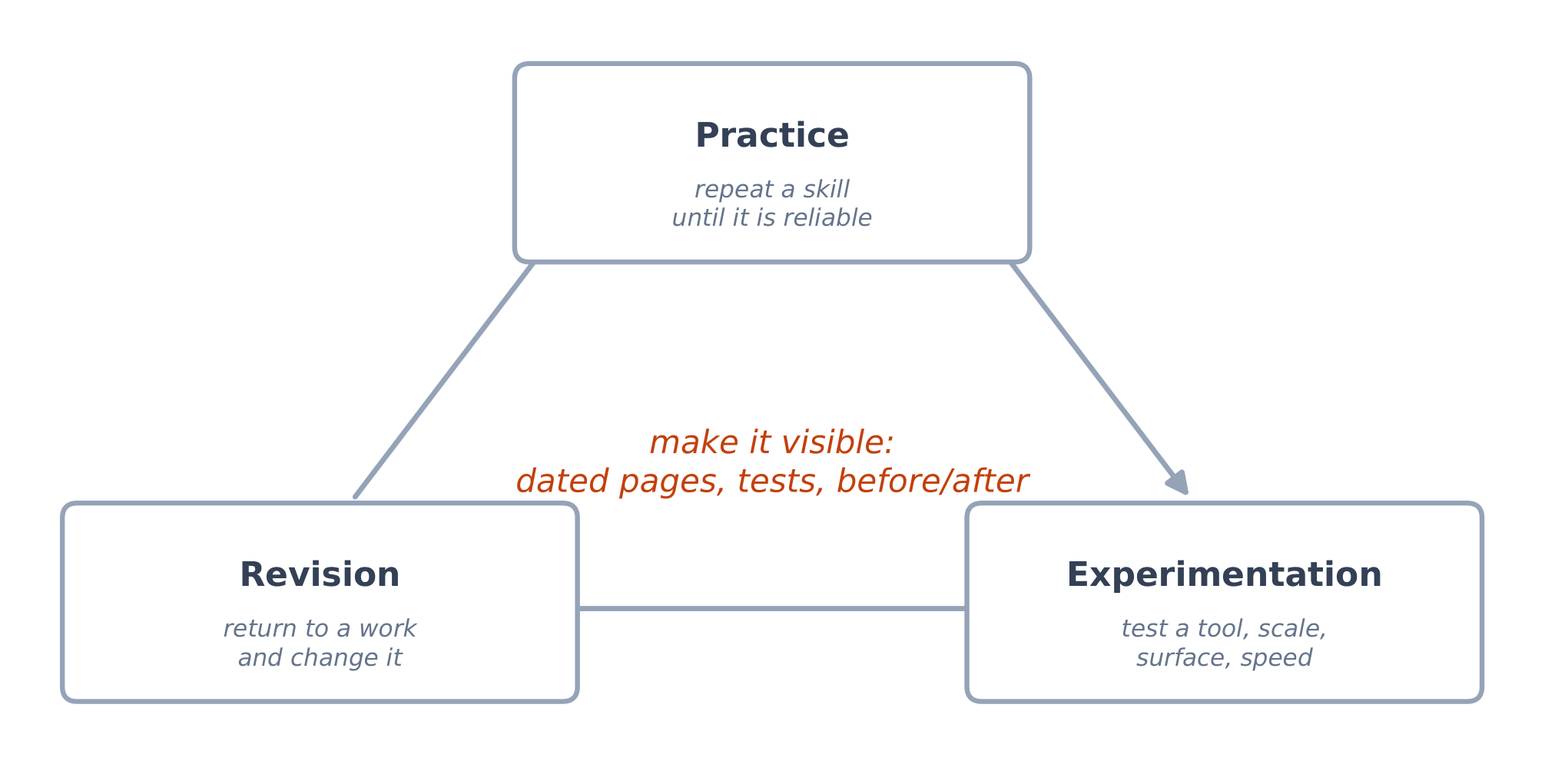
Practice, experimentation and revision
Development or repetition?
Sort each sequence by whether the idea develops.
Select all genuine development moves.
Difficulty 2/5 · 140 coins + a small bonus on first completion today
Recopying is repetition, not development.
Compare newest to first
- Compare your newest work to your first — if nothing changed (skill, idea, ambition), push a variable.
- Repetition is not development; variation with a reason is.
- The investigation should end somewhere its beginning could not have predicted.
Pushing one ____ to its extreme is a development move.
Difficulty 1/5 · 100 coins + a small bonus on first completion today
Change scale, viewpoint, or another variable.
Match the term to its meaning.
Difficulty 2/5 · 140 coins + a small bonus on first completion today
Growth, not repetition.
Fifteen skilful but near-identical drawings show repetition, not development — and the rubric scores development, not repetition. Every new work should move at least one variable a reader can name.
An investigation into solitude: image 1, a figure alone in a big room (small, centred). By image 15, the room has been cropped away entirely and only the negative space around an absent figure remains. The idea developed — you can see the thought move.
Development is visible growth of an inquiry: sequence the works to read as change, move a variable or vary a motif each time, document turns, and make sure the last work could not have been the first.
Write from version 3
- Version 1 crowds the head against the top edge.
- Version 3 moves the head down and gives it room.
Version 1 crowds the head against the top edge. Version 3 moves the head down. Is this a new theme or growth of the same drawing?
The later drawing solves a problem the first drawing showed.
What is version 3?
Difficulty 1/5 · 100 coins + a small bonus on first completion today
The head was moved so the composition could breathe.