Cyber Foundations
Introduced| English | Meaning |
|---|---|
| confidentiality/ˌkɒnfɪˌdenʃiˈæləti/ | The protection of information from access or disclosure to people or systems without permission. |
| integrity/ɪnˈteɡrɪti/ | The accuracy, completeness and protection of data against unauthorised or unintended alteration. |
| availability/əˌveɪləˈbɪlɪti/ | Whether a resource can be obtained when and where it is needed. |
| risk/rɪsk/ | The possibility of an adverse outcome, often assessed using its likelihood and consequences. |
| threat/θret/ | A circumstance, event or actor with the potential to harm an information system or its assets. |
| vulnerability/ˌvʌlnərəˈbɪlɪti/ | A weakness in a system or its controls that can be exploited to cause harm. |
| asset/ˈæset/ | Anything of value that needs protection, such as data, accounts, equipment or services. |
| likelihood/ˈlaɪklihʊd/ | The assessed chance that an event will occur under specified circumstances. |
| severity/səˈverɪti/ | The seriousness or extent of an event's consequences. |
| script kiddie/skrɪpt ˈkɪdi/ | An inexperienced attacker who relies on ready-made hacking tools or scripts rather than developing their own. |
| hacktivist/ˈhæktɪvɪst/ | A person who uses hacking activity to promote a political or social cause. |
| insider/ɪnˈsaɪdə/ | A person with authorised access or a trusted relationship within an organisation. |
| cyberterrorist/ˈsaɪbəterərɪst/ | A person who uses cyberattacks to pursue terrorist aims, such as intimidating a population or disrupting critical services. |
| reconnaissance/rɪˈkɒnɪsəns/ | Gathering information about a target or environment before deciding on further action. |
| lateral movement/ˈlætərəl ˈmuːvmənt/ | An attacker's movement from an initial compromised system or account to other parts of the same environment. |
| physical/ˈfɪzɪkl/ | Describing security measures involving tangible barriers, facilities or protection of people and equipment. |
| technical/ˈteknɪkl/ | Describing security controls implemented through hardware or software mechanisms. |
| managerial/ˌmænəˈdʒɪərɪəl/ | Describing security controls concerned with governance, policies, planning and oversight. |
| preventative/prɪˈventətɪv/ | Designed to stop an unwanted event before it occurs. |
| detective/dɪˈtektɪv/ | Designed to identify or reveal an event, weakness or unauthorised activity. |
| corrective/kəˈrektɪv/ | Designed to repair damage, restore operation or address a problem after it is detected. |
| defense in depth/dɪˈfens ɪn depθ/ | defense in depth |
The CIA triad
- Confidentiality 保密性: only authorised people can read the data.
- Integrity 完整性: the data is accurate and unaltered.
- Availability 可用性: it is there when needed.
What risk is
- A risk 风险 appears when a threat 威胁 exploits a vulnerability 漏洞 to harm an asset 资产.
- We assess it by likelihood 可能性 and severity 严重性.
- Four responses: avoid, transfer, mitigate, or accept the residual risk.
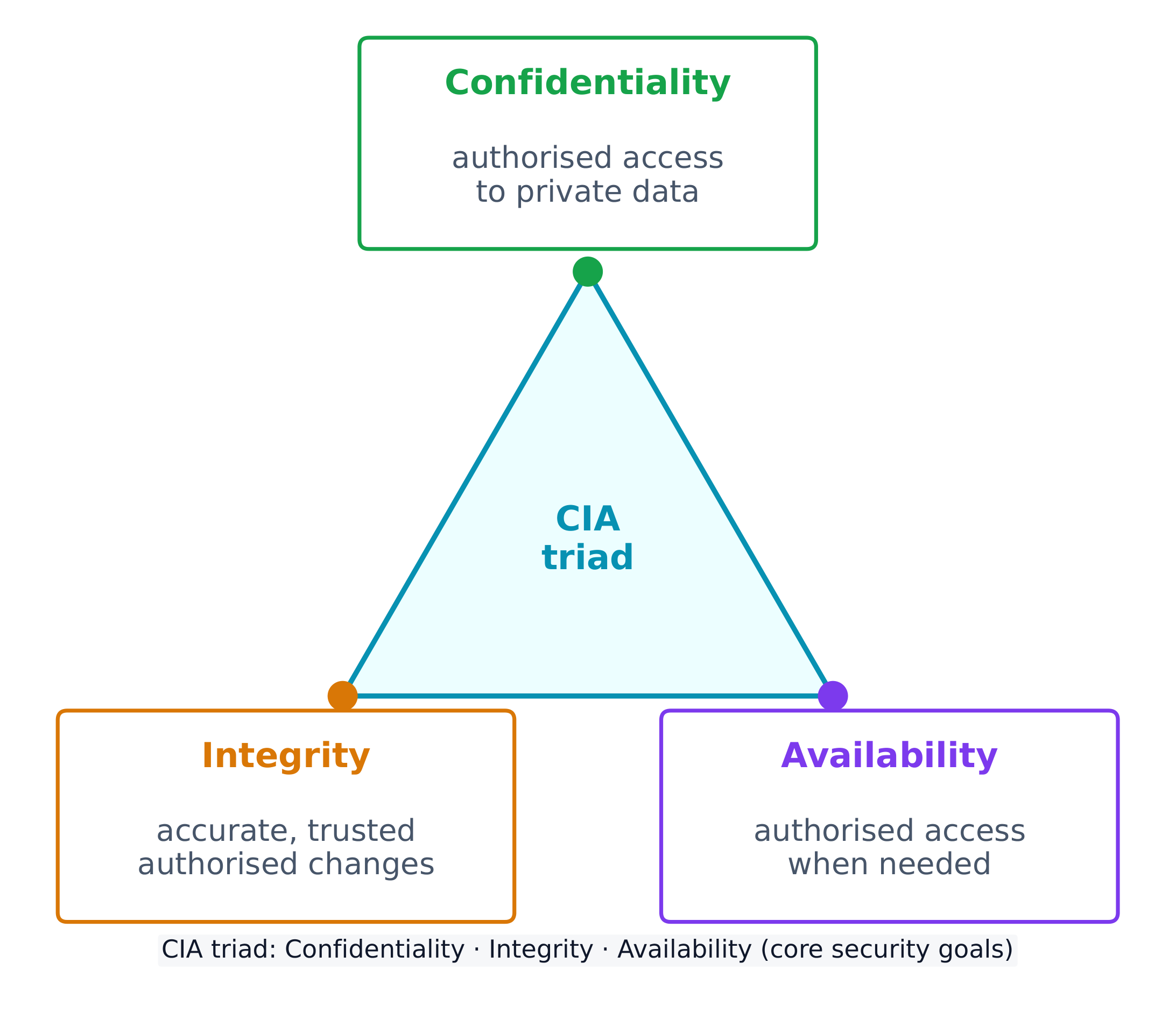
The CIA triad: confidentiality, integrity and availability
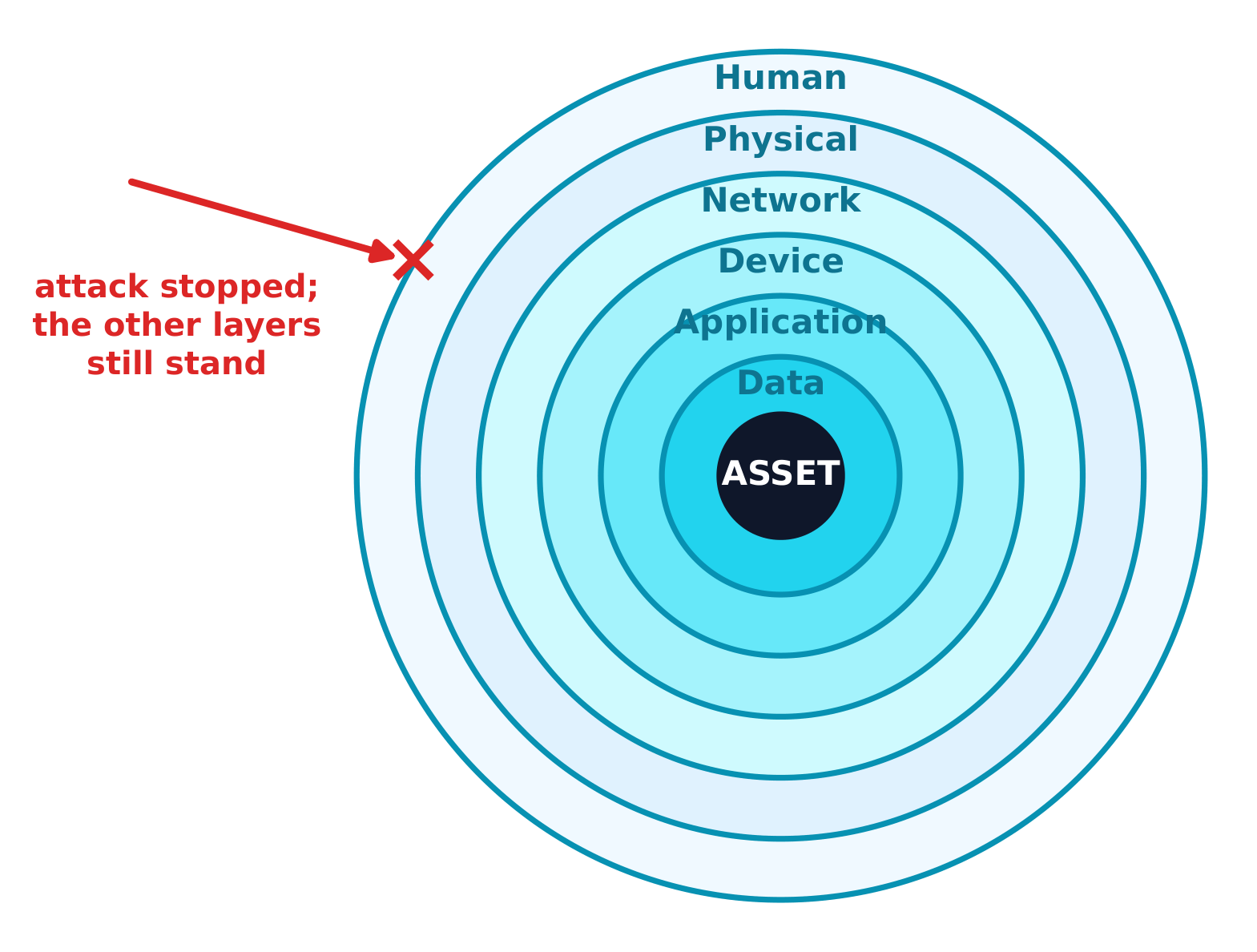
Defence in depth: layered controls so one breach does not expose the asset
Which CIA goal does the control protect?
Encryption protects confidentiality; a hash checks integrity; a backup restores availability.
Encrypting data mainly protects which CIA goal?
Difficulty 1/5 · 100 coins + a small bonus on first completion today
Encryption hides data = confidentiality.
A risk exists when a threat exploits a ____ to harm an asset.
Difficulty 1/5 · 100 coins + a small bonus on first completion today
A vulnerability is the weakness a threat uses.
Who attacks, and how
- A script kiddie 脚本小子 reuses others' tools; a hacktivist 黑客活动分子 acts for a cause.
- An insider 内部人员 already has access; a cyberterrorist 网络恐怖分子 hits infrastructure.
- Attacks move in phases: reconnaissance 侦察, access, persistence, lateral movement 横向移动, action.
An attacker who copies code from online tutorials and reuses others' tools is a...
Difficulty 1/5 · 100 coins + a small bonus on first completion today
Low skill + reused tools = a script kiddie.
Types and layers of control
- By type: physical 物理, technical 技术, managerial 管理.
- By function: preventative 预防性, detective 检测性, corrective 纠正性.
- Defense in depth 纵深防御 layers many controls so one breach is not enough.
Defense in depth means using a single very strong control.
Difficulty 1/5 · 100 coins + a small bonus on first completion today
It means layering many controls, not one.
The leftover risk an organisation lives with after mitigation is ____ risk.
Difficulty 1/5 · 100 coins + a small bonus on first completion today
Residual risk remains after avoid/transfer/mitigate.
Match each control to its function.
Difficulty 2/5 · 140 coins + a small bonus on first completion today
Function = what the control does.
Do not confuse the two ways of grouping controls. Type answers "where does it work?" (physical/technical/managerial). Function answers "what does it do?" (prevent/detect/correct). A camera is a physical control by type and a detective control by function.
A hospital encrypts patient records (confidentiality), uses file hashes to catch tampering (integrity), and keeps backups so care continues after an outage (availability). One system, all three CIA goals.
The CIA triad (confidentiality, integrity, availability) names security's goals. A risk = threat × vulnerability × asset, assessed by likelihood and severity. Controls are grouped by type and function, and layered as defense in depth.