Binary Numbers
Introduced| English | Meaning |
|---|---|
| bit/bɪt/ | A binary digit, taking the value zero or one. |
| binary/ˈbaɪnəri/ | A number system using base two, with the digits zero and one. |
| decimal/ˈdesɪml/ | The base-ten number system, using the digits 0 to 9 and powers of ten for place values. |
| power of two/ˈpaʊə ɒv tuː/ | power of two |
| fixed number of bits/fɪkst ˈnʌmbə ɒv bɪts/ | fixed number of bits |
| overflow error/ˌəʊvəˈfləʊ ˈerə/ | overflow error |
| Analog/ˈænəlɒɡ/ | Analog |
| digital/ˈdɪdʒɪtl/ | Represented using discrete values or states rather than a continuously varying signal. |
| sample/ˈsæmpl/ | To record a signal's value at a selected time or position; the recorded measurement is also called a sample. |
| byte/baɪt/ | A group of eight bits, commonly used as a unit of data storage. |
Everything is bits
- Deep down, a computer knows only two states: on and off, written 1 and 0.
- A bit 位 is a single 0 or 1 — the smallest piece of data.
- Two states are easy to build from a wire (voltage or none) and hard to confuse.
- Counting with two digits is binary 二进制 (base 2); everyday decimal 十进制 (base 10) uses ten.
A single 0 or 1, the smallest piece of data, is called a ______.
Difficulty 1/5 · 100 coins + a small bonus on first completion today
Eight bits group into a byte.
Place values and conversion
- In binary, each position is a power of two 2 的幂, doubling leftward: $\dots, 8, 4, 2, 1$.
- To read binary → decimal, add the position values where there is a 1.
- To go decimal → binary, keep subtracting the largest power of two that fits.
Binary to decimal: $1011$ lines up with $8, 4, 2, 1$. The 1-bits are at $8, 2, 1$, so $8 + 0 + 2 + 1 = 11$. Decimal to binary: for $13$, take $8$ (leaves 5), then $4$ (leaves 1), skip $2$, take $1$ → $1101$.
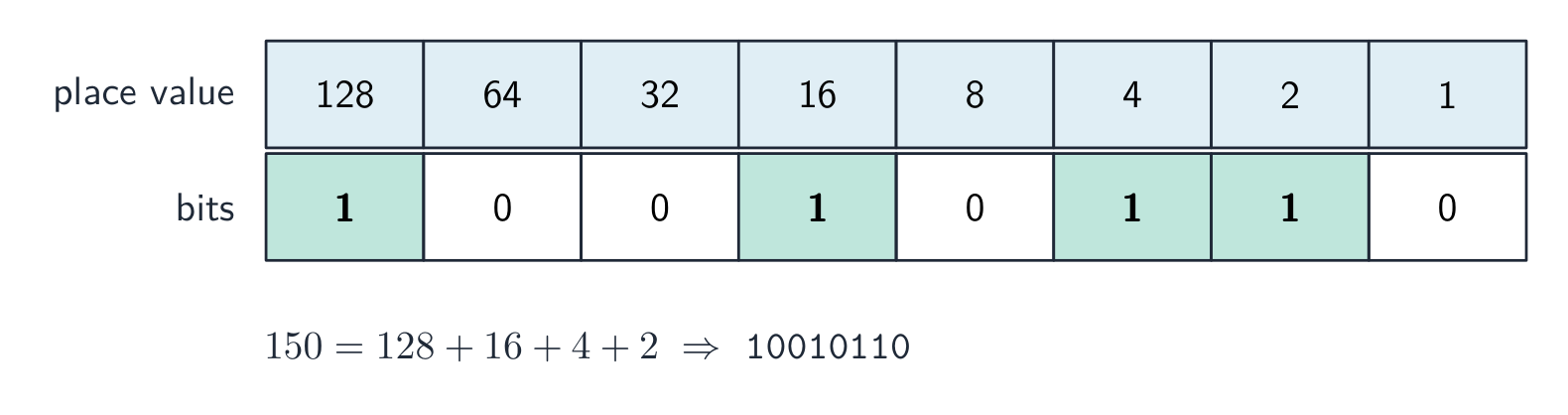
An 8-bit place-value chart: the 1s sit under the values that add to the number
Binary place values
value = Σ place values where a bit is 1
See how an 8-bit pattern maps to a decimal number by adding the place values (128, 64, 32, 16, 8, 4, 2, 1) wherever there is a 1.
What is the binary number 1011 in decimal?
Difficulty 2/5 · 140 coins + a small bonus on first completion today
Place values 8,4,2,1 with 1-bits at 8,2,1: 8+2+1 = 11.
What is decimal 13 in binary?
Difficulty 1/5 · 100 coins + a small bonus on first completion today
8 + 4 + 1 = 13, so bits 8,4,1 are on: 1101.
With 4 bits, what is the largest value you can store (2^4 − 1)?
Difficulty 2/5 · 140 coins + a small bonus on first completion today
2^4 = 16 patterns, from 0 up to 15. Adding 15+1 overflows.
Fixed bits and overflow
- Computers store numbers in a fixed number of bits 固定位数, such as 8 or 16.
- With $n$ bits you can make $2^n$ patterns, from $0$ up to $2^n - 1$.
- If a result is too big to fit, the extra bits are lost — an overflow error 溢出错误.
- Worked idea. With 4 bits the largest value is $2^4 - 1 = 15$; adding $15 + 1$ needs a 5th bit that does not exist, so it overflows.
Turning a smooth analog sound wave into bits by taking many measurements is called:
Difficulty 1/5 · 100 coins + a small bonus on first completion today
Each measurement is a sample; the stored result is digital data.
Analog to digital
- Analog 模拟 data is smooth and continuous, like a real sound wave.
- To store it, a computer takes many quick measurements; each is a sample 采样.
- Each sample is rounded to the nearest storable value, so the copy only approximates the original.
- More samples and more bits per sample give a closer copy — the result is digital 数字 data.
How many bits are in one byte?
Difficulty 2/5 · 140 coins + a small bonus on first completion today
Eight bits make one byte.
Bytes
- Bits are tiny, so we group them: eight bits make one byte 字节.
- A byte is the common unit of data size — enough for one letter of English text.
- Bigger units build on it: ~1000 bytes is a kilobyte, ~a million is a megabyte.
- Worked idea. A 200-letter message at 1 byte each is 200 bytes, or $200 \times 8 = 1600$ bits.
A bit is one 0/1; binary (base 2) uses place values that are powers of two, so $1011_2 = 8+2+1 = 11$. A fixed number of bits limits the range to $2^n-1$; exceeding it is an overflow error. Analog signals become digital by sampling, and eight bits group into one byte.