Solubility
Introduced| English | Meaning |
|---|---|
| saturated solution/ˈsætʃəreɪtɪd səˈluːʃn/ | A solution containing the solute's equilibrium solubility limit at the stated conditions. |
Why oil and water won't mix
- Salt vanishes in water but sand does not.
- Oil floats in a stubborn layer, refusing to blend.
- Whether something dissolves follows a simple rule of thumb.
- "Like dissolves like" — match the type and it mixes.
Like dissolves like
- Polar solvents dissolve polar and ionic solutes.
- Nonpolar solvents dissolve nonpolar solutes.
- Water (polar) dissolves salt; oil (nonpolar) does not.
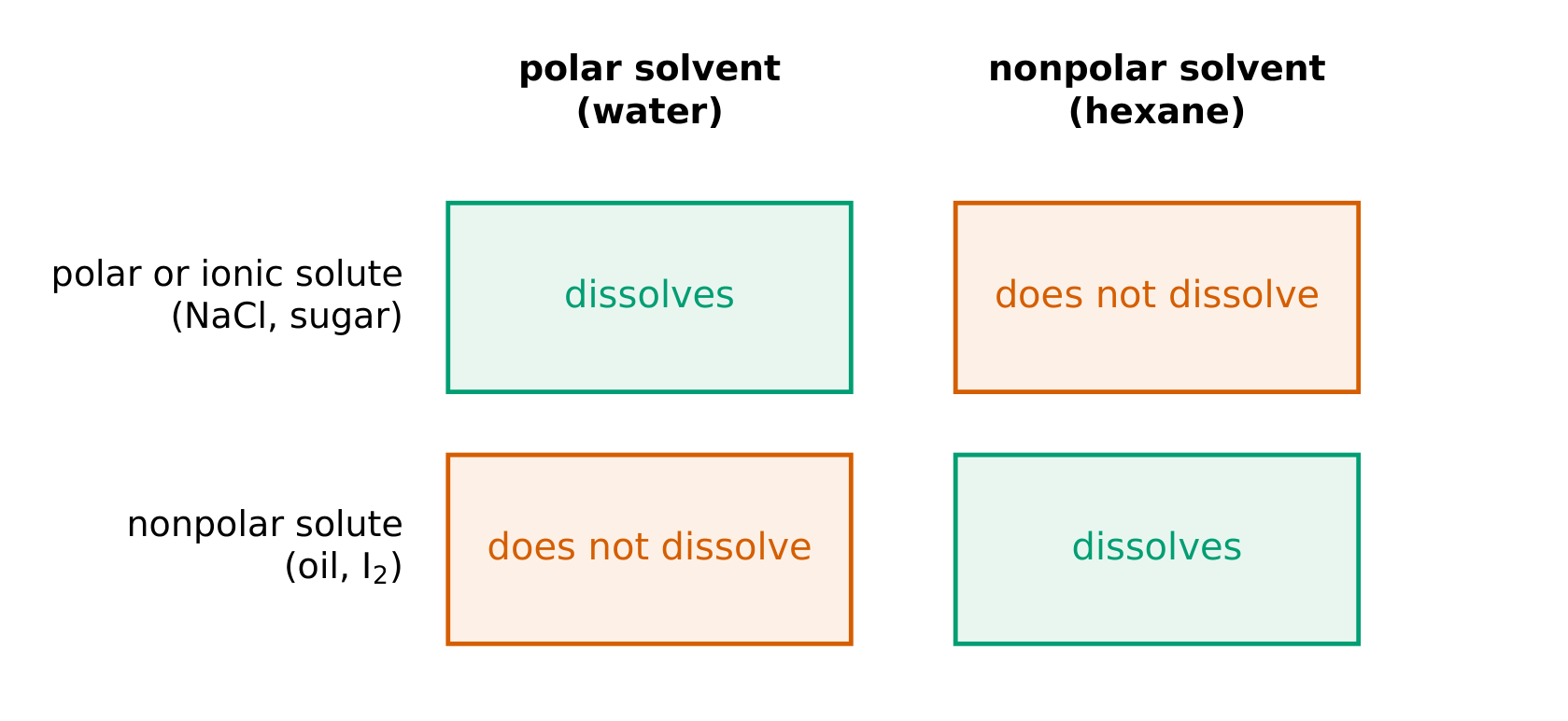
Like dissolves like: solutes dissolve in solvents with similar intermolecular forces
A polar solvent like water best dissolves solutes that are...
Difficulty 1/5 · 100 coins + a small bonus on first completion today
By "like dissolves like", polar water dissolves polar and ionic solutes.
Oil (nonpolar) dissolves readily in water (polar).
Difficulty 1/5 · 100 coins + a small bonus on first completion today
Unlike polarities do not mix, so oil and water separate.
The guiding rule for dissolving is "like dissolves ____".
Difficulty 1/5 · 100 coins + a small bonus on first completion today
Similar polarities dissolve each other.
How much will dissolve
- A saturated solution 饱和溶液 holds the maximum solute at that temperature.
- Below that limit it is unsaturated, and more can still dissolve.
- Add extra beyond the limit and it simply settles out.
A solution holding the maximum solute at a given temperature is...
Difficulty 1/5 · 100 coins + a small bonus on first completion today
At the maximum it is saturated; more solute just settles out.
Temperature changes solubility
- Most solids dissolve more in hot solvent than in cold.
- Gases do the opposite — they dissolve less as it warms.
- That is why a warm soda goes flat faster.
As temperature rises, the solubility of most gases in water...
Difficulty 1/5 · 100 coins + a small bonus on first completion today
Gases become less soluble in warmer water -- warm soda goes flat.
Most solids dissolve more in hot solvent than in cold.
Difficulty 1/5 · 100 coins + a small bonus on first completion today
Higher temperature usually raises a solid's solubility.
Will oil dissolve in water?
- Oil is nonpolar; water is polar.
- "Unlike" will not mix, so the oil stays as a separate layer.
Soluble or insoluble?
Use the solubility rules to sort each ionic compound.
"Like dissolves like" is about polarity — polar and ionic dissolve in polar water, nonpolar in nonpolar solvents. Solids usually get more soluble as temperature rises, but gases get less soluble. And a saturated solution is not full forever: heat it and it can dissolve more.
Whether a solute dissolves follows "like dissolves like": polar and ionic in polar solvents, nonpolar in nonpolar. A saturated solution holds the most solute possible at that temperature. Warming usually raises a solid's solubility but lowers a gas's.