Intermolecular and Interparticle Forces
Introduced| English | Meaning |
|---|---|
| London dispersion forces/ˈlʌndn dɪˈspɜːʃn ˈfɔːsɪz/ | Attractions arising when temporary fluctuations in electron density produce correlated dipoles in neighbouring particles. |
| hydrogen bonding/ˈhaɪdrədʒn ˈbɒndɪŋ/ | An attraction involving a hydrogen atom bonded to an electronegative atom and an electron-rich site on another atom. |
| dipole-dipole forces/ˈdaɪpəʊl ˈdaɪpəʊl ˈfɔːsɪz/ | dipole-dipole forces |
The weak grip between molecules
- Water is a liquid at room temperature, but similar-sized gases are not.
- Something makes molecules stick lightly to their neighbours.
- These attractions are far weaker than the bonds inside a molecule.
- Yet they decide whether a substance is a gas, liquid, or solid.
London dispersion forces
- Every molecule has London dispersion forces 伦敦色散力.
- Fleeting uneven electron clouds create tiny, temporary attractions.
- Bigger molecules, with more electrons, have stronger dispersion.
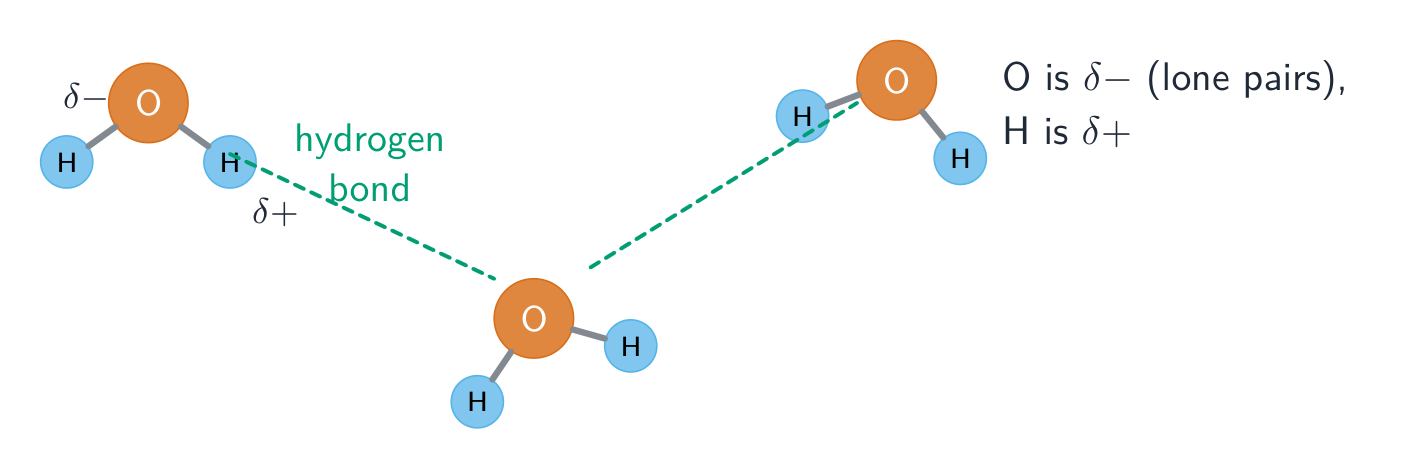
Hydrogen bonding 氢键: an H on N/O/F is attracted to a lone pair on another molecule

London dispersion: an instantaneous dipole induces a dipole in a neighbour
All molecules experience London dispersion forces.
Difficulty 1/5 · 100 coins + a small bonus on first completion today
Temporary uneven electron clouds occur in every molecule.
Larger molecules with more electrons have weaker dispersion forces.
Difficulty 1/5 · 100 coins + a small bonus on first completion today
False. More electrons make larger temporary dipoles, so dispersion forces get stronger with size; that is why boiling points rise down a group of nonpolar molecules.
Dipole-dipole forces
- Polar molecules also feel dipole-dipole forces 偶极-偶极作用.
- The positive end of one molecule attracts the negative end of another.
- These are stronger than dispersion alone.
Hydrogen bonding
- The strongest of these is hydrogen bonding.
- It happens when hydrogen is bonded to N, O, or F.
- It gives water its unusually high boiling point.
Which intermolecular force?
Identify the strongest force acting between each pair of molecules.
Which is the strongest intermolecular force?
Difficulty 1/5 · 100 coins + a small bonus on first completion today
Hydrogen bonding (H to N, O, or F) is the strongest of the three.
Hydrogen bonding requires hydrogen bonded to...
Difficulty 1/5 · 100 coins + a small bonus on first completion today
Only the small, very electronegative N, O, F give true hydrogen bonds.
Select all forces a polar molecule like $\text{HCl}$ experiences.
Difficulty 2/5 · 140 coins + a small bonus on first completion today
A polar molecule has both dispersion and dipole-dipole forces.
Why does water boil at a higher temperature than $\text{H}_2\text{S}$?
- Water has hydrogen bonds (H on O); $\text{H}_2\text{S}$ does not.
- The stronger attraction takes more energy to break, so water boils higher.
When a molecular liquid boils, what breaks?
Difficulty 1/5 · 100 coins + a small bonus on first completion today
Boiling separates molecules by breaking the weaker forces between them.
These forces act between molecules and are much weaker than the covalent bonds within them — boiling breaks the forces, not the bonds. All molecules have dispersion; polar ones add dipole-dipole; only H bonded to N, O, or F gives hydrogen bonding. Stronger forces mean a higher boiling point and higher viscosity.
Attractions between molecules set the physical state. Every molecule has London dispersion forces (stronger for more electrons); polar molecules add dipole-dipole forces; and H bonded to N, O, or F gives the strongest, hydrogen bonding. Stronger forces raise the boiling point — as with water.