Membrane Transport
Introduced| English | Meaning |
|---|---|
| passive transport/ˈpæsɪv ˈtrænspɔːt/ | passive transport |
| active transport/ˈæktɪv ˈtrænspɔːt/ | Energy-dependent transport against a concentration or electrochemical gradient. |
Two ways across the membrane
- A cell must move materials in and out all day long.
- Some movement is free; some has to be paid for with energy.
- The direction of travel decides which one is needed.
- Sorting transport into these two kinds makes it all click.
Passive transport: free
- Passive transport 被动运输 moves substances down their concentration gradient.
- It uses no energy — the particles' own motion does the work.
- Simple diffusion, facilitated diffusion, and osmosis are all passive.
- Movement continues until the gradient disappears.
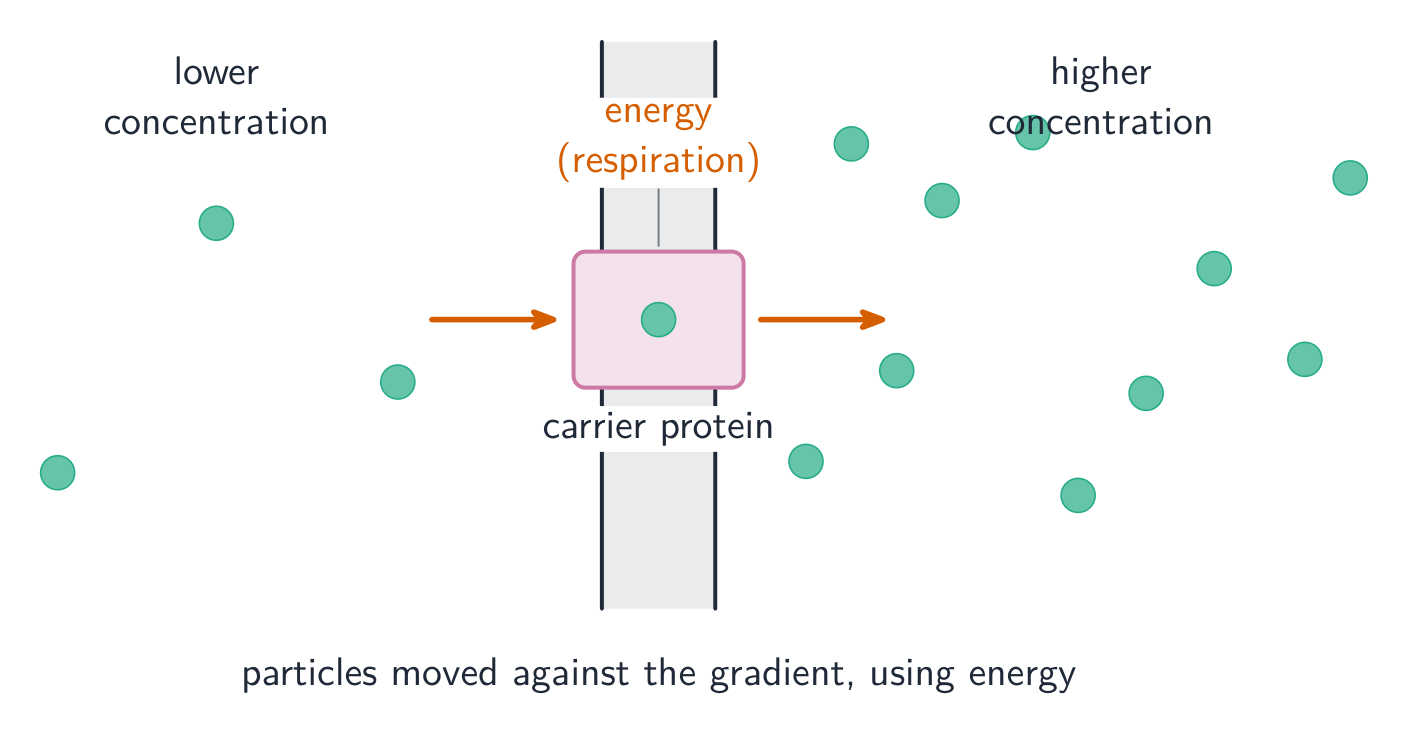
Active transport 主动运输 moves particles against the gradient, using ATP and a carrier protein
Passive transport moves substances…
Difficulty 1/5 · 100 coins + a small bonus on first completion today
Passive transport goes down the concentration gradient and costs the cell no energy.
Active transport: pay with ATP
- Active transport moves substances against their gradient — from low to high.
- Going uphill needs energy, supplied by ATP.
- A carrier protein acts as a pump, using that energy.
- This lets a cell build up a substance far above its surroundings.
What makes active transport different from passive transport?
Difficulty 1/5 · 100 coins + a small bonus on first completion today
Active transport spends ATP to pump substances against their gradient, from low to high.
Active transport moves substances down their concentration gradient without using energy.
Difficulty 1/5 · 100 coins + a small bonus on first completion today
False. Active transport moves substances against their gradient, which needs energy from ATP. Movement down a gradient without energy is diffusion.
Comparing the two
- Passive goes with the gradient; active goes against it.
- Passive is free; active costs ATP.
- Both can use proteins, but only active spends energy.
- The direction of travel is the quickest way to tell them apart.
Passive or active?
Sort each kind of transport by whether it needs energy and which way it moves.
The passive movement of water across a membrane has a special name: ____.
Difficulty 1/5 · 100 coins + a small bonus on first completion today
Osmosis is the passive diffusion of water across a selectively permeable membrane.
Select all true statements about membrane transport.
Difficulty 2/5 · 140 coins + a small bonus on first completion today
Passive transport needs no energy, so not all transport does. The other three are correct.
The tell-tale is direction, not speed. If a substance is moving against its gradient (low to high), it must be active transport using ATP — nothing moves uphill for free. Down the gradient is passive.
Root cells pumping in minerals:
- Soil often has a lower mineral concentration than the root cell inside.
- Yet the plant still needs to take minerals in — uphill.
- Root cells use active transport, spending ATP to pump minerals against the gradient.
Membrane transport is either passive or active. Passive transport moves substances down the gradient with no ATP (diffusion, facilitated diffusion, osmosis). Active transport uses ATP to pump substances against the gradient. The direction of travel — with or against the gradient — tells you which.
Write from active transport
- A solute is moved from low concentration to high concentration.
- The cell spends ATP.
What kind of transport is this?
Uphill movement that spends ATP is active.
What moves a solute uphill using ATP?
Difficulty 1/5 · 100 coins + a small bonus on first completion today
Against the gradient plus ATP means active transport.