Plasma Membrane
Introduced| English | Meaning |
|---|---|
| plasma membrane/ˈplæzmə ˈmembreɪn/ | A phospholipid bilayer with proteins scattered through it — the fluid mosaic model. |
| phospholipid bilayer/ˈfɒsfəlɪpɪd ˈbɪleɪə/ | A membrane structure made of two phospholipid layers, with water-facing heads and hydrophobic tails facing inward. |
| fluid mosaic/ˈfluːɪd məˈseɪɪk/ | fluid mosaic |
| selectively permeable/sɪˈlektɪvli ˈpɜːməbl/ | selectively permeable |
The cell's border
- Every cell is wrapped in a thin skin: the plasma membrane.
- It decides what gets in, what stays out, and what leaves.
- It is only two molecules thick, yet it controls the whole cell's traffic.
- Its clever design comes straight from the phospholipids you met earlier.
A phospholipid bilayer
- The plasma membrane 质膜 is built from a phospholipid bilayer 磷脂双分子层.
- Water-loving heads face the watery outside and inside.
- Water-fearing tails hide in the middle, away from water.
- This double layer forms a stable, self-sealing sheet around the cell.
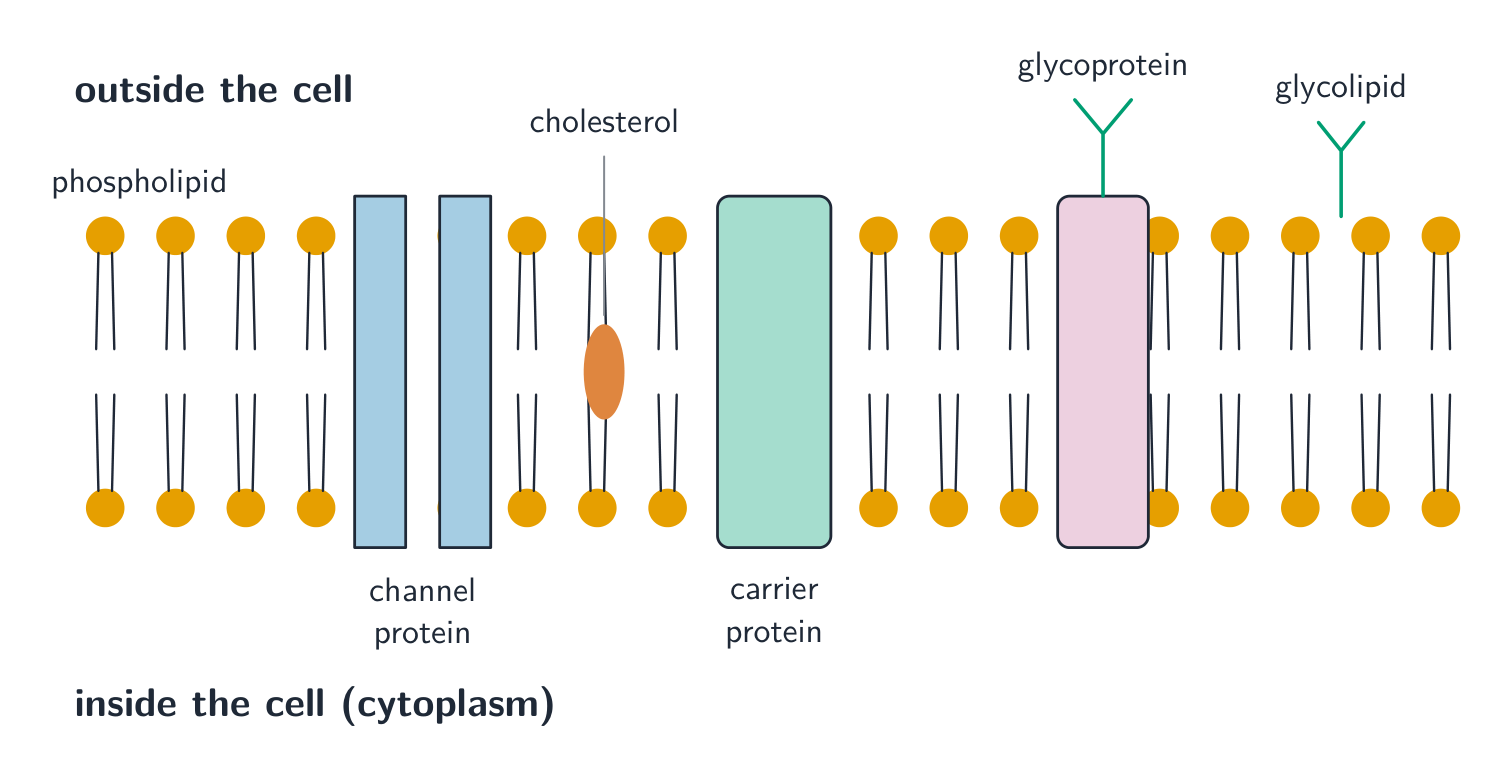
The fluid mosaic 流动镶嵌 model of the cell membrane
The plasma membrane is built mainly from a…
Difficulty 1/5 · 100 coins + a small bonus on first completion today
The membrane is a phospholipid bilayer — two layers of phospholipids with proteins embedded in them.
A fluid mosaic
- The membrane is not rigid — the lipids drift like a fluid.
- Proteins are scattered through it like tiles in a fluid mosaic.
- Some proteins are channels; some are pumps; some are receptors.
- Cholesterol sits between the lipids to keep the membrane steady.
The model of the membrane, with proteins floating in a moving lipid sheet, is the ____ mosaic model.
Difficulty 1/5 · 100 coins + a small bonus on first completion today
In the fluid mosaic model the lipids move like a fluid, and proteins are scattered through them like a mosaic.
Selectively permeable
- The membrane is selectively permeable 选择性通透的: it lets some things cross, not others.
- Small nonpolar molecules (like oxygen) slip straight through the oily middle.
- Charged ions and large molecules cannot — they need protein help.
- This control is how the cell keeps its inside different from its surroundings.
Parts of the membrane
Sort each membrane part by the job it does in the fluid mosaic.
The membrane is selectively permeable — it lets some substances cross but not others.
Difficulty 1/5 · 100 coins + a small bonus on first completion today
Being selectively permeable lets the cell control exactly what enters and leaves.
Which crosses the lipid bilayer most easily on its own?
Difficulty 1/5 · 100 coins + a small bonus on first completion today
Small nonpolar molecules slip through the oily core; charged or large molecules need a protein to help.
Select all true statements about the plasma membrane.
Difficulty 2/5 · 140 coins + a small bonus on first completion today
The membrane is fluid and flexible, not a solid wall. The other three are correct.
The membrane is not a solid wall. It is a flexible, moving sheet only two molecules thick. Picture a layer of oil droplets on water, not a brick wall — it can bend, flow, and even reseal itself.
Why oxygen crosses but sodium needs help:
- Oxygen is small and nonpolar, so it dissolves through the lipid tails freely.
- A sodium ion carries a charge, so the oily core repels it.
- Sodium must pass through a protein channel or pump — it cannot cross on its own.
The plasma membrane is a phospholipid bilayer with proteins scattered through it — the fluid mosaic model. It is selectively permeable: small nonpolar molecules cross freely, while charged or large molecules need protein channels or pumps. This is how the cell controls its traffic.
Write from unsaturated tails
- A membrane's phospholipids have kinked unsaturated fatty-acid tails.
- Temperature is falling.
How do these tails affect fluidity in the cold?
Kinks from double bonds resist tight packing.
What do unsaturated tails do as the membrane cools?
Difficulty 1/5 · 100 coins + a small bonus on first completion today
Kinked tails do not pack into a stiff sheet as easily.