Monitoring and control systems
| English | Chinese | Pinyin |
|---|---|---|
| preset value | 预设值 | yù shè zhí |
| actuator | 执行器 | zhí xíng qì |
| monitoring | 监控 | jiān kòng |
| sensors | 传感器 | chuán gǎn qì |
| control system | 控制系统 | kòng zhì xì tǒng |
| actuators | 执行器 | zhí xíng qì |
| feedback | 反馈 | fǎn kuì |
| thermistor | 热敏电阻 | rè mǐn diàn zǔ |
| ADC | 模数转换器 | mó shù zhuǎn huàn qì |
| feedback loop | 反馈回路 | fǎn kuì huí lù |
The teacher who was tired of being interrupted
- In 1883 Warren Johnson, a college teacher in Wisconsin, was fed up with the janitor walking into his classroom to check the heating.
- He built a device with a strip of two metals that bent as the room warmed and cooled. At a set temperature it closed a circuit and rang a bell in the boiler room.
- A sensor, a preset value 预设值, a signal to someone who acts, and a room that is measured again afterwards: the first automatic control loop in a building.
- Today the loop is a processor and an actuator 执行器 instead of a janitor, but the parts are the same.
Monitoring and control
- Both kinds of system read sensors 传感器. The difference is what happens next.
- A monitoring 监控 system collects, records or displays the readings and takes no action, though it may raise a warning: a weather station, a patient monitor that beeps.
- A control system 控制系统 compares each reading with a preset value and, if it is outside the range, sends signals to actuators that change the physical process: a thermostat switching a boiler.
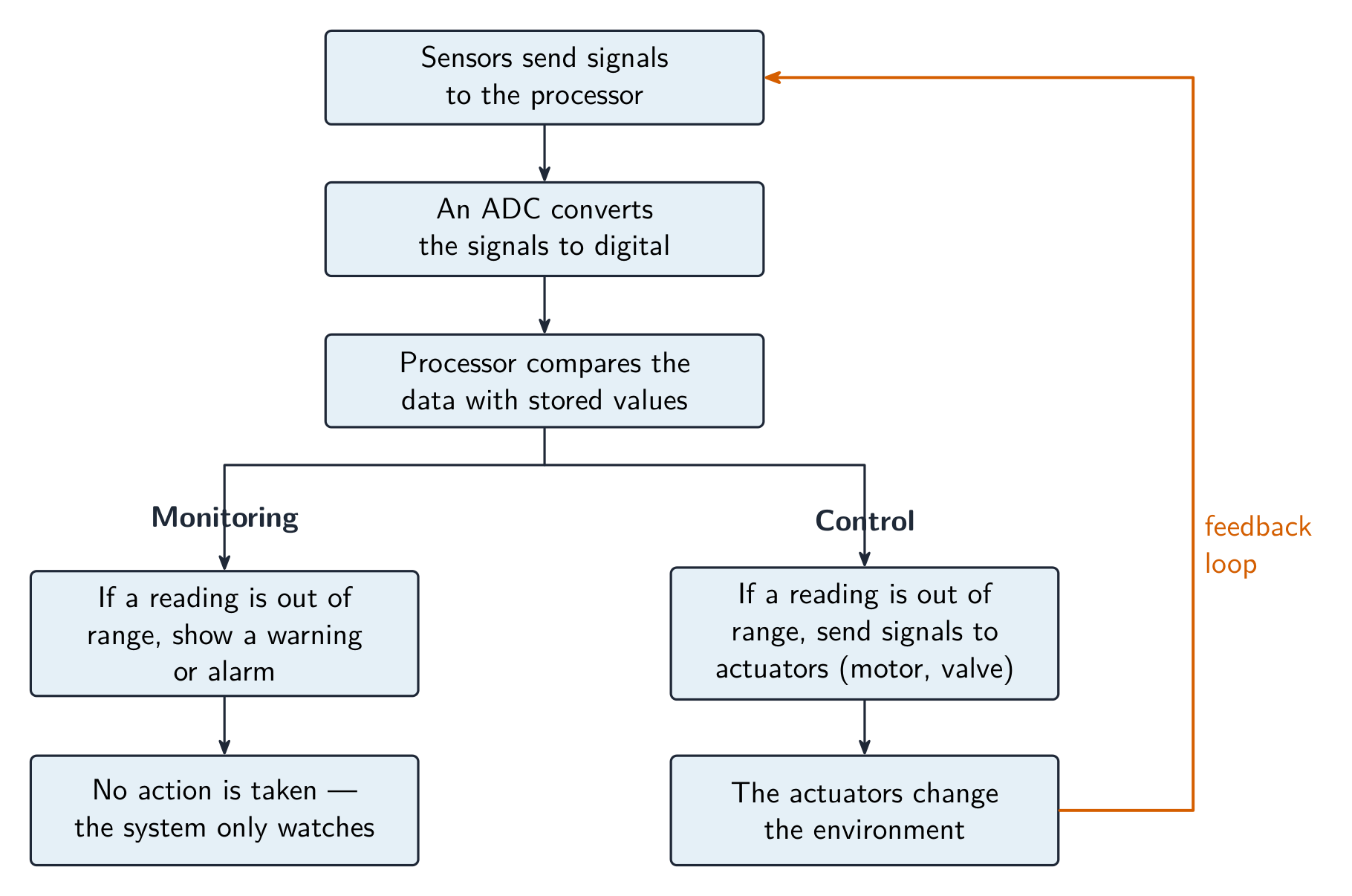
Monitoring reports; control acts and then measures again
The key difference between a monitoring system and a control system is that a control system:
Both read sensors, but a control system uses the data to act (via actuators), while monitoring only collects and reports.
A pure monitoring system takes action through actuators to change its environment.
Monitoring only collects and reports data — it does not act. Acting through actuators is what makes it a control system.
Worked example: the three-mark "describe the differences"
- A monitoring system only measures, records or displays the readings, and at most raises a warning.
- A control system compares each reading with a preset value and, if it is outside the range, sends signals to actuators that change the process.
- The change is then measured again, so a control system contains feedback 反馈 and a monitoring system does not.
- Three points, three marks. The test for any system is the second point: does it act on the reading?
A control system compares each sensor reading with a ____ value and acts only if the reading is outside the range.
The comparison with a stored, preset value is the mark that separates a control system from a device that merely reacts.
Sensors
- A sensor turns a physical quantity into an electrical signal: temperature (a thermistor 热敏电阻 or thermocouple), pressure (a strain gauge), infra-red, sound, light, moisture.
- Most sensor signals are analogue, so an ADC 模数转换器 (analogue-to-digital converter) turns them into binary before the processor can compare them with anything.
- Name the sensor for the quantity: a "temperature sensor" is a fair answer, "thermistor" is a better one.

A thermistor: its resistance changes with temperature
A sensor:
A sensor measures the world and outputs a signal. An actuator does the reverse — it turns a signal into an action.
Actuators
- An actuator does the reverse of a sensor: it turns a signal from the processor into a physical action.
- Motors open doors and valves, heaters and coolers change a temperature, pumps move water, a buzzer or lamp warns a person.
- The processor's output is digital; where the actuator needs a varying signal, a DAC converts it first.

A motor: an actuator that turns a signal into movement
Match each device to whether it is a sensor (input) or an actuator (output).
A sensor turns a physical quantity into a signal; an actuator turns a signal into a physical action.
Which is an actuator?
An actuator carries out an action (motor, valve, heater, buzzer). The others are sensors/inputs.
The control loop
- The sensor measures. The ADC converts the reading to digital. The processor compares it with the preset value.
- If the reading is outside the range, the processor sends a signal to an actuator, which changes the process.
- The sensor measures again, and the loop repeats. That repeated measuring after each action is the feedback loop 反馈回路.
The control feedback loop
Tap round the loop a thermostat or autopilot repeats. A control system doesn't just read the world — it acts, then re-measures, correcting itself again and again.
Put the stages of one pass round a control loop in order.
Measure, convert, compare, act, measure again. The last step is what makes it feedback.
Worked example: the automatic door
- Describe how a system opens a door when a person is within 2 metres and closes it when nobody is.
- An infra-red or ultrasonic sensor measures the distance to anything in front of the door. The ADC converts the analogue reading and sends it to the processor.
- The processor compares the distance with the preset 2 metres. If it is less, it sends a signal to the actuator, a motor, to open the door.
- The sensor keeps measuring. When no reading below 2 metres arrives, the processor signals the motor to close the door. The repeated measuring is the feedback.
Which of these belong in the automatic door system? Select all that apply.
Sensor, converter, comparison value and actuator are the working parts. A printer would be monitoring bolted on; it plays no part in opening the door.
Worked example: a greenhouse
- Keep a greenhouse between 20 °C and 26 °C. A thermistor reads the temperature; the ADC digitises it; the processor compares it with the two preset limits.
- Below 20 °C: a signal to the heater actuator switches it on. Above 26 °C: a signal to the motor opens the vent and switches the heater off.
- Inside the range: no action, but the reading is still taken. Then the loop repeats.
- Every control-system answer has these five parts: sensor, ADC, comparison with a preset, actuator, and measuring again.
Why feedback matters
- Without feedback the system cannot tell whether its action worked, so it cannot correct itself or know when to stop. A heater with no temperature feedback heats forever.
- Feedback also lets the system respond to the world changing on its own: a door opened by hand, a cloud over the greenhouse.
- A monitoring system has no feedback because it changes nothing. It can only report or warn.
Why is feedback essential in a control system?
Feedback closes the loop: the actuator changes the environment, the sensors re-measure it, and the system adjusts — e.g. a thermostat stops heating once the target is reached.
Match each system to its type.
Raising an alarm is still reporting. Only a system that changes the physical process through an actuator is control.
Marks that slip away
- A monitoring system does not use actuators. If your answer has the weather station switching something on, it has become a control system.
- Sensor signals are analogue. Say the ADC converts them before the processor compares.
- The comparison is with a preset value. "The processor decides" is not a mark; "compares the reading with the stored 2 metres" is.
- Say that the loop repeats. The feedback point is the one most often left out.
You've got it
- monitoring = read sensors, record or display, at most warn; control = compare with a preset value, act through actuators, measure again
- a sensor turns a physical quantity into a signal, through an ADC; an actuator turns a signal into an action
- the loop: sensor → ADC → compare → actuator → measure again; the repeat is feedback
- describe any control system with those five parts, in that order