The nature of operations
Introduced| English | Meaning |
|---|---|
| inputs/ˈɪnpʊts/ | Resources or values used by a process to produce outputs. |
| outputs/ˈaʊtpʊts/ | The goods, services or other results produced by an activity or production process. |
| transformation/trænsfɔːˈmeɪʃn/ | A change in form, state, nature or organisation. |
| operations/ˌɒpəˈreɪʃnz/ | operations |
| productivity/ˌprɒdəkˈtɪvɪti/ | Output produced per unit of input over a given period. |
| efficiency/ɪˈfɪʃənsi/ | The fraction of total energy or power input converted to useful output. |
| effectiveness/ɪˈfektɪvnəs/ | effectiveness |
| sustainable/səˈsteɪnəbl/ | Able to continue over time without exhausting the resources or undermining the conditions on which it depends. |
Turning inputs 投入 into outputs 产出
- Every business takes things in — materials, labour, machines — and turns them into something customers want.
- That transformation 转化 is operations 运营, the engine room of the firm.
Operations management turns:
Difficulty 1/5 · 100 coins + a small bonus on first completion today
Operations is the transformation of inputs into outputs.
Materials, labour and capital used in production are the ______ of operations.
Difficulty 1/5 · 100 coins + a small bonus on first completion today
Inputs are transformed into outputs.
The transformation process
- Inputs (materials, labour, capital) → process (the transformation) → outputs (goods or services).
- Operations management makes this flow efficient and reliable.
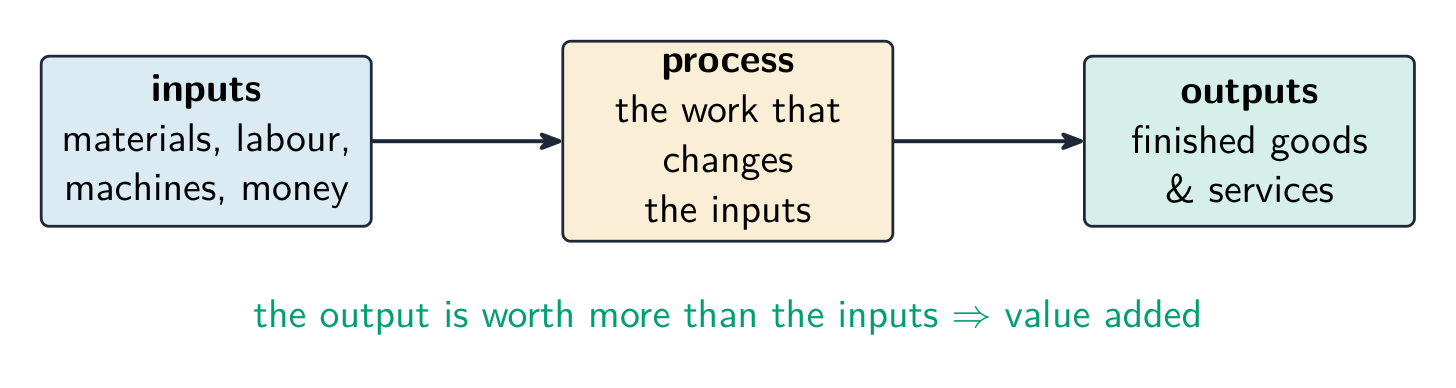
Operations turn inputs into outputs, adding value
Operations: input → output
Operations management turns inputs into finished goods or services through a transformation process.
6 workers produce 480 units. What is labour productivity (units per worker)?
Difficulty 2/5 · 140 coins + a small bonus on first completion today
480 / 6 = 80 units per worker.
Efficiency in operations means:
Difficulty 1/5 · 100 coins + a small bonus on first completion today
Efficiency minimises resource waste.
Effectiveness is about actually meeting the objective, such as quality and on-time delivery.
Difficulty 1/5 · 100 coins + a small bonus on first completion today
Effectiveness = achieving the goal; efficiency = doing so without waste.
Productivity 生产率, efficiency 效率, effectiveness 有效性
- Productivity = output ÷ inputs (e.g. output per worker).
- Efficiency = producing with the least waste of resources.
- Effectiveness = actually meeting the objective (quality, on time).
Worked example. A bakery makes 600 loaves with 5 bakers → labour productivity = 120 loaves per baker. Buying a better oven lifts output to 750 with the same 5 bakers → productivity rises to 150.

A distribution centre: operations management moves inputs through to finished goods
Operations objectives
- Keep costs low, quality high, delivery reliable, and stay flexible.
- Increasingly, operations must also be sustainable 可持续的 (less waste, lower emissions).
You've got it
- operations transform inputs → process → outputs
- productivity = output ÷ inputs; efficiency = least waste; effectiveness = meeting the objective
- operations aim for low cost, high quality, reliable delivery and flexibility
Write from productivity of 35
- A process uses 16 workers to make 560 units.
- Find labour productivity.
An operation uses 16 workers and produces 560 units. What is labour productivity, in units per worker?
560 divided by 16 is 35.
What is the labour productivity?
Difficulty 1/5 · 100 coins + a small bonus on first completion today
Output divided by workers is 35. Other options — 560 units per worker (the whole output); 16 units per worker (the size of the crew).