Demand, supply and elasticity
Introduced| English | Meaning |
|---|---|
| demand/dɪˈmænd/ | The quantity of a good or service that buyers are willing and able to purchase at different prices over a period. |
| supply/səˈplaɪ/ | The quantity sellers are willing and able to offer at different prices over a specified period. |
| equilibrium/ˌiːkwɪˈlɪbrɪəm/ | A state in which opposing influences balance so there is no tendency for the relevant quantities to change. |
| quantity demanded/ˈkwɒntɪti dɪˈmændɪd/ | The amount buyers are willing and able to purchase at a particular price over a specified period. |
| price elasticity of demand/praɪs ɪlæˈstɪsɪti ɒv dɪˈmænd/ | The percentage change in quantity demanded divided by the percentage change in price. |
| elastic/ɪˈlæstɪk/ | Describing demand or supply whose percentage response exceeds the percentage change in its determining price or income. |
| inelastic/ɪnɪˈlæstɪk/ | Describing demand or supply whose percentage response is smaller than the percentage change in its determining price or income. |
| revenue/ˈrevənjuː/ | Income received by a business from selling goods or services before costs are deducted. |
The market sets the price
- A firm would love to charge whatever it likes — but the market has the final say, through demand 需求 and supply 供给.
- Understanding how they interact is the foundation of pricing and forecasting.
The equilibrium price is where:
Difficulty 1/5 · 100 coins + a small bonus on first completion today
Equilibrium clears the market.
Demand, supply and equilibrium 均衡
- Demand falls as price rises; supply rises as price rises.
- The market settles at the equilibrium price, where the two are equal.
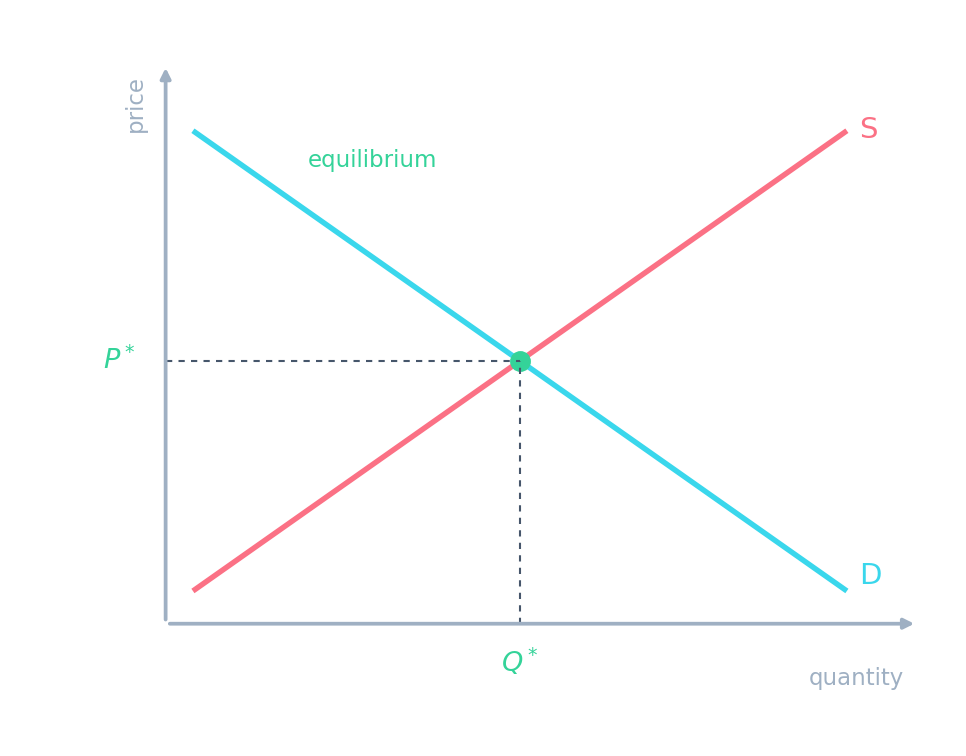
The equilibrium price is where quantity demanded 需求量 equals quantity supplied.
Demand, supply & elasticity
Price is set where demand meets supply.
Price rises 10% and quantity demanded falls 25%. What is the size of PED?
Difficulty 2/5 · 140 coins + a small bonus on first completion today
PED = 25% / 10% = 2.5 (elastic).
A product with many close substitutes tends to have inelastic demand.
Difficulty 1/5 · 100 coins + a small bonus on first completion today
False. Close substitutes let customers switch easily when the price rises, so demand is price elastic.
When quantity demanded responds strongly to price, demand is said to be ______.
Difficulty 1/5 · 100 coins + a small bonus on first completion today
Elastic demand has PED greater than 1.
Price elasticity of demand 需求价格弹性
- PED measures how much quantity demanded responds to a price change.
- Elastic 富有弹性 (PED > 1): quantity is sensitive to price; inelastic 缺乏弹性 (PED < 1): it is not.
If demand for a product is inelastic, raising its price will:
Difficulty 1/5 · 100 coins + a small bonus on first completion today
With inelastic demand, quantity falls little, so revenue rises.
Why elasticity matters for revenue 营业收入
- If demand is inelastic, raising price raises revenue.
- If demand is elastic, raising price lowers revenue — so a firm may cut price to sell far more.
Know your elasticity before changing price. A price rise helps revenue only if demand is inelastic. For an elastic product, the same rise drives customers away and revenue falls.
Worked examples
1. Formula: $\text{PED} = \dfrac{\%\text{ change in quantity demanded}}{\%\text{ change in price}}$. A café raises a coffee from 20 to 22 (up 10%) and daily sales fall from 1000 to 950 (down 5%): $\text{PED} = -5/10 = -0.5$, inelastic. Revenue rises from $20 \times 1000 = 20\,000$ to $22 \times 950 = 20\,900$.
2. If instead PED were $-2$ (elastic), a 5% price cut would raise quantity by 10%; revenue changes by a factor of $0.95 \times 1.10 = 1.045$, a 4.5% rise. With elastic demand, cutting the price raises revenue.
Price rises by 8 percent and quantity demanded falls by 12 percent. What is the size of PED, and should the firm expect revenue to rise if it raises price again?
12 divided by 8 is 1.5, which is elastic.
What is the size of PED?
Difficulty 1/5 · 100 coins + a small bonus on first completion today
The percentage quantity change over the percentage price change is 1.5. Other options — 2.5 (the lesson example's PED); 0.67 (the price change divided by the quantity change).
You've got it
- price settles at equilibrium, where demand meets supply
- PED measures demand's sensitivity to price (elastic >1, inelastic <1)
- inelastic → raise price to raise revenue; elastic → the opposite
Write from a PED of 1.5
- Price rises by 8 percent and quantity demanded falls by 12 percent.
- Find the size of PED and say what that means for a further price rise.