The taxonomic hierarchy and kingdoms
Introduced| English | Meaning |
|---|---|
| taxonomic hierarchy/ˌtæksəˈnɒmɪk ˈhaɪərɑːki/ | The nested levels used to classify organisms into increasingly specific groups. |
| kingdom/ˈkɪŋdəm/ | A broad taxonomic rank below domain and above phylum. |
| phylum/ˈfaɪləm/ | A taxonomic rank below kingdom and above class. |
| genus/ˈdʒenəs/ | A taxonomic group containing one or more closely related species. |
| Protoctista/ˈprəʊtəʊktɪstə/ | Mostly single-celled (e.g. *Amoeba*). |
| Fungi/ˈfʌŋɡi/ | Feed by absorbing food. |
| photosynthesis/ˌfəʊtəʊˈsɪnθəsɪs/ | The process by which plants and other organisms use light energy to make organic substances from carbon dioxide and water. |
Sorting all of life
- Inside the Eukarya, organisms are sorted into smaller and smaller groups.
- This is the taxonomic hierarchy 分类层级.
- The Eukarya split into four kingdoms 界.
The smallest, most specific group in the taxonomic hierarchy is the ______.
Difficulty 1/5 · 100 coins + a small bonus on first completion today
Domain → kingdom → phylum → class → order → family → genus → species.
Kingdom to species
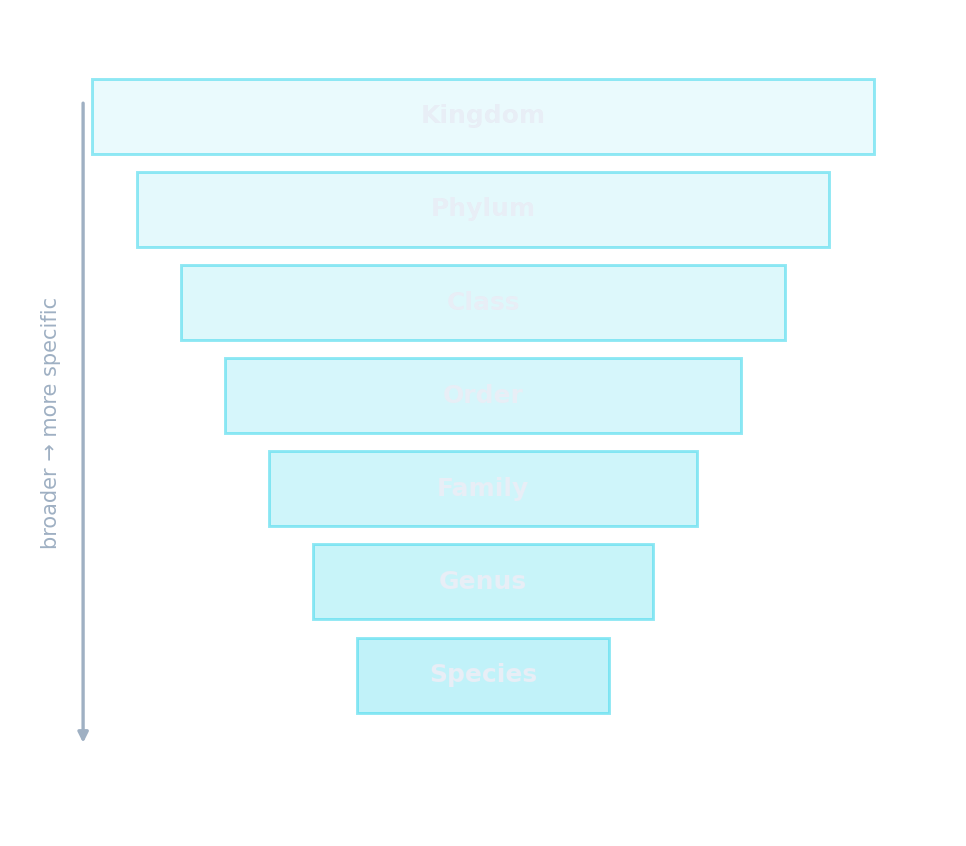
- The levels: Kingdom → Phylum 门 → Class → Order → Family → Genus 属 → Species.
- Each level is a smaller, more closely related group, ending at a single species.
The taxonomic hierarchy
Step down the levels for one species — humans — from the broadest domain to the most specific species.
Put the taxonomic levels in order, from broadest to most specific.
Difficulty 3/5 · 200 coins + a small bonus on first completion today
Kingdom → Phylum → Class → Order → Family → Genus → Species (broad to specific).
Which level is the smallest, most closely related group?
Difficulty 1/5 · 100 coins + a small bonus on first completion today
Species is the most specific level; kingdom is the broadest.
Two organisms in the same class are more closely related than two in the same genus.
Difficulty 1/5 · 100 coins + a small bonus on first completion today
False. Genus is lower in the hierarchy than class, so sharing a genus means a closer relationship than sharing only a class.
The four eukaryote kingdoms
- Protoctista 原生生物界 — mostly single-celled (e.g. Amoeba).
- Fungi 真菌界 — feed by absorbing food; cell walls of chitin.
- Plantae — make their own food by photosynthesis 光合作用.
- Animalia — feed on other organisms.
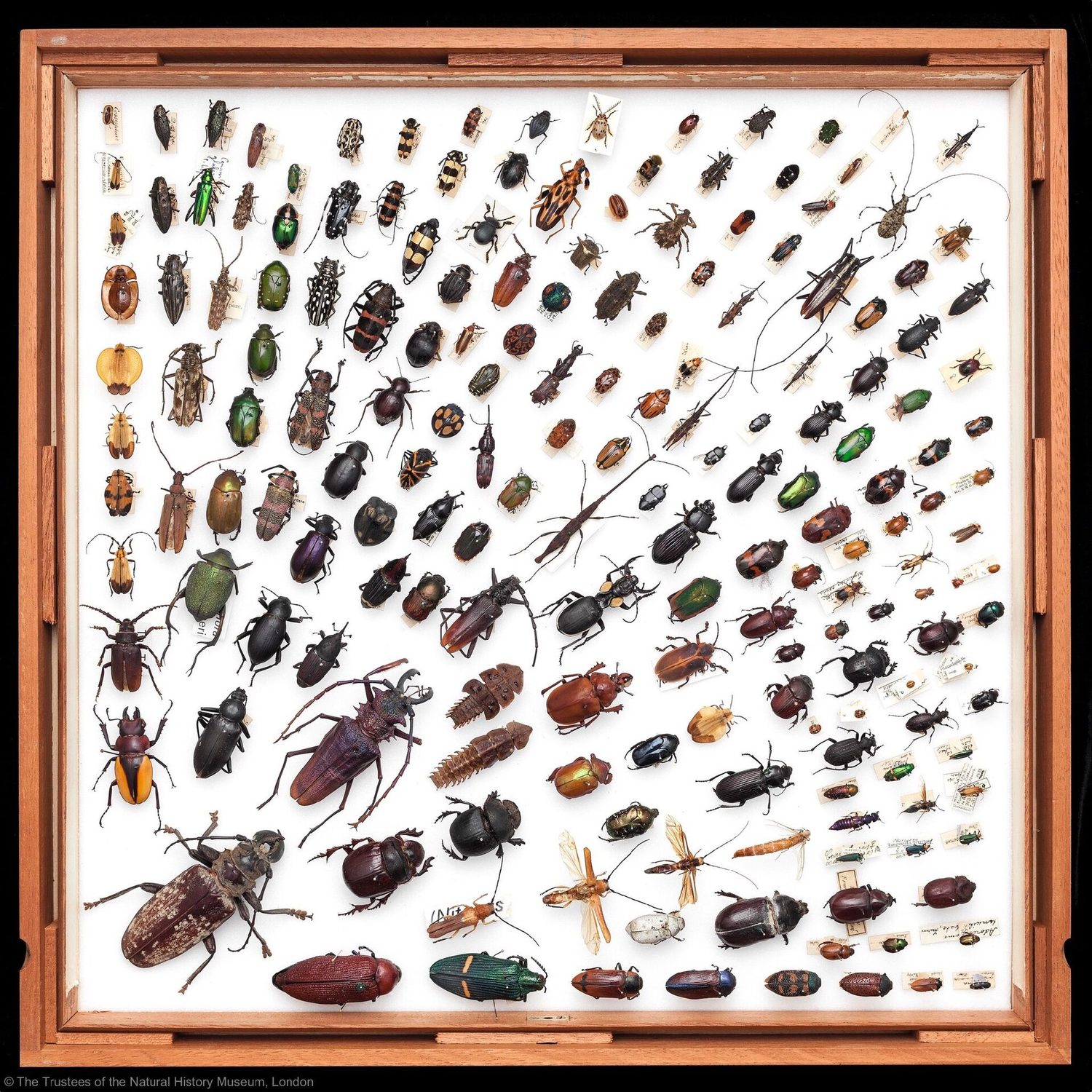
A museum insect collection: classification groups organisms by shared features.
Which kingdom makes its own food by photosynthesis?
Difficulty 1/5 · 100 coins + a small bonus on first completion today
Plantae photosynthesise; Animalia feed on others; Fungi absorb food; Protoctista are mostly single-celled.
Match each kingdom to how it feeds.
Difficulty 2/5 · 140 coins + a small bonus on first completion today
Plantae photosynthesise; Fungi absorb; Animalia feed on other organisms; Protoctista are a mixed group.
Why classification changes
- New evidence — especially DNA and protein comparisons — can reveal true relationships.
- Organisms are reclassified when the evidence shows the old grouping was wrong.
You've got it
- hierarchy: Kingdom → Phylum → Class → Order → Family → Genus → Species (broad → specific)
- four eukaryote kingdoms: Protoctista, Fungi (absorb), Plantae (photosynthesise), Animalia (feed on others)
Write from a binomial
- An organism is named Homo sapiens.
- The name has two parts.
What do the two parts mean?
The first word is the genus. The second is the species.
What is Homo in the name Homo sapiens?
Difficulty 1/5 · 100 coins + a small bonus on first completion today
The first word of a binomial is the genus.