The synapse
Introduced| English | Meaning |
|---|---|
| synapse/ˈsɪnæps/ | A junction through which a neuron communicates with another cell, usually using a chemical transmitter. |
| cholinergic/ˌkɒlɪˈnɜːdʒɪk/ | cholinergic |
| neurotransmitter/ˈnjuːrətrænsmɪtə/ | A chemical released by a neuron that transmits a signal across a synapse by binding to receptors on a target cell. |
| acetylcholine/ˈæsɪtɪlkəliːn/ | A neurotransmitter released at neuromuscular junctions and at many other synapses. |
| neuromuscular junction/ˌnjuːrəˈmʌskjʊlə ˈdʒʌŋkʃn/ | The specialised synapse through which a motor neurone signals to a muscle fibre. |
| summation/sʌˈmeɪʃn/ | summation |
The gap between neurones
- A synapse 突触 is a tiny gap between two neurones.
- The electrical impulse can't jump the gap — so it's carried across by a chemical.
- The same idea connects a neurone to a muscle.
The electrical impulse jumps directly across the synaptic gap to the next neurone.
Difficulty 1/5 · 100 coins + a small bonus on first completion today
False. The impulse cannot cross the gap directly; neurotransmitters released from the presynaptic neurone diffuse across the cleft and bind to receptors on the next neurone.
The tiny gap between two neurones at a synapse is the synaptic ______.
Difficulty 1/5 · 100 coins + a small bonus on first completion today
The neurotransmitter diffuses across the synaptic cleft to the next neurone.
A cholinergic 胆碱能 synapse
- the impulse arrives and makes calcium ions enter the first neurone.
- this makes vesicles release a neurotransmitter 神经递质, acetylcholine 乙酰胆碱, into the gap.
- acetylcholine diffuses across and binds receptors on the next neurone.
- this starts a new impulse in the next neurone.
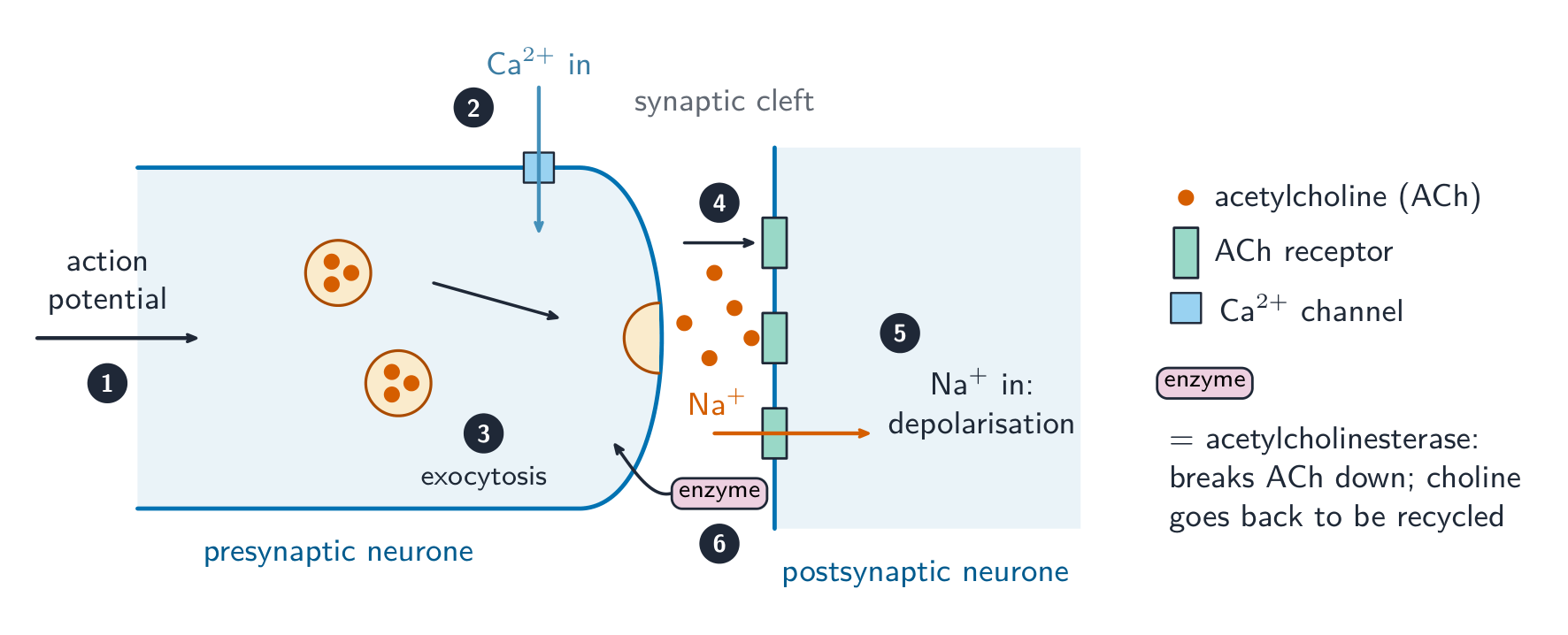
A cholinergic synapse passing a signal across the cleft
Across a synapse
Step through it. The electrical impulse becomes a chemical one — neurotransmitter carries the signal across the gap.
When an impulse arrives at a synapse, the first thing that happens is:
Difficulty 1/5 · 100 coins + a small bonus on first completion today
Ca²⁺ entering the presynaptic neurone causes vesicles to release acetylcholine into the cleft.
Acetylcholine carries the signal across the synapse by:
Difficulty 1/5 · 100 coins + a small bonus on first completion today
The neurotransmitter diffuses across the cleft and binds receptors, starting a new impulse.
Put the events at a cholinergic synapse in order.
Difficulty 3/5 · 200 coins + a small bonus on first completion today
Impulse → Ca²⁺ in → ACh released → ACh binds receptors → new impulse.
Match each part of the synapse to its role.
Difficulty 2/5 · 140 coins + a small bonus on first completion today
Ca²⁺ triggers release, ACh crosses and binds receptors, then the enzyme clears it so signals stay separate.
The neuromuscular junction 神经肌肉接头
- A neuromuscular junction works just like a synapse.
- But it is between a motor neurone and a muscle.
- The neurotransmitter triggers the muscle to contract.
A neuromuscular junction is a synapse between:
Difficulty 1/5 · 100 coins + a small bonus on first completion today
It works like any synapse, but the second cell is a muscle that is made to contract.
Why synapses matter
- Synapses make transmission one-way (only the ending releases neurotransmitter).
- They also allow summation 总和 and integration — many signals combining to decide the response.
You've got it
- a synapse is a gap between neurones; the signal crosses it as a chemical
- cholinergic synapse: impulse → Ca²⁺ in → vesicles release acetylcholine → binds receptors → new impulse
- a neuromuscular junction is a synapse between a motor neurone and a muscle
Write from one-way synaptic transmission
- Transmitter is stored in vesicles.
- The vesicles are only in the neurone before the gap.
Why does the synapse transmit one way?
Only one side can release the transmitter.
Why is synaptic transmission one way?
Difficulty 1/5 · 100 coins + a small bonus on first completion today
The release machinery is on one side only.